Issey Miyake: Pleats Please, A-POC and Clothing Design
Explore pleating after sewing, continuous textiles and folding through the designers, dancers and engineers behind the work.
ÉPOPLI ·

Pleating after sewing
What changes when a garment is sewn before its pleats are set? Issey Miyake house history begins with production sequence. PLEATS PLEASE coordinates the projected size with garment pleating.
Heat-set folds influence volume and movement rather than merely decorating a surface. Compact storage and expansion around a moving body are properties of the same object. These concerns connect appearance with everyday use.
Not every synthetic pleated garment employs the same process.
From graphic design to clothing production
Born in Hiroshima in 1938, he studied graphic design at Tama Art University. Training in Paris in 1965 and work in couture houses preceded ready-to-wear experience in New York. Issey Miyake house history follows different production conditions, not simply a list of cities.
Miyake Design Studio was established in Tokyo in 1970; overseas presentations followed in New York in 1971 and Paris in 1973. Flat cloth and a three-dimensional wearer became a sustained design question.
Rhythm and a dancer’s body
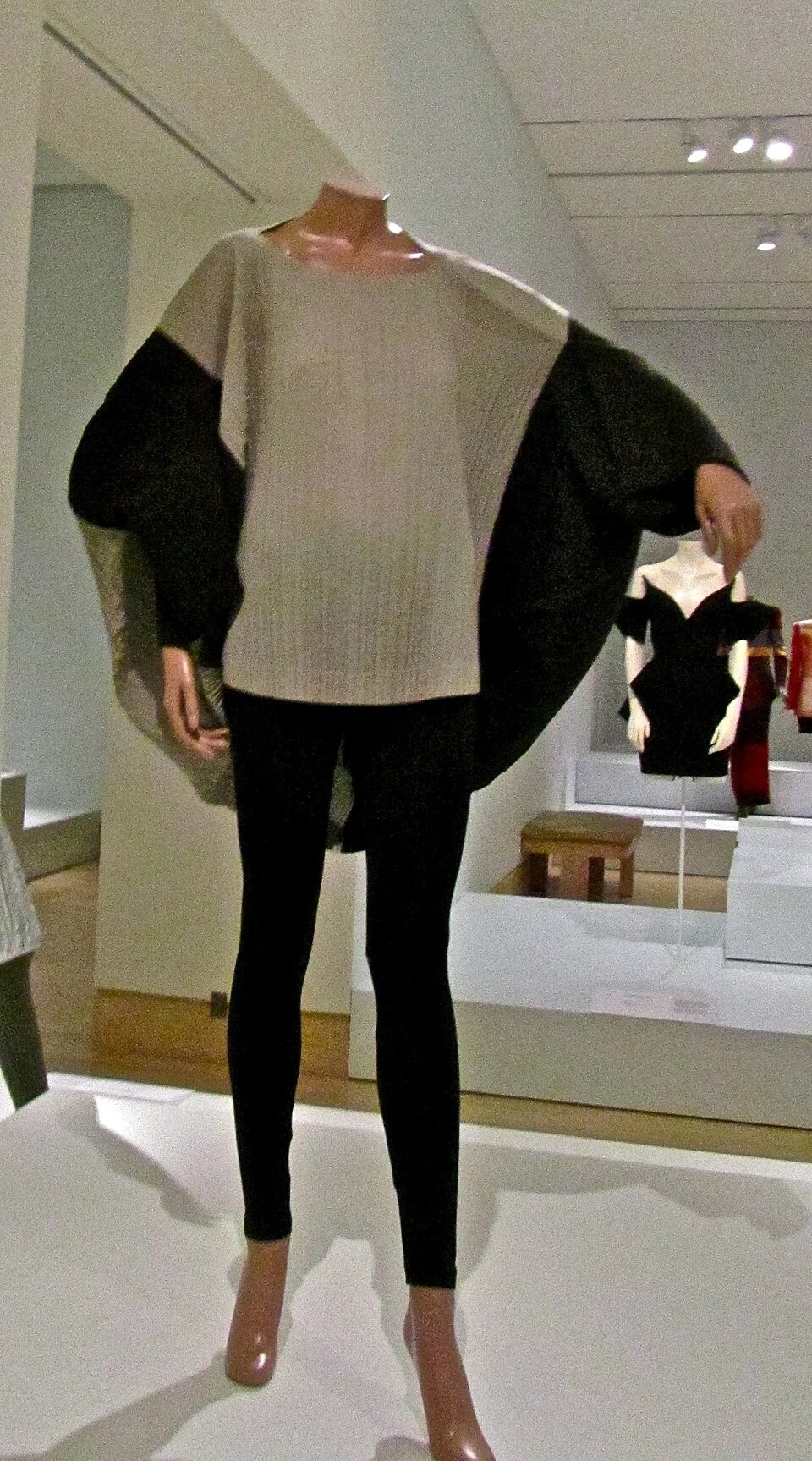
Rhythm Pleats of 1990 demonstrates how broad sleeves and a torso change through folds. Issey Miyake house history considers garment pleating as a way to create a responsive surface. A museum mannequin shows only one state.
Work for William Forsythe’s Frankfurt Ballet production in 1991 tested clothing through another range of movement. The PLEATS PLEASE brand launched in 1993. Designers, textile specialists and performers brought different knowledge to the development; performance research does not imply identical comfort for every wearer.

Building garment boundaries into fabric
A-POC was developed with Dai Fujiwara. Issey Miyake house history follows clothing forms incorporated into continuous textile production, with users cutting along designed boundaries. M+ distinguishes its Queen’s 1998 design from manufacture in 2003; MoMA dates an early Queen textile to 1997.
Project histories and individual object dates should not be flattened into one year. Mass production and personal adjustment coexist within a predetermined structure. The system does not mean that every part can be cut arbitrarily.
A folded plane becomes clothing
Introduced in 2010, 132 5. explored forms that rise from a folded plane. Issey Miyake house history includes the Reality Lab team, computer scientist Jun Mitani and textile producers.
A piece of cloth does not behave exactly like folded paper, so translating a geometric proposal into wearing requires experimentation. Recycled polyester was part of material development, not proof that every environmental impact had disappeared. Flat storage and three-dimensional use are two states of the same design.
An organization for research
Collaboration with Irving Penn began in 1986. Issey Miyake house history distinguishes photographic interpretation from manufacturing research while recognizing their interaction. In 1999, Naoki Takizawa took responsibility for the women’s collections as the founder continued research.
Garment pleating required repeated tests and production expertise, not a single isolated idea. The 2010 Reality Lab exhibition also addressed the future of manufacturing centers. A piece of cloth connected designers with engineers, patternmakers, factories and users.
Questions that outlive a founder
He died in 2022. Issey Miyake house history separates later brand products from the founder’s own work. PLEATS PLEASE, A-POC and 132 5.
reconsidered different relationships between body, material and production. Sewing sequence, integrated garment boundaries and folding are distinct approaches. Calling all of them Japanese origami obscures those differences.
Looking at manufacture, storage and the user’s choices reveals a collective body of knowledge behind an internationally familiar name.
Timeline
- 1938 — Born in Hiroshima
- 1970 — Established Miyake Design Studio
- 1973 — Joined Paris collections
- 1990 — Rhythm Pleats
- 1991 — Clothing for Frankfurt Ballet
- 1993 — PLEATS PLEASE brand
- 1998 — A-POC project developed
- 2010 — 132 5. introduced
- 2022 — Died
Sources
- Issey Miyake — PLEATS PLEASE, production concept
- National Art Center, Tokyo — The Work of Miyake Issey
- Miyake Design Studio — Selected biography
- National Art Center — Exhibition announcement and biography (PDF)
- Miyake Design Studio — Concepts and work
- Rhythm Pleats, 1990 — museum photograph
- M+ — A-POC Queen, designed 1998, made 2003
- MoMA — A-POC Queen Textile, 1997
- 21_21 DESIGN SIGHT — Development of 132 5.
- Issey Miyake — 132 5. concept
- 21_21 DESIGN SIGHT — Reality Lab, 2010
Related reading
Madeleine Vionnet: Bias-Cut Dresses and Draping · Cristóbal Balenciaga: The Sack Dress and Sculptural Couture · Claire McCardell: The Popover and American Sportswear · Yohji Yamamoto: Asymmetric Cutting and Moving Clothes · Kenzo Takada · Paco Rabanne · Designers