Madeleine Vionnet: Bias-Cut Dresses and Draping
Understand how diagonal cutting, fabric weight and geometric patterns shaped dresses that respond to a moving body.
ÉPOPLI ·
Movement created by diagonal lines
Silk dresses from the 1930s reveal their structure better when the body moves than when they are placed on a mannequin. The bias cut, central to Madeleine Vionnet house history, is a method of cutting at an angle to the vertical and horizontal threads of the fabric. The technique uses the different ways woven fabric responds to tension along its grain and across the diagonal. Even if the material itself is not an elastic fiber, the amount of room to follow the body can vary depending on the direction.
It is not appropriate to say that this method was first invented by one person. Vionnet's significance lies in developing the already known properties of cloth into full-body proportions and an elaborate production system. The seemingly soft draping is maintained only when the placement of cuts, weight of the fabric, and sewing direction are correct. A dress that looks simple isn't necessarily easy to make. Even small twists and pulls are noticeable on surfaces where decoration has been removed, making cutting and finishing decisions even more important.
The reality of clothes learned in the workshop
Born in France in 1876, she learned sewing at a young age, and gained fitting experience at Kate Riley's studio in London. After returning to Paris, she worked for Callot Soeurs and Jacques Doucet. Within Madeleine Vionnet house history, this experience has more meaning than just listing the names of famous houses. The task of adjusting clothes on a customer's body illustrates the problems that arise when a two-dimensional sketch is turned into an actual garment.
She opened her own house in 1912, closed during World War I and reopened after the war. Rather than presenting a completed style from the beginning, the method was developed through the process of handling actual fabric. Her method is best understood through documented work rather than conjecture about her feelings. The remaining clothes and work records show specifically what problems she solved. The weight on the shoulders, the position of the waist, and the hem that changes depending on the walking motion were elements that had to be continuously reviewed in the studio.
The tiers of a 1927 dress
The Metropolitan Museum of Art's circa 1927 silk dress uses tight pleats at the top and becomes looser toward the bottom. Within Madeleine Vionnet house history, geometry concerns more than drawing patterns. The points where the pleats come together and where they come loose divide the space around the body, and the two layers of the skirt create a graduated outline. The seemingly decorative surface simultaneously regulates the volume of the garment.
If you lump this piece together as a representative of all bias dresses, it's easy to miss the different techniques. Vertical pleats, tiered skirts and satin flowing along the body each require different materials and production decisions. By looking at clothes from the same designer side by side, you can tell when certain techniques are used and when they are not. Beauty cannot be explained solely through the efficiency of cutting. The shadows the fabric creates and the surface that changes when it moves are the result of calculation and visual judgment working together. This clothing is an example where it is difficult to separate structure and decoration.
The direction of cutting revealed by satin
In the V&A's 1932–34 satin evening dress, sheen is a clue to reading the direction of the fabric. In Madeleine Vionnet house history, the bias cut creates shape differently from a rigid frame that constricts the body. When the angle at which light hits changes, fabric of the same color is divided into light and dark parts, and this change makes the body's movements appear more clearly. The way to emphasize the waist doesn't necessarily have to be strong internal support.
However, this is not to say that these clothes automatically fit all bodies. Fitting that matches the weight and length of the fabric and the proportions of the wearer is still necessary. The economic conditions of customers who were able to purchase high-quality custom-made clothing must also be considered. A design that suggests room around the body and the range of people who could actually afford the clothes are two different issues. The wear record of the dress worn by Lady Foley in 1935 provides an opportunity to examine a customer's wardrobe instead of an abstract female figure. The meaning of technology becomes concrete when the relationship between materials and users is seen together.
The wearer completes the form
Some works minimize fastenings and complete the form through the act of draping or tying the fabric. If you only describe the draping within Madeleine Vionnet house history as a reproduction of an ancient sculpture, you will miss this wearing process. The same piece of clothing looks different depending on which direction the fabric turns and where the shoulders and waist meet. Here geometry is not a diagram separate from the body, but becomes a rule that operates when worn.
In fabrics with a metallic sheen, such as the gold lamé dress of 1937–38, the differences in folds are more evident. If you follow the surface of the work and look at the points where the light and dark sides change, you can see that even though there is little decoration, there is a wealth of visual information. However, the posture of the exhibition mannequin should not be determined based on the wearing style of all customers at the time. Photographs, collections, and fitting records each provide different information. Reading these materials together restores the role of not only the designer who created the form but also the person who wore the clothes.
Making and recording the clothes
Madeleine Vionnet house history also includes efforts to protect the labor and works of workshops. Records of employee welfare and working conditions show that custom clothing was not created solely by one person. The production team must be skilled in accurately moving and finishing complex cuts for the design judgment to remain in the actual clothes. Records of the working environment are a resource for understanding what goes behind a beautiful finished product.
Photographers such as Edward Steichen and George Hoyningen-Huene conveyed the structure of clothing through magazine images. Lighting in a photo can emphasize wrinkles or erase details. Therefore, the simplicity seen in the photo should not be immediately accepted as the simplicity of the sewing structure. The model's posture and shooting angle also change the impression of the clothes. Efforts to record design authorship and manage reproduction are also connected to the industrial conditions of this period. To fully understand her work, one must look not only at the form of the clothes but also at the methods of production and distribution.
The front of the dress, about 1932
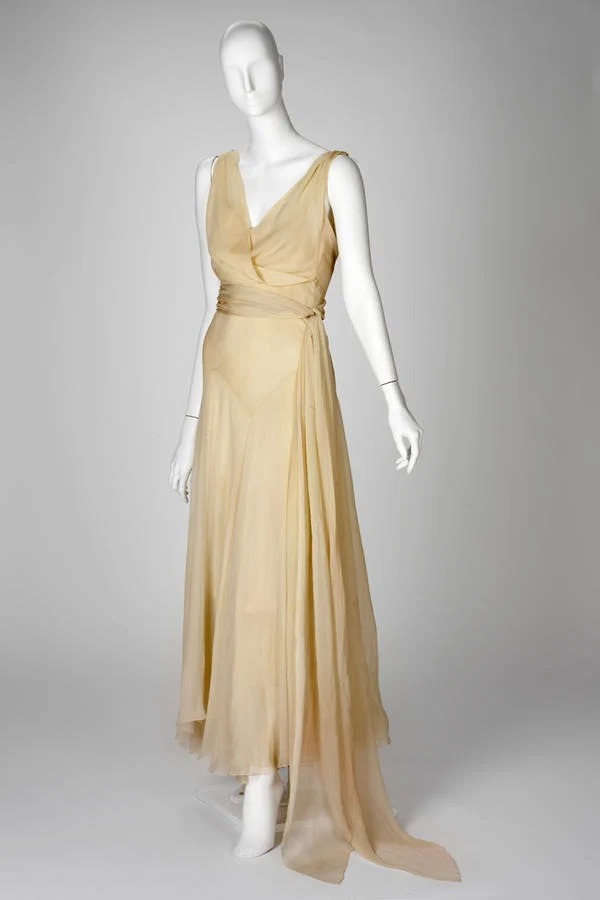
The RISD Museum evening dress of about 1932 carries pale chiffon crêpe from the shoulders through the waist into a long skirt. Overlapping material and diagonal lines keep the bodice from reading as a simple rectangle. The wider fabric gathers near the floor, giving the lower part a different weight from the upper body. Tonal changes make these differences in height more visible. A still photograph cannot establish exactly how the dress moved in use, but it does allow the direction of seams and overlaps to be examined.
Questions about production that remain even after closure
With the beginning of World War II, the house closed, and she later retired from the front line and died in 1975. It is basic to distinguish Madeleine Vionnet house history from the later brand activities of the same name. Just because the name continues to be used does not mean that the founder designed subsequent clothing. Exhibitions and collection research have made it possible to re-read works from her lifetime, but support for preservation and restoration are also involved in old clothes.
When applying bias cut today, the important thing is not only to replicate a soft silhouette. If you change the direction of the thread, you should observe which areas stretch and where the weight gathers. Comparing the pleated 1927 dress with the glossy 1930s dress shows that more than one technique led to the same goal. Expressions of respect for the body become more persuasive when explained through specific choices of materials and fittings rather than abstract praise. Her clothes show a production attitude that first listens to the properties of the fabric and then decides on the shape.
Timeline
- 1876 — Born
- 1912 — Founded her house
- 1918 — Reopened after the war
- c. 1927 — Dress with pleats and tiered layers
- 1939 — Closed her house
- 1975 — Died
Sources
- V&A — Madeleine Vionnet: an introduction
- The Met — Dress, ca. 1927
- Image and object record — Madeleine Vionnet, evening dress in ombré silk chiffon crêpe, about 1932. RISD Museum, 1994.006.

Related reading
Cristóbal Balenciaga: The Sack Dress and Sculptural Couture · Claire McCardell: The Popover and American Sportswear · Issey Miyake: Pleats Please, A-POC and Clothing Design · Yohji Yamamoto: Asymmetric Cutting and Moving Clothes · Fashion History · Madame Grès · Azzedine Alaïa · Designers