Azzedine Alaïa: Building Structure Around the Body
Reading the structures of fitted dress through zips, leather, knits and checks.
ÉPOPLI ·
A fastening draws a line
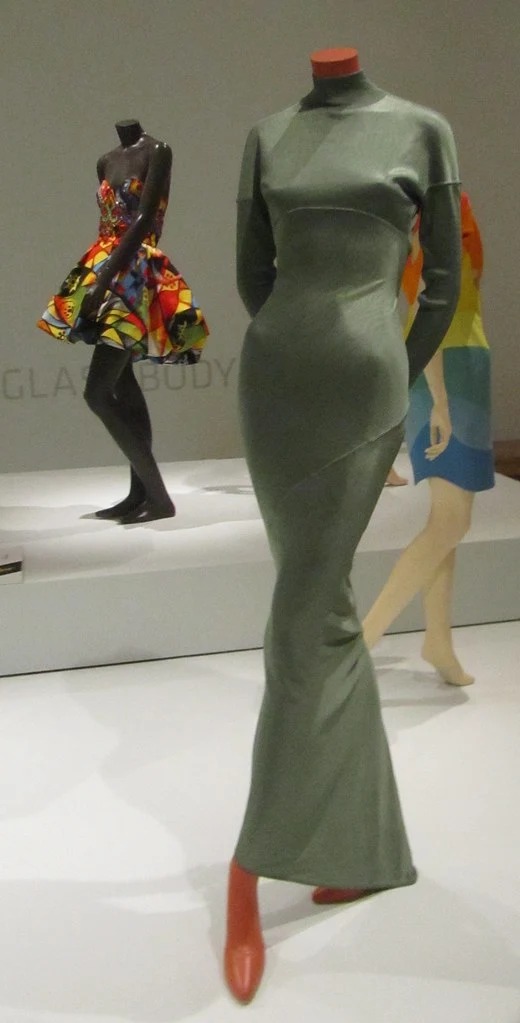
Azzedine Alaïa Alaïa history can begin with the long zips of early-1980s dresses. A fastening also traced the body, directing tension and the sequence of dressing. Sculptural cutting organizes flat material around volume and movement; a small size or stretchy cloth alone cannot do this.
Leather clothing posed related questions through a firmer surface. Smoothness in a photograph can conceal complex joins and support. Asking how a silhouette is maintained reveals more than describing its closeness to the body.
Learning in Tunis and Paris
Born in Tunis in 1935, he studied sculpture and learned sewing with his sister, earning money through dressmaking. Azzedine Alaïa Alaïa history connects anatomy and clothing through his documented recollections, not assumptions about innate talent. He moved to Paris in 1956, spending only four days at Dior.
Leila Menchari and Simone Zehrfuss helped him establish a home and clientele. Employment at Guy Laroche followed in 1958–59. Years of private fittings mattered alongside these recognizable institutional names.
Leather and knitted structures
Leather clothing and Knitwear create different kinds of tension near the body. Azzedine Alaïa Alaïa history developed both through cutting, joining and elasticity. Early-1980s ready-to-wear widened the audience beyond private clients; institutional accounts distinguish initial collections and first shows differently.
Lison Bonfils and Silvia Bocchese’s Italian production expertise contributed to knit development. The bandage forms associated with Grace Jones in 1985 gained meaning through construction, her presence and their presentation. Design was supported by specialized material knowledge rather than an isolated sketch.
The Tati check in 1991
The spring/summer 1991 collection used Tati’s check following Julian Schnabel’s paintings on the retailer’s canvas. Azzedine Alaïa Alaïa history transferred a familiar commercial pattern onto carefully shaped clothing. Curvature and seams changed how the repeat appeared.
A T-shirt, bag and espadrilles were also made for Tati stores. The foundation’s priority claim is not necessary to understand the concrete collaboration. Popular recognition and sophisticated making operated at different levels within the same project, questioning a definition of luxury based only on expensive materials.
Cut and direction in 2003
Presented on 23 January 2003, the collection included extended shirts, zip dresses, perforated denim skirts and coats. Azzedine Alaïa Alaïa history returned to a major presentation after a long distance from regular shows. Straight and bias directions give cloth different movement.
Sculptural cutting could become visible through a waist or hem rather than conspicuous decoration. The foundation also records financial vulnerability and renewed backing. Carla Sozzani’s support belongs in this account: creative accomplishment and business stability were not identical conditions.
Fitting and working time
Azzedine Alaïa Alaïa history treats fitting as part of making, not simply the display of an already completed design. Knitwear responds differently to standing, walking and sitting, making repeated adjustment meaningful. Long relationships with Christoph von Weyhe, Sozzani and models including Naomi Campbell formed the working environment.
The Design Museum emphasized his direct engagement in making and resistance to rapid turnover. Sculptural cutting required time. Limited participation in scheduled shows should not automatically be confused with the absence of continuing work.
Clothes made and clothes collected
He died in 2017. Azzedine Alaïa Alaïa history distinguishes lifetime production, later brand design and the foundation’s preservation work. He collected other designers’ garments as well as retaining his own.
Comparing zip dresses, Leather clothing, Tati checks and the 2003 coats shows different materials organized around precise bodily structures. Not every object reduces to one tight silhouette. Backs, interiors, seams and expanding hems reveal differences that a front-view photograph can obscure, making the surviving garment an important historical record.
Timeline
- 1935 — Born in Tunis
- 1956 — Moved to Paris
- 1958–1959 — Worked at Guy Laroche
- 1991 — Tati-check collection
- 2003 — Couture collection presented
- 2017 — Died
Sources
- Fondation Azzedine Alaïa — Chronology
- Fondation Azzedine Alaïa — Activity report 2018–2020 (PDF)
- Fondation Azzedine Alaïa — Another way to look at fashion
- Fondation Azzedine Alaïa — Couture collection 2003 (PDF)
- Design Museum — The Couturier
- Fondation Azzedine Alaïa — Collection