Cristóbal Balenciaga: The Sack Dress and Sculptural Couture
Follow a Spanish career into the Paris atelier, where the sack dress and gazar constructions made space around the body.
ÉPOPLI ·
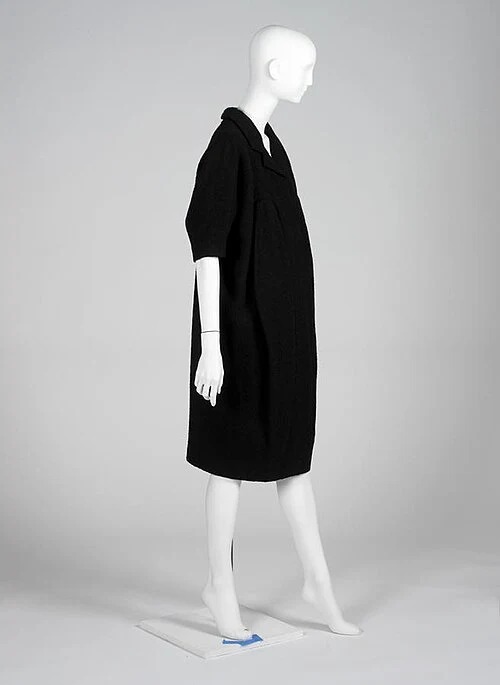
A dress without an emphatic waist
The space between cloth and body offers a starting point for Cristóbal Balenciaga Balenciaga history. The 1957 sack dress did not need a tightly marked waist to establish proportion. Its shoulder, neckline and hem supplied other points of reference.
This was not an indifference to the wearer: where fabric touched or stood away still required precise judgement. Haute couture, individually fitted luxury dressmaking, could use precision to release rather than constrict the body. Looking at the sack dress means following the direction of the eye from the shoulders, not merely noting the absence of a waist seam.
Empty space becomes an active component of the design.
A Spanish career before Paris
Born in Getaria in 1895, he grew up close to his mother’s dressmaking work. Cristóbal Balenciaga Balenciaga history did not begin with a Paris debut. Museum business records document San Sebastián activity from 1917, subsequent partnerships and expansion, including the Eisa business.
Madrid and Barcelona became further working centres. The Spanish Civil War changed these circumstances; he opened in Paris in 1937. A biography organised only around formal education would miss the practical training of cutting, sewing and serving clients.
Different business names and dates should not be collapsed into a single foundation story. Moving cities changed access to customers and the conditions in which clothes could be produced.
Moving the centre of a garment
Cristóbal Balenciaga Balenciaga history uses 1937 as the beginning of the Paris house, not of the entire career. Post-war forms progressively reassessed the body: semi-fitted clothes in 1951, the 1955 tunic, the 1957 sack dress and the 1958 baby-doll silhouette. Comparison is more informative than a list.
Front and back need not fit equally closely, and releasing the waist does not require enlarging every part. Shoulders, sleeves and length establish a balance. An uncluttered appearance therefore does not indicate little design work.
As decoration recedes, the consequences of each line become more visible. These shifts are best examined as continuing experiments rather than a single rejection of convention.
Volume supported from within
The V&A’s investigation of a 1954 taffeta evening dress shows how interior support and handling of cloth produce the outward silhouette. Cristóbal Balenciaga Balenciaga history loses something when it treats clothes only as sculpture. Exterior fabric and internal construction perform different tasks; their points of connection guide volume.
Abundance is not simply a matter of gathering more cloth. Some areas require support while others need freedom. Comparing this garment with later work reveals changing structural solutions.
Technical investigation supplies information absent from a runway photograph. The workshop’s labour is partly concealed, but inseparable from the result. A viewer can begin asking these questions by observing folds and the behaviour of a hem.
The restraint of a tulip shape
The V&A’s 1965 tulip dress invites attention to construction before floral metaphor. Its arrangement avoids conventional side seams and uses connected sections to organise the surrounding shape. Cristóbal Balenciaga Balenciaga history here places cutting ahead of applied ornament.
Reducing the number of pieces redistributes the work performed by seams. The fabric gazar retains shape differently from a yielding silk, so material and pattern cannot be treated as independent choices. Following the outline of the tulip dress reveals how width develops below the neck and is resolved lower down.
Rather than simply imitating petals, it negotiates distances between textile and wearer. Material is not an afterthought added to an already complete design.
A 1967 dress in motion
The Met’s 1967 gown uses silk gazar developed by the Swiss firm Abraham. Cristóbal Balenciaga Balenciaga history thus includes a textile manufacturer’s contribution. Different grain directions create contrasting behaviour at the front and back; the museum also describes air entering beneath the shorter front and inflating the trailing fabric.
Grain is the direction of the woven threads, and cutting diagonally can alter how cloth falls. Gazar supports a sculptural form without making movement irrelevant. The garment is not exhausted by its stationary outline.
Comparison with earlier supported dresses shows how the means of producing volume evolved. Front, back and walking movement are all necessary to understanding this object.
Closure and the life of a name
He closed his couture business in 1968 and died in 1972. Cristóbal Balenciaga Balenciaga history must separate this career from the later brand. Contemporary products are not automatically works by its founder.
Yet historical clothes need not become inert relics. What distinguishes displaying a body from making space around it? What does a photograph conceal about wearing?
Spanish workrooms, the Paris atelier and textile development together reveal a production system behind the signature. Haute couture matters here not only as expense or ornament, but as a setting for repeated, exact adjustments. The surviving garments remain practical evidence for studying construction, collaboration and the behaviour of cloth.
Timeline
- 1895 — Born in Getaria
- 1917 — Business activity in San Sebastián
- 1937 — Paris house opened
- 1968 — Couture business closed
- 1972 — Died
Sources
- Cristóbal Balenciaga Museoa — Biography
- Cristóbal Balenciaga Museoa — Press dossier (PDF)
- V&A — Secrets of Balenciaga’s construction
- The Met — Dress, 1967, 2015.711
- Cristóbal Balenciaga Museoa — Un legado para el futuro
Related reading
Madeleine Vionnet: Bias-Cut Dresses and Draping · Claire McCardell: The Popover and American Sportswear · Issey Miyake: Pleats Please, A-POC and Clothing Design · Yohji Yamamoto: Asymmetric Cutting and Moving Clothes · Hubert de Givenchy · 1950s fashion · Designers