Claire McCardell: The Popover and American Sportswear
The Popover, Monastic dress and separates explain how fastenings, fabric and adjustable proportions made clothes easier to use.
ÉPOPLI ·
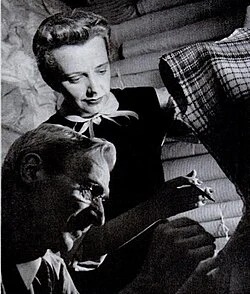
A dress for doing things
The 1942 Popover offers an unusually practical entrance into Claire McCardell Townley history. Its wrap form and useful pocket linked the dress to the movements and tasks of daily life. The design could serve different situations depending on fabric and styling, rather than requiring a separate elaborate outfit for every activity.
The practical question is how the wearer puts it on and uses it. A fastening within reach, room to move and a place to keep a small object all affect independence. These are design decisions even when they do not produce a spectacular runway image. The dress makes it possible to discuss fashion through use, while still considering proportion, line and appearance. Comfort does not require the abandonment of visual choices; it changes the criteria by which those choices are judged.
Waist ties also reveal the relationship between a standard size and an individual body. Their position and tension can change both ease and outline, giving the wearer a small but consequential part in the final adjustment.
From Frederick to Parsons and Paris
Born in Frederick, Maryland, in 1905, McCardell first attended Hood College before studying at Parsons in New York. A period of study in Paris gave her direct access to European fashion and the opportunity to examine garments closely. Claire McCardell Townley history therefore does not describe American sportswear as something created in isolation from European knowledge.
Her early jobs included work outside prestigious design studios, followed by employment with Robert Turk and Townley. The route into fashion involved sketching, sewing and learning within a manufacturing environment. Looking at how an existing garment was made could be as informative as admiring it from the outside. This attention to construction later supported clothes that appeared straightforward but used fabric, ties and fastenings in deliberate ways. The eventual independence of her design language grew through study and work rather than through a refusal to learn from others.
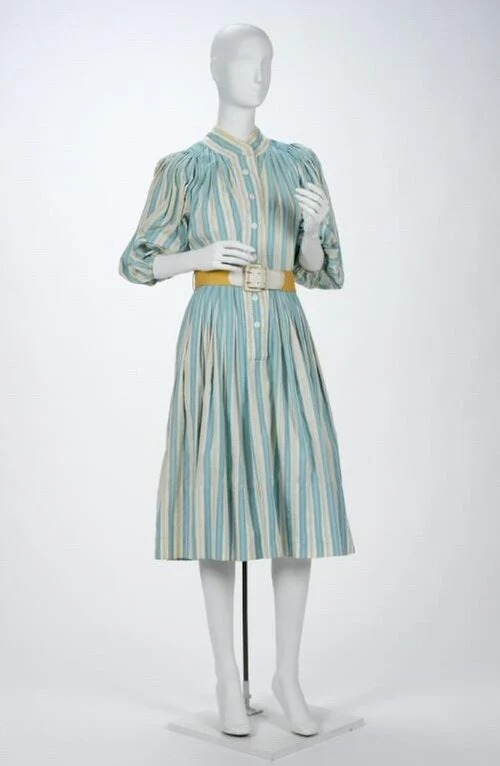

An unshaped dress finds its wearer
The 1938 Monastic dress is a turning point in Claire McCardell Townley history. Its generous, relatively unstructured form could be gathered at the waist with a tie. Instead of establishing every contour through tightly fitted seams, it allowed part of the final shape to emerge when the wearer put it on.
The tie is therefore more than decoration. Its placement changes the distribution of fullness and the relationship between the upper and lower body. The same basic garment can respond to different proportions without becoming a completely different design. This does not eliminate the need for careful cutting: the shoulder, sleeve opening and amount of cloth still determine whether the result hangs well. The dress’s commercial success demonstrated an audience for a less rigid relationship between clothing and the figure.
War, materials and the everyday wardrobe
Claire McCardell Townley history developed within the constraints of wartime America, including limits on materials and reduced contact with Paris. Denim, cotton and jersey offered possibilities that did not depend on the conventional prestige of luxurious evening fabrics. A useful material could become part of a considered fashion design rather than remain confined to work clothing.
The Popover illustrates that shift, but it should not be used to claim that one designer invented every form of wrap dress or practical pocket. The history is more specific: she developed a recognizable solution for a particular market and period, then returned to it in variations. Material, price and manufacture helped determine who could buy the clothes. Descriptions of accessibility should therefore remain connected to the actual product and its customers, rather than imply that every garment was affordable to every woman.
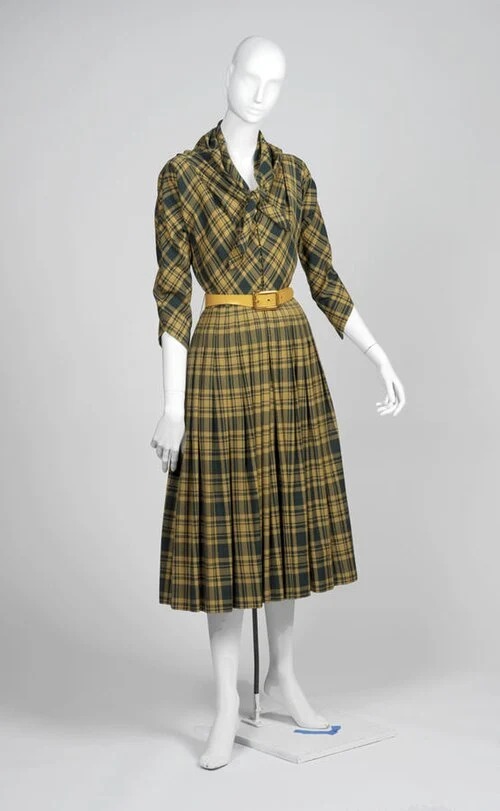

Several pieces, more than one outfit
Coordinated separates provided another important direction in Claire McCardell Townley history. A group of tops and lower garments could be mixed, making a smaller collection of clothes useful for different days or settings. The idea was especially relevant to travel, when the contents of a suitcase had to serve several purposes.
The design depends on the interfaces between pieces. A top’s length affects where it meets a skirt; a waistband affects what can be tucked in; color and pattern determine which combinations remain coherent. This is a different problem from designing a single self-contained dress. The wearer becomes an active participant in selecting the final arrangement, while the designer supplies compatible parts. The principle later became widespread in American sportswear, but its history includes many contributors and should not be reduced to an unsupported claim of a single invention.
Ordinary cotton, deliberate cutting
A printed cotton dress in the Powerhouse collection provides a material point of reference for Claire McCardell Townley history. Its record places the garment within McCardell’s work for Townley and her use of everyday fabrics. A patterned surface can make a dress look informal, yet its cut still organizes the body and determines how it moves.
The Monastic dress and the later printed garments can be compared through their treatment of fullness. Is cloth gathered by a tie, shaped by a seam or allowed to fall freely? Does a pocket interrupt a pattern or become part of its rhythm? Such questions reveal technical choices that are easily missed when the entire career is summarized as comfortable clothes. Manufacturers, pattern cutters and dressmakers translated those choices into products, while the presence of her own name on the label made the designer’s contribution unusually visible within that system.
A short career with a long practical vocabulary
McCardell published What Shall I Wear? in 1956 and died in 1958, aged fifty-two. Claire McCardell Townley history ends with a lifetime’s work rather than assigning later American sportswear to her authorship. Her influence is visible in recurring questions about movement, self-dressing, useful pockets and coordinated separates, but later designers answered those questions within different industries and social conditions.
The archive encourages a close look at what a garment asks of its wearer. Can it be fastened without assistance? Does its shape change when the person sits? Can it be cared for and combined with clothes already owned? These questions do not make appearance irrelevant. They show how appearance can be developed alongside the practical realities of a body and a day. That relationship gives the work its continuing interest beyond a list of supposed firsts.
Timeline
- 1905 — Born in Frederick, Maryland
- 1920s — Studied at Parsons and in Paris
- 1930s — Worked with Robert Turk and Townley
- 1938 — Monastic dress
- 1942 — Popover dress
- 1956 — Published What Shall I Wear?
- 1958 — Died
Sources
- National Women’s History Museum — Claire McCardell biography
- Maryland State Archives — Claire McCardell biographical essay
- Maryland Women’s Hall of Fame — Claire McCardell
- Powerhouse — Printed dress designed by Claire McCardell
Related reading
Madeleine Vionnet: Bias-Cut Dresses and Draping · Cristóbal Balenciaga: The Sack Dress and Sculptural Couture · Issey Miyake: Pleats Please, A-POC and Clothing Design · Yohji Yamamoto: Asymmetric Cutting and Moving Clothes · Fashion History · Donna Karan · Mary Quant · Designers