Donna Karan: A Wardrobe Built to Work Together
A Wardrobe Built to Work Together.
ÉPOPLI ·

The collection begins underneath the jacket
The 1985 debut collection provides a clear entrance into Donna Karan brand history. Instead of presenting every outfit as a completely separate solution, it proposed a small group of pieces that could work together. A close-fitting base could remain in place while a jacket, skirt or trousers changed the outfit’s use. The body was the organizing center of the wardrobe.
The idea associated with Seven Easy Pieces was not simply to own fewer objects. It was to make the relationships between them useful. A jacket that only works with one particular skirt offers fewer possibilities than one that can be worn over several coordinated layers. The system therefore depends on proportion, color and fit as much as on the number of items. The concept is best understood through those relationships rather than treated as an inflexible shopping list.
Learning American sportswear at Anne Klein
Karan studied at Parsons and entered the professional world through Anne Klein. After Klein’s death in 1974, she and Louis Dell’Olio continued the design work. Donna Karan brand history recognizes this shared succession because an account focused only on one person would erase a collaborator’s contribution. The experience supplied practical knowledge of coordinated clothing and the demands of an American ready-to-wear business.
The studio had to make clothes that could be manufactured in multiple sizes, delivered to stores and combined by customers. Those requirements differ from fitting a single couture client. A seemingly simple piece must still have a reliable pattern, suitable material and consistent finish. Her subsequent independent work did not begin from nothing: it developed an approach to separates learned through years of designing within a larger organization. The continuity is visible in the attention paid to what a woman might put on before leaving for work.

A company and a first collection
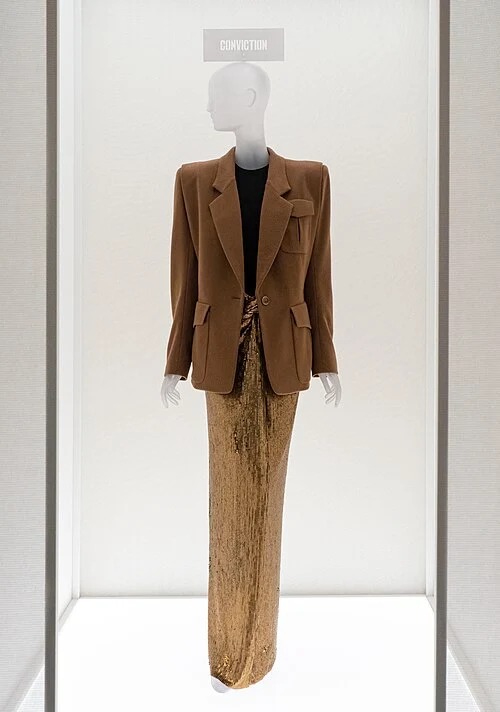
The independent business was established before its first fall 1985 collection. Donna Karan brand history distinguishes the company’s formation from the season in which its clothes appeared. The initial wardrobe combined a bodysuit with tailored and softer pieces, offering changes of coverage and formality without requiring an entirely new outfit.
A close-fitting base solves some problems and introduces others. It avoids the loose edge of a tucked-in shirt, but its comfort depends on stretch, torso length and fastening. A skirt or jacket layered over it needs to accommodate movement without pulling the base out of place. These are concrete design questions behind the image of effortless dressing. The concept also addressed a particular customer and working environment; it should not be presented as a universal account of how all women dressed or what all women needed.
Softness within a structured wardrobe
Donna Karan brand history is especially interested in the interaction of draping and tailored pieces. Fabric gathered or arranged around the torso can create fullness where needed and reduce it elsewhere. A fold directs the eye, but it also changes the amount of material available when the wearer sits or turns. Softness is therefore an effect of construction, not merely the absence of tailoring.
The cashmere layer, leather jacket and evening option within the Seven Easy Pieces vocabulary perform different tasks. A knit can follow the body; leather can establish a firmer outer surface; an evening garment may expose or emphasize a different area. The system links these differences rather than making every piece behave alike. The familiar cold-shoulder treatment similarly directs attention to a specific part of the body while leaving other areas covered. It is a choice about framing, not a general rejection of structure.
A second rhythm for the city
The lower-priced DKNY line developed in the late 1980s, extending the business toward a different pace and customer. Donna Karan brand history separates that line from the main collection instead of treating every product with the initials as the same design proposition. Sportswear, layering and the visual identity of New York became part of a broader commercial language.
The distinction can be seen as a change of scale. A collection aimed at a more formal wardrobe and a range intended for frequent everyday combinations require different decisions about price, fabrication and distribution. A photograph may make both appear equally polished, but the product has to meet its own use and market. The designer’s name grew through these parallel activities, supported by teams responsible for translating an overall direction into many specific garments and categories.
Urban Zen and a different form of practice
Donna Karan brand history distinguishes the foundation’s social projects from seasonal clothing collections. A change in the field of activity also changes the collaborators involved and the purpose of the work.
The associated design practice connected clothing and objects with artisans and a proposed way of living. This moved the focus from a city wardrobe toward a wider environment, while continuing the interest in tactile materials and bodily comfort. The work also requires attention to who makes the objects and how collaboration is credited. An artisan’s contribution should remain visible rather than being absorbed into the public image of a famous founder. Her ongoing Urban Zen activity is a separate chapter from current collections sold by the namesake fashion business.
Reading the system rather than a single icon
Donna Karan brand history is most useful when a garment is examined alongside the pieces intended to accompany it. A bodysuit changes the line beneath a jacket; the jacket changes the balance of a skirt; a soft layer changes how the same outfit feels and moves. The design resides partly in those connections.
The continuing relevance of draping and coordinated separates does not mean that the original 1985 customer’s life has remained unchanged. Workplaces, bodies and expectations differ. The archive offers a set of questions rather than a permanent formula: which parts of a wardrobe genuinely combine, which demand additional purchases, and how does the wearer move through the day? By keeping those practical questions in view, the clothes can be understood beyond promotional claims of empowerment and beyond the repetition of a famous collection name.
Timeline
- 1974 — Succeeded Anne Klein with Louis Dell’Olio
- 1985 — First Donna Karan New York collection
- Late 1980s — DKNY developed as a separate line
- 2007 — Urban Zen Foundation established
- 2015 — Left the namesake company’s chief-designer role
Sources
- Donna Karan — Our Brand and the 1985 wardrobe
- CFDA — Donna Karan biography
- Parsons — Donna Karan profile
- Vogue — Donna Karan on career highlights
- Urban Zen — Current practice and philosophy
Related reading
Fashion History · Claire McCardell · Calvin Klein · Designers