Calvin Klein: Clothes, Bodies and Advertising
Clothes, Bodies and Advertising.
ÉPOPLI ·

A simple dress is not an empty design
A silk evening dress from autumn–winter 1996–97 in the Metropolitan Museum’s collection offers an entrance into Calvin Klein brand history. The reduced surface associated with this period directs attention toward line, material and the body wearing it. When conspicuous decoration is removed, the placement of a seam or the behavior of a neckline becomes more visible.
This is one reason minimalism should not be confused with an absence of work. A narrow garment has fewer places to hide an awkward transition. The cloth needs to fall as intended, and the finish must support that effect without distracting from it. The familiar slip dress is particularly revealing: it carries the memory of an undergarment into public dress, changing the meaning of a restrained shape through fabric, styling and setting.
A coat business in New York
Born in the Bronx in 1942, Klein studied at the Fashion Institute of Technology and entered the garment industry after graduating in 1962. Work for coat-and-suit manufacturer Dan Millstein preceded the company he established with Barry Schwartz in 1968. Calvin Klein brand history distinguishes the designer’s creative role from Schwartz’s importance in building the business.
An early coat preserved by the Museum at FIT places the beginning in the practical world of outerwear. A coat has to accommodate the clothes beneath it while producing a clear outline of its own. The sample is a reminder that the later name associated with jeans and underwear began with the cut and proportion of a visible outer layer. Publicist Eleanor Lambert helped bring the young business to attention, showing how recognition also depended on people who connected designers, retailers and the press.

Denim becomes a named product
Jeans brought a different kind of visibility to Calvin Klein brand history. Their appeal depended on a familiar garment being associated with a designer’s name, an image and a particular attitude toward the body. The company dates a major Times Square billboard to 1978, while the 1980 Brooke Shields campaign became a widely discussed example of provocative promotion.
The history needs to keep the clothes and the campaign distinct. A pair of jeans is made through decisions about denim, rise, leg shape and finishing. An advertising image selects a body, gesture, framing and audience. These operations reinforce each other but are not identical. The controversy around youthful casting and suggestive language is part of the public record, not simply proof of creative success. It reveals the power and responsibility involved when a commercial message turns a person’s image into a selling device.
The waistband becomes visible
The underwear business extended this strategy into a product usually hidden from public view. Calvin Klein brand history includes the early-1990s campaigns with Mark Wahlberg and Kate Moss, in which the body and branded waistband were central. The logo could remain legible even when there was very little clothing in the frame.
The design question differs from that of an evening gown. An elastic edge, seam placement and stretch influence comfort, while the repeated name turns a functional component into a sign. Photography enlarges that sign far beyond the scale at which it is normally seen. Models, photographers, art directors and the commercial team all contribute to the result. Treating the campaign as the work of the fashion designer alone would conceal the collaboration that made the brand recognizable across media.
The 1990s silhouette
Calvin Klein brand history returns to the runway through the long, spare silhouettes associated with the 1990s. A slip dress places the weight of its design in the relationship between shoulder, neckline, torso and hem. A coat over it can create a firmer outer frame, while a subdued palette keeps the eye on changes of texture and proportion.
The Met’s dated silk garment offers a stable object against which to compare the period’s photographs. A photograph may emphasize youth, movement or a deliberately casual pose; the garment record fixes the season and material. Looking at both prevents an entire decade from being reduced to an advertising mood. The term minimalism is most helpful when it identifies what has been reduced and what remains important, rather than functioning as a vague synonym for any plain or expensive outfit.
A name shared across products and ownership
The expansion into fragrance, jeans, underwear and multiple clothing lines made Calvin Klein brand history a history of organization as well as design. These categories required different manufacturers, distribution arrangements and creative specialists. A coherent name did not mean that every object came from the same workshop or followed the same production process.
PVH acquired the business in 2003. The founder’s departure from collection design separates his lifetime creative direction from the work of successors. Francisco Costa, Raf Simons and other designers belong to later chapters with their own briefs and decisions. The difference matters when dating a garment in an archive or resale listing. A label bearing the founder’s name identifies a business, but it does not by itself identify which person designed a particular season.
Looking at a decorated dress
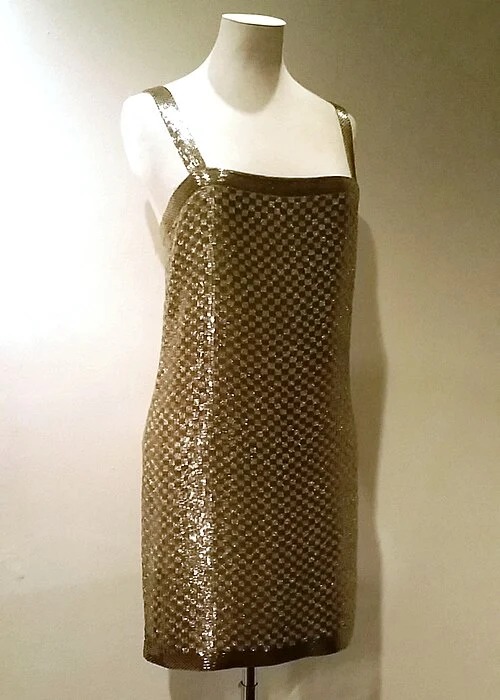
The minidress commissioned for British Vogue’s seventy-fifth anniversary uses silver-coloured beads to form a chequerboard pattern. A compact outline meets a reflective surface. It therefore complicates any account in which this designer’s clothes are always undecorated. The regularity of the pattern, the limited colour and the balance between surface and outline are more useful distinctions. Comparing this short beaded dress with a long silk gown explains why form and material should be examined separately.
The archive and the current collection
At the time of writing, PVH’s September 2026 announcement identifies Veronica Leoni as the designer of the spring 2027 collection. Calvin Klein brand history therefore describes that presentation as the continuing brand’s activity, not a new collection by its founder. Current leadership is a separate fact from the historical authorship of the clothes discussed above.
The archive’s central question is how little a garment can display while still carrying a powerful identity. The early coat, named denim, visible waistband and silk evening dress provide different answers. Each depends on material construction, but each also circulates through an advertising image or a recognizable social setting. Reading those layers together makes the work more precise: the quietness of the clothes and the loudness of their public presence are connected parts of the same history.
Timeline
- 1942 — Born in the Bronx, New York
- 1962 — Graduated from FIT
- 1968 — Company founded with Barry Schwartz
- 1978 — Times Square billboard milestone
- 1980 — Brooke Shields jeans campaign
- 1992 — Wahlberg and Moss underwear campaign
- 2003 — PVH acquired the business
- 2026 — Veronica Leoni presented the brand’s spring 2027 collection
Sources
- The Met — Silk evening dress, autumn–winter 1996–97
- HISTORY — Calvin Klein and 1990s fashion
- Museum at FIT — Eleanor Lambert: Empress of Seventh Avenue
- Utah Education Network — Designer biographies (PDF)
- Calvin Klein — Brand history
- PVH — Calvin Klein brand and acquisition
- PVH — Veronica Leoni spring 2027 presentation
- Image and object record — Calvin Klein at the celebration of the Tribeca Film Festival’s tenth anniversary.
- Image and object record — Calvin Klein, beaded chequerboard minidress commissioned for British Vogue’s 75th anniversary.

Related reading
Fashion History · Raf Simons · Ralph Lauren · Kate Moss · Designers