Raf Simons: Images carried by clothes
Images carried by clothes.
ÉPOPLI ·
A photograph acquires a wearer
For spring/summer 2017, photographs selected with the Robert Mapplethorpe Foundation appeared on simple garments. The images retained a distinct framed presence rather than dissolving into an all-over pattern. This offers a clear starting point for Raf Simons Prada history: how does an image change when it is carried by a moving person, and how does the image change the clothes beneath it?
The garments also carried a shared artistic credit. That detail matters because the collection depends on an existing body of photographic work. The designer's contribution lies in selection, framing, proportion and placement, not in claiming to have made the photographs. A shirt or panel becomes a temporary display surface, but folds and movement continually interrupt the stable conditions of a gallery wall.
From furniture to a first label
Born in Neerpelt in 1968, the designer studied industrial design in Genk and graduated in 1991. Work with Walter Van Beirendonck and encouragement from Linda Loppa helped him move toward fashion. His own menswear label began in 1995. Raf Simons Prada history thus starts outside a conventional fashion-school route, although it quickly involved the detailed knowledge required to produce clothing.
Early narrow silhouettes combined recognizable tailoring with references to music and youth culture. The important contrast was between an inherited adult wardrobe and the attitudes of younger wearers. A jacket could retain its formal fabric while losing the proportions associated with a conventional business suit. Casting young people from Antwerp's streets helped communicate that change as a way of inhabiting clothes rather than as a technical exercise alone.
An image made with a team
Peter de Potter's graphic contributions and Willy Vanderperre's photography and film belong to the record of the label. MoMu documents video stills used for the spring/summer 2002 collection's lookbook. In Raf Simons Prada history, such material shows that a collection reaches its audience through several connected forms: garment, body, printed page and moving image.
The text and imagery can suggest membership in a community without functioning as an ordinary brand logo. This is where youth culture becomes a working language rather than a demographic label. The clothes can make a wearer feel aligned with a sound, an image or a mood, even when the references are not universally recognized. The effect depends on relationships among collaborators and viewers, not only on a designer's solitary intention.
Sterling Ruby and the surface of a coat
The autumn/winter 2014–15 collection was developed with artist Sterling Ruby. Textile sculptures occupied the show environment, while garments used photographic collage, words and paint-like marks. This chapter of Raf Simons Prada history makes collaboration visible in both objects and setting. The runway did not merely borrow a backdrop from an artist; the collection and the surrounding work shared a vocabulary.
A coat offers a useful area for examining that vocabulary because its broad panels can carry large passages of colour and imagery. The underlying form remains recognizable, but its surface refuses the neutrality expected of a standard overcoat. One can compare the graphic edge of an inserted image with a seam: both divide the surface, yet they perform different jobs. The tension between them is part of the finished object.
Learning the scale of womenswear
At Jil Sander, where he became creative director in 2005, womenswear added new proportions and materials to the practice. MoMu identifies ceramicist Pol Chambost as a reference for sculptural volumes in autumn/winter 2009–10. In Raf Simons Prada history, this is a specific example of transferring a formal idea across media. A curved vessel and a garment do not behave identically, but each can organize a volume through its outer contour.
The move to Dior in 2012 brought another archive into play. For spring/summer 2013, compact upper sections met fuller skirts, and the house's hourglass language was reconsidered through shorter formal suits. The task was not to reproduce every historical detail. It was to decide which relationship between waist, shoulder and volume could remain legible when the fabric, length and context changed.
An American house, then a shared role
The Calvin Klein appointment in 2016 produced work that examined familiar American clothing and imagery. A 2017 organza dress with hand-painted feathers, preserved by MoMu, differs substantially from the austere menswear associated with the designer's beginnings. Raf Simons Prada history includes these changes of setting because each house supplies different archives, expectations and production resources.
In April 2020 he joined Miuccia Prada as co-creative director of Prada. The official announcement specified equal responsibilities for creative input and decisions. Their first joint women's collection was spring/summer 2021. This arrangement is not a succession in which one designer replaces the other. It places discussion within the authorship of the collection itself, and the names of both designers should remain attached to the resulting work.
The open form of the 1999–2000 cape
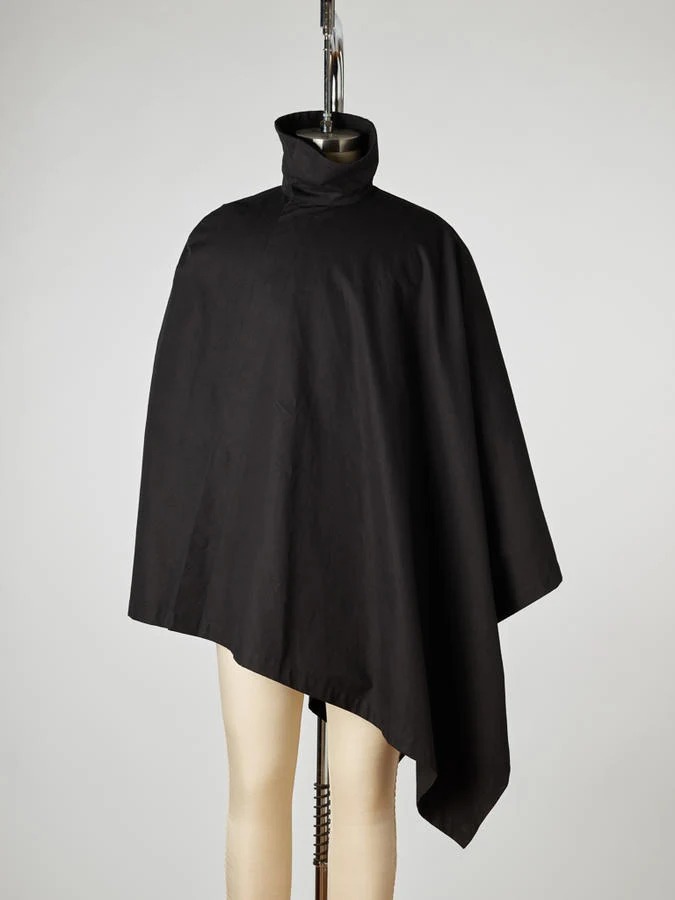
The black cotton cape attracts attention through outline rather than a prominent photograph or slogan. A high, closed neckline meets a wide lower opening, while the uneven hem gives the profile direction. Without sleeves following each arm, the space between body and garment becomes more conspicuous. This early work distinguishes an investigation of form from garments used to carry images. It also belongs to the independent label’s history, before the later appointments at womenswear houses.
An independent label ends; a practice continues
The own-name label closed in 2022, with spring/summer 2023 as its final collection. The closure does not end Raf Simons Prada history. Prada's 2026 campaign credits still identify Miuccia Prada and Raf Simons together, confirming the continuing shared role at the time of writing. The independent label's archive and the current Prada collections must nevertheless remain separately attributed.
The Mapplethorpe garments, Ruby project, Jil Sander volumes and Dior silhouettes show several ways of translating an existing visual language into clothing. Across them, tailoring supplies a structure on which images and proportions can be tested. The enduring question is how much of the reference to preserve and how much to transform. That question gives collaboration a practical meaning: another person's work changes the choices available to the designer.
Timeline
- 1968 — Born in Neerpelt.
- 1991 — Graduates in industrial design.
- 1995 — Launches his menswear label.
- 2005–2012 — Creative director of Jil Sander.
- 2012–2015 — Creative director of Dior womenswear.
- 2016 — Joins Calvin Klein.
- 2020 — Becomes Prada co-creative director with Miuccia Prada.
- 2022 — Closes his independent fashion label.
Sources
- MoMu — Raf Simons collection story
- Raf Simons — official biography
- Prada Group — co-creative directors announcement, 2020 (PDF)
- Prada Group — spring/summer 2026 campaign credits
- Image and object record — Raf Simons, black cotton cape with an asymmetric hem, autumn–winter 1999–2000. RISD Museum.

Related reading
Fashion History · Miuccia Prada · Christian Dior · Calvin Klein · Designers