Miuccia Prada: Questioning the Rules of Taste
Nylon, unexpected colour and shared authorship reconsider familiar taste.
ÉPOPLI ·

How do we decide what is beautiful?
Miuccia Prada Prada history concerns the criteria of taste as much as the production of attractive clothes. The spring–summer 1996 collection combined restrained shapes with browns, mustard tones and unexpectedly ordinary-looking patterns. The term ugly chic describes a challenge to approved taste, not careless workmanship.
Familiar form and disconcerting colour can interrupt judgement. That does not make every awkward combination intellectually superior. The effect has to be examined through actual proportions, materials and relationships.
The convenient label ugly chic can also conceal differences between collections. The useful question is how beauty is judged, rather than whether a designer has simply chosen its opposite.
Transforming an existing family business
Born in Milan in 1948, she studied political science before designing for the family business. Its origins lie in her grandfather Mario’s 1913 shop. Miuccia Prada Prada history is therefore a transformation of an inherited enterprise, not the foundation of the original company.
The late-1970s partnership with Patrizio Bertelli combined creative work with production and business organisation. His contribution should not dissolve into a story of individual inspiration. Her education and social interests are documented, but do not justify inventing a psychological explanation for a particular hem or colour.
Leather-goods knowledge, new materials and an expanding commercial structure together supported the transition toward a broader fashion house.
Nylon and the appearance of luxury
The nylon bags associated with her 1980s work questioned the assumption that luxury must announce itself through leather or precious decoration. Miuccia Prada Prada history gives practical lightness a prominent role. A utilitarian-looking surface combined with a luxury identity could alter perceptions of value.
Synthetic material did not automatically make the product inexpensive or universally accessible: material, price and social meaning are different things. Weight, touch and visible ornament provide concrete points of comparison. Later recycled-material products also require their own dates and claims; they should not be projected backwards onto the original bags.
The choice of nylon concerned use as well as appearance.
Clothing and another brand
Her first women’s ready-to-wear appeared in 1988. Miu Miu followed in 1993, alongside menswear and the cultural foundation’s establishment. Miuccia Prada Prada history did not expand merely by duplicating one look.
Miu Miu supplies a distinct setting for the same designer’s work. Calling it only a cheaper copy misses its separate collections. The 1996 clothes also need to be seen as complete outfits: tops, skirts and shoes establish tensions that a single isolated garment may not reveal.
Rather than accept an advance label of intellectual fashion, viewers can identify exactly which elements feel familiar and which disrupt their expectations.

Faces shared by garments and a stage
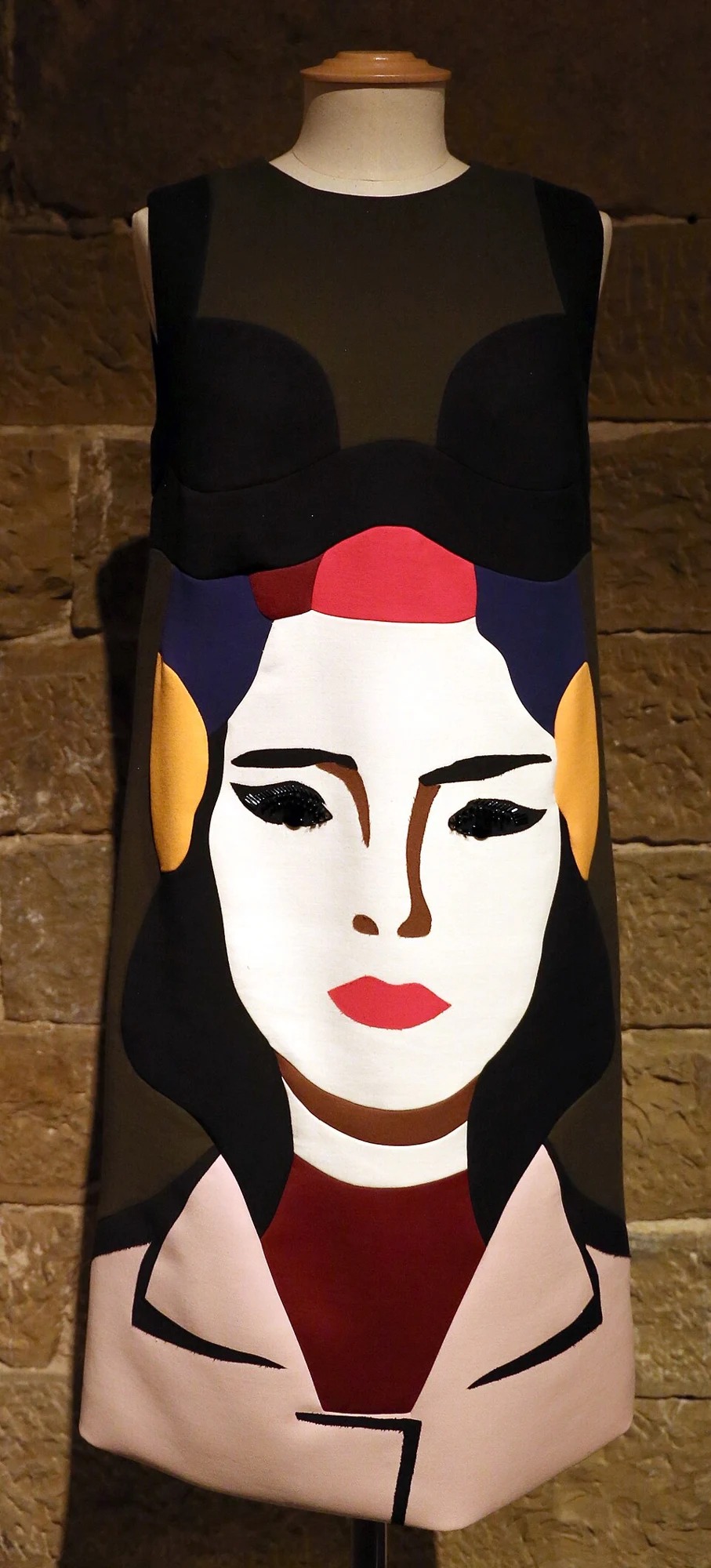
For spring–summer 2014, images on clothes connected with the show environment. The commissioned artists included El Mac, Mesa, Gabriel Specter, Stinkfish, Jeanne Detallante and Pierre Mornet. Miuccia Prada Prada history here requires naming collaborators rather than attributing every image to the designer alone.
A large face on a garment appears beside the wearer’s own face, producing a second gaze. Colour and decoration do more than flatter a body. Garment and mural inform one another without becoming the same work.
The interesting question is what changes when an image moves into clothing, not whether fashion must be ranked above or below visual art.

A shared creative signature
Raf Simons joined in 2020 with equal creative responsibility. Their first shared women’s collection, for spring–summer 2021, was shown that September. Miuccia Prada Prada history must now distinguish joint Prada authorship from a single designer’s work.
This arrangement was not a replacement. Its digital presentation also shaped reception: the OMA/AMO environment and cameras organised how clothes were seen. Existing house vocabulary met another designer’s judgement.
Public interviews and collections supply evidence of that exchange, without proving that collaboration is effortless agreement. Miu Miu remains a separate creative responsibility.
Continuing work in 2026
Official information checked on 1 October 2026 identifies her as Prada co-creative director and Miu Miu creative director. Her co-CEO role ended in 2023. Miuccia Prada Prada history is ongoing: the September 2026 presentation of spring–summer 2027, made with Simons, revisited the skirt and its ways of being worn.
This does not justify speculation about retirement or future results. Comparing nylon accessories, the 1996 palette, 2014 faces and jointly authored collections suggests a recurring examination of familiar things. Museum interpretation and brand explanation are different perspectives.
Neither guarantees that all viewers experience a work in the same way; those differences are part of its cultural life.
Timeline
- 1948 — Born in Milan
- 1988 — Women’s ready-to-wear debut
- 1993 — Miu Miu launched
- 2020 — Creative co-direction with Raf Simons
- 2026 — Prada co-direction and Miu Miu direction verified
Sources
- Vogue — Prada Spring 1996
- The Met — Impossible Conversations
- Prada Group — History
- Treccani — Miuccia Prada
- Vogue Italia — Miuccia Prada interview
- Prada — Spring/Summer 2014
- Prada Group — Board biographies
- Prada Group — Dialogues, Spring/Summer 2021
- Prada Group — Spring/Summer 2027 womenswear