Tom Ford — Clothing, Image and Gucci
Satin, velvet and the openings of white dresses: how clothes construct an image.
ÉPOPLI ·

The tension between two surfaces
Tom Ford Gucci history becomes tangible in the satin shirts and velvet trousers of autumn/winter 1995. One surface reflects light while the other holds it. Buttoning, waist placement and the movement of fabric determine the effect as much as colour.
Calling the result simply revealing misses these material relationships. Gucci was connecting an established name in leather goods with a contemporary clothing image. Runway, advertising and styling reinforced that change, although its commercial success also depended on management, production and retail work.
Practical experience before Gucci
Tom Ford Gucci history began outside Italy. Born in Austin in 1961, he studied at Parsons and worked for Cathy Hardwick and Perry Ellis before joining Gucci in 1990. He became creative director in 1994.
These are professional transitions, not evidence for an invented psychological explanation of his clothes. His role also expanded beyond an individual garment to the way clothing, accessories and photographs represented the house. Birthplace, training and the location of a fashion business describe different aspects of a career; none should stand in for the others.
A white dress viewed from both sides
Tom Ford Gucci history includes the white dresses of autumn/winter 1996–97. A Museo del Traje example contrasts a covered front with a deeply open back; a Metropolitan Museum ensemble uses an oval opening within a long silhouette. A cut-out makes the body and background part of the composition, but its position also affects support.
Remaining fabric must keep the garment in place during movement. The cut-out is therefore a construction choice as well as a visual device. Beside velvet tailoring, these pale jersey surfaces demonstrate how different materials can produce intensity without elaborate pattern.
The image is collaborative
Tom Ford Gucci history also involves stylist Carine Roitfeld, photographer Mario Testino and business partner Domenico De Sole. Lighting and pose shape how a fastening or the boundary between skin and fabric is read. A photograph does not merely transmit a finished product; it constructs an encounter with it.
Yet photographic impact does not prove comfort or manufacturing quality. The strongly sexual imagery can also invite different responses, from attraction to criticism of objectification. Recording commercial recovery and judging the bodies represented by advertising are related but distinct tasks.
A 2004 dress for a different house
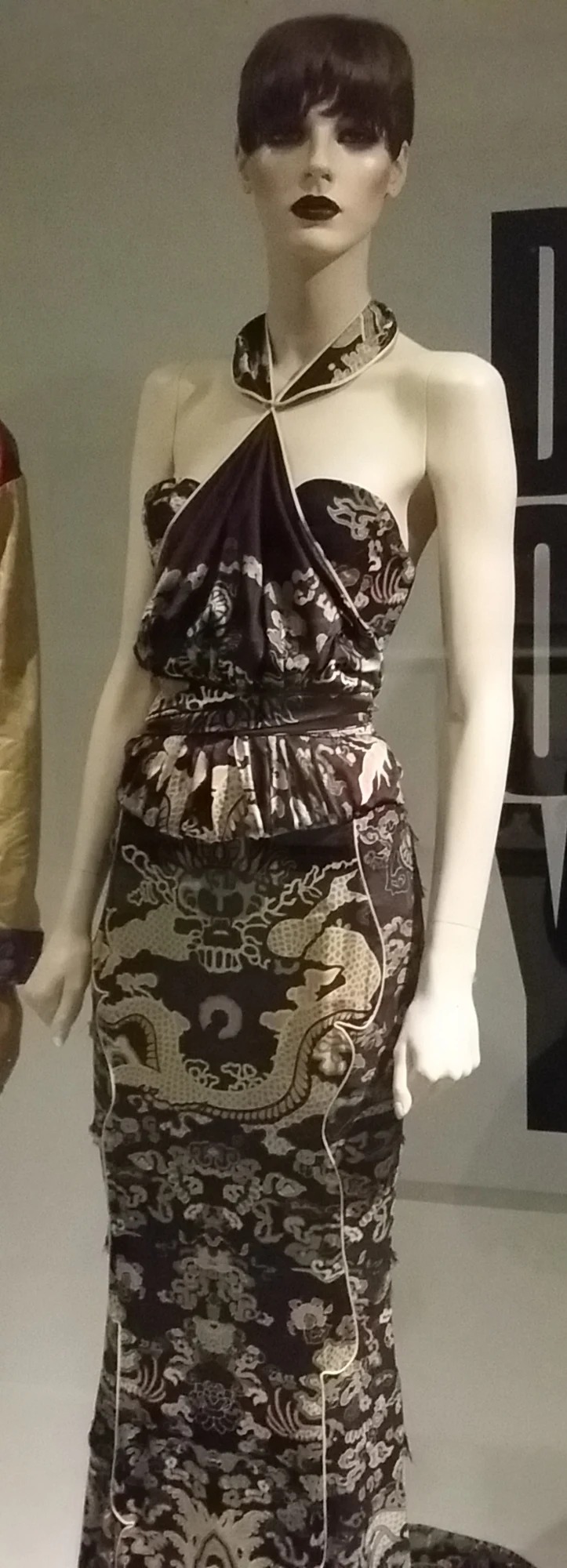
Tom Ford Gucci history must distinguish his work for Yves Saint Laurent Rive Gauche. The dragon-print satin evening gown dated 2004 follows a long line from its halter neckline into flowing fabric. The pattern’s direction meets folds and movement rather than remaining a flat picture.
Draping means the folds formed as fabric hangs or rests around the body. This differs from the empty area of a cut-out and from a plain satin shirt’s reflection. The dress is not a design by founder Yves Saint Laurent merely because it carries the house name.
Ford’s departure from the Gucci group in 2004 creates another boundary before his subsequent independent work.

Clothing and cinema use different time
Tom Ford Gucci history does not name everything he made afterward. His own label and cinema involved different conditions. A Single Man appeared in 2009 and Nocturnal Animals in 2016.
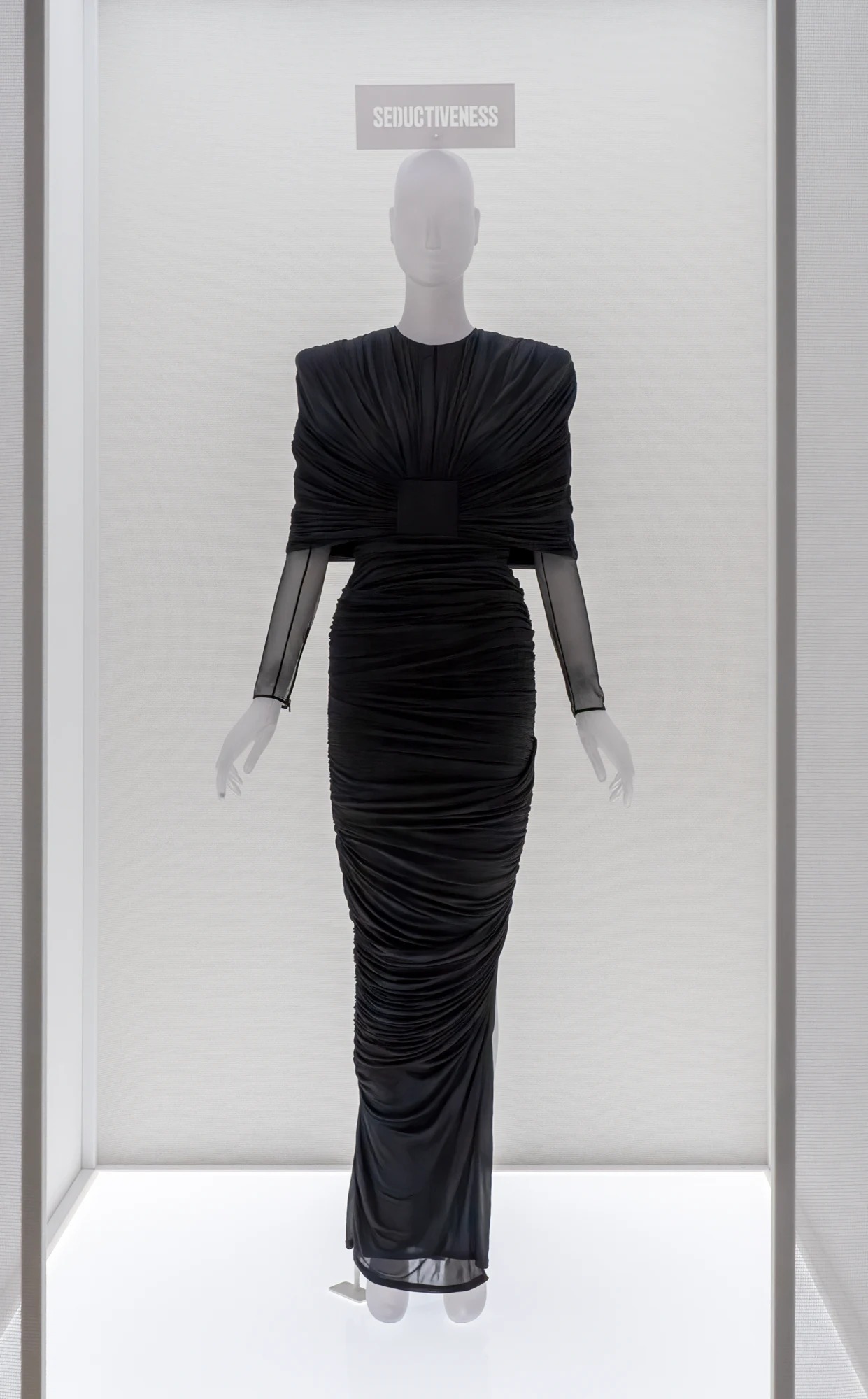
Clothing collections organize a sequence of products, whereas a feature film places colour, space and costume inside an unfolding narrative. Actors, cinematography, production design and editing contribute to that result. His interviews offer a perspective on the relationship between attractive images and storytelling, but the films should still be examined rather than treated as illustrations of a designer’s statement.
Nor is every garment under his own name simply a repetition of Gucci.

Ownership and the current record
Tom Ford Gucci history should not be presented as a current appointment. Estée Lauder Companies completed its acquisition of the Tom Ford brand in April 2023. A founder’s continuing trademark and personal authorship of new collections are different things.
As checked in October 2026, Italy for Movies records filming of his directorial project Cry to Heaven from 19 January to 23 March 2026; this does not establish a release date. Returning to the garments, compare velvet with satin, openings with continuous surfaces, and photographic poses with construction. His influence extends beyond provocation to the close coordination of clothes, images and business.
Timeline
- 1961 — Born in Austin, United States
- 1990 — Joins Gucci
- 1994 — Becomes Gucci creative director
- 2004 — Leaves the Gucci group
- 2009 — Releases A Single Man
- 2023 — Acquisition of his brand completed
- 2026 — Cry to Heaven filming documented
Sources
- Vogue — Gucci Fall 1996 collection
- Vogue Türkiye — Tom Ford, yeniden Gucci’de
- Biography — Tom Ford
- Vogue — Remembering Tom Ford’s Gucci
- Museo del Traje — Tom Ford for Gucci, 1996 (PDF)
- The Met — Gucci ensemble, 1996–97
- Wikimedia Commons — 2004 Yves Saint Laurent Dress of the Year documentation
- The Talks — Tom Ford interview
- Associated Press — Cry to Heaven announced
- Estée Lauder Companies — Acquisition completed, April 2023
- Italy for Movies — Cry to Heaven production record