Yohji Yamamoto: Asymmetric Cutting and Moving Clothes
The Secret Dress, textile development and Y-3 show how clothing can change through movement, use and collaboration.
ÉPOPLI ·

A wedding dress with another life inside
During the spring/summer 1999 wedding presentation, a model opened compartments in her skirt and removed accessories. The dress contained the means to complete its own ensemble. This is an unusually practical starting point for Yohji Yamamoto brand history: what can a garment do after it has established an attractive silhouette? A skirt can hold things, change its appearance and turn dressing into an event witnessed by an audience.
The Secret Dress joined a simple bodice to a long hoop skirt. Its proportions referred to ceremonial clothing, while the model's actions interrupted the expectation that a bride should remain a perfectly arranged image. The interest lies in the sequence. A photograph records one state; the runway film records the discovery of other states concealed in the same garment.
Tokyo, study and the first company
Born in Tokyo in 1943, the designer attended Keio University and then Bunka Fashion College. He established Y's in 1972 and made his Paris debut in 1981. Yohji Yamamoto brand history grew through the relationship between a Japanese production base and an international presentation system. The clothes were not simply national symbols transported overseas; they proposed a different relation between the figure and its covering.
The early silhouettes left space rather than closely describing every contour. With asymmetric cutting, a hem or closure could refuse the expected balance between left and right. A loose garment still requires decisions about weight, grain and support. Its apparent ease is therefore not evidence that it was made without careful construction. This distinction is essential when comparing an unstructured appearance with an actually unsupported piece of cloth.

Fabric determines the outline
The V&A identifies textile development as central to the practice, including commissioned materials and dyeing or embroidery undertaken with Japanese craftspeople. A dark fabric can absorb light, reflect it softly or reveal a rough surface. Yohji Yamamoto brand history cannot be reduced to the use of black, because two black textiles may produce entirely different edges and folds.
A useful way to look at a coat is to follow what happens below the shoulder. A dense material may hold a plane away from the body; a softer one may collapse into a shifting fold. The V&A's account of textile development explains why the fabric must be considered alongside the paper pattern. The line drawn by a designer is only a proposal until a particular cloth is cut, assembled and worn.
Who models a man's wardrobe?
The autumn/winter 1998 menswear presentation included women wearing the clothes. The V&A later displayed pieces from that season in its retrospective. In Yohji Yamamoto brand history, this is a concrete case of clothing categories being tested through casting. The cut remains available for inspection, but the person wearing it changes the assumptions brought to its shoulders, pockets and length.
For spring/summer 1999 menswear, genuine couples from Paris took part. The museum revisited that approach with London couples in 2011. These presentations invite comparison between related bodies rather than presenting a single ideal model. They also show why runway direction is part of design communication: the same coat looks different when its wearer appears as an individual in a relationship rather than as an anonymous example of a standard size.
Reading the Wedding collection
The 1999 Wedding collection explored volume through collars, circular cuts and supported hems. Plastic boning gave selected edges a curved shape. The relationship between support and movement is crucial to Yohji Yamamoto brand history. A large outline need not be rigid throughout: its edge may be controlled while the cloth above it responds to the person walking.
The Secret Dress makes that distinction especially clear. Its concealed storage is legible only when used, while the skirt's geometry is immediately visible. The collection also included black clothing associated with widowhood, bringing different stages of ceremonial life into one presentation. Rather than treating the wedding as a single white image, the clothes made room for several social roles and emotional registers without requiring every garment to tell the same story.
Sport and a different production partner
Y-3 introduced another technical and commercial setting. Adidas's contemporary announcement dates the first spring/summer 2003 collection's launch to October 2002. That distinction between presentation date and selling season helps clarify Yohji Yamamoto brand history. The project brought the designer's approach to proportions into contact with a sports company's footwear, manufacturing and distribution knowledge.
The collaboration should not be understood as one person inventing sportswear. It is more useful to compare two design priorities: equipment made for athletic use and clothing that builds an everyday image around that language. A stripe, a sole or an extended proportion can function differently in each setting. The partnership made those priorities coexist within a continuing line rather than within a single borrowed runway accessory.
Directions in the 2003–04 checked ensemble
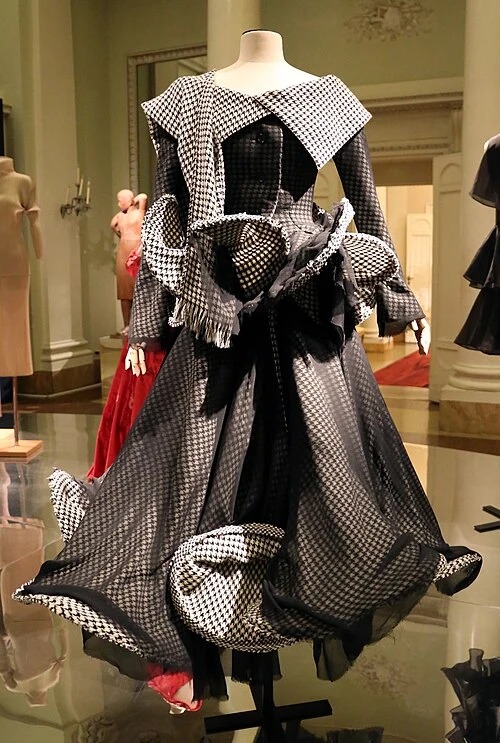
In the photographed wool and silk jacket-and-skirt ensemble, the check does not remain a continuous flat plane. Its direction changes around folds and overlaps, making the fabric’s arrangement around the body visible. The broad upper opening and layered lower part have different visual weights. The familiar association with black clothing does not explain this object. In a patterned garment too, the crucial decisions concern where cloth is held and where it is released; a still photograph gives time to examine those decisions.
Clothes, photographs and the present
Photographer Nick Knight, graphic designer Peter Saville and art director Marc Ascoli helped communicate the work beyond the runway. Masao Nihei designed the V&A's 2011 retrospective. These collaborators belong in Yohji Yamamoto brand history because lighting, framing and display affect whether a viewer notices a cut, a texture or the distance between garment and skin. The museum exhibition made that distance available for sustained examination.
The official house archive records the spring/summer 2027 women's show in Paris on 2 October 2026. This confirms an active practice at the time of writing. Looking back across the archive, asymmetric cutting, the Wedding collection's hidden functions and the Y-3 partnership offer distinct questions about use. Their common value lies in making room for movement and for the wearer to contribute something that a static silhouette cannot supply.
Timeline
- 1943 — Born in Tokyo.
- 1972 — Establishes Y's.
- 1981 — Paris debut.
- 1999 — Wedding collection and couples in the menswear presentation.
- 2002 — Launches Y-3 spring/summer 2003 with adidas.
- 2011 — V&A retrospective.
- 2026 — Presents spring/summer 2027 in Paris.
Sources
- Vogue — Yohji Yamamoto’s Transformative Wedding Collection, runway film and interviews
- V&A — Yohji Yamamoto retrospective, 2011 (PDF)
- V&A — Fashion in Motion: Yohji Yamamoto
- adidas — Y-3 collaboration announcement, 2006 (PDF)
- Yohji Yamamoto — spring/summer 2027
- Image and object record — Yohji Yamamoto at the finale of the Y-3 autumn–winter show in New York, February 2010.
- Image and object record — Yohji Yamamoto, wool and silk jacket and skirt, autumn–winter 2003–04. Galleria del Costume, Florence.

Related reading
Madeleine Vionnet: Bias-Cut Dresses and Draping · Cristóbal Balenciaga: The Sack Dress and Sculptural Couture · Claire McCardell: The Popover and American Sportswear · Issey Miyake: Pleats Please, A-POC and Clothing Design · Fashion History · Rei Kawakubo · Shalom Harlow · Designers