Rei Kawakubo: Comme des Garçons and the Changing Body
From padded gingham to Flatness: how materials and construction challenge familiar ideas of fit at Comme des Garçons.
ÉPOPLI ·
A dress that changes the outline
A gingham dress from spring/summer 1997 seems familiar until its rounded projections interrupt the expected line of the torso. The checked surface follows those projections closely, making it difficult to decide where the body ends and the garment begins. This is a useful entrance to Rei Kawakubo Comme des Garçons history: clothes can propose a body rather than simply describe one. The question is not whether a waist looks smaller, but why that should be the only desirable result.
In the Metropolitan Museum's example, stretchy nylon and polyurethane work with down-filled padding. The checks provide a visible measuring system; they bend and spread across the raised areas. Seen this way, the garment is an experiment in the relationship between surface and volume. Its departure from conventional fit is achieved through material choices, not merely through a provocative title.
Before the label
Born in Tokyo in 1942, the designer studied at Keio University rather than at a fashion school. Work in the advertising department of the textile company Asahi Kasei preceded independent fashion work. That route placed fabrics, presentation and commerce beside one another before she established a label. Rei Kawakubo Comme des Garçons history therefore begins with several kinds of visual work, not with an apprenticeship in a Paris couture atelier.
Comme des Garçons began in 1969 and was incorporated in 1973. Those dates describe different stages and should not be treated as competing answers to the same question. Menswear followed, and the label established a Paris presence in 1981. The name now covers several lines; attribution to a specific designer and collection remains essential when examining an individual garment.
Openings rather than damage
The black sweater with irregular holes from 1982 offers another way into Rei Kawakubo Comme des Garçons history. Its openings disturb the idea that a finished textile must present an uninterrupted surface. Against skin or a layer underneath, the empty spaces become part of the pattern. The wearer supplies a changing background, so the appearance cannot be understood by studying the knitted yarn alone.
The designer compared those openings with lace. That comparison is more precise than calling the sweater destroyed: lace also organizes absence into decoration. Here asymmetry interrupts the expectations associated with expensive knitwear. It directs attention to the standards by which a garment is judged complete, respectable or worth buying. These are questions raised by the visible construction, rather than a diagnosis of the designer's personality.
The people behind a surface
The 1997 gingham was commissioned from Orimono Kenkyu Sha and its designer Hiroshi Matsushita. This collaboration matters to Rei Kawakubo Comme des Garçons history because the cloth needed enough stretch to follow unusually placed volumes. A printed check on an unsuitable rigid fabric would behave very differently. Textile development and pattern cutting cannot be separated from the visual result.
The placement of padding also establishes an uneven balance. The dress is not a historical bustle transferred intact to a new decade: its projections can occupy several parts of the body. The asymmetry changes the relationship between front, side and back. A single frontal photograph therefore offers an incomplete account of the object, especially when the person wearing it turns or bends.
A garment enters choreography
In 1997 Merce Cunningham's Scenario brought this investigation into dance. The collaboration premiered at the Brooklyn Academy of Music in October. Bodies moving together exposed the clothes to duration, contact and changing viewpoints. For Rei Kawakubo Comme des Garçons history, the performance supplies a different kind of evidence from a still fashion photograph: a shape can be understood through the movements it permits or complicates.
The costume and the dance do not simply illustrate each other. A dancer has to negotiate the additional volume, while the audience sees a familiar human action acquire an unfamiliar outline. This distinction helps explain why such clothes cannot be reduced to wearable sculpture alone. Their three-dimensional structure remains in conversation with a moving person, even when that conversation involves resistance.
Not Making Clothing
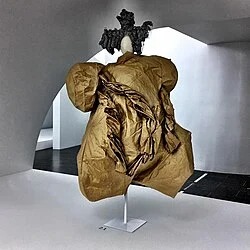
The spring/summer 2014 collection Not Making Clothing shifted attention toward objects arranged around the body. The Met's 2017 exhibition placed this work beside earlier garments to show both a break and continuing concerns. Rei Kawakubo Comme des Garçons history is more intelligible when that change is treated as a specific experiment, rather than as proof that every collection follows one unchanging philosophy.
In these works, enlarged abstract forms can obscure the ordinary positions of sleeves, waistlines and shoulders. Their three-dimensional structure asks the viewer to look for a new organizing principle. The practical question of dressing has not disappeared; it has become visible precisely because familiar answers are withheld. Looking for the opening, support and balance of an object is a more productive starting point than immediately deciding that it is either fashion or art.
Different forms within black
The black garments in the exhibition photograph demonstrate how one colour can accommodate different volumes. Some forms extend sideways, others upward, while areas where a body might be expected appear unexpectedly open. With little colour difference, outline and empty space become especially important. Everyday comfort alone cannot explain the exhibition’s questions. Nor should all the black garments be assigned to one season or construction method. The photograph offers a starting point for comparison; each object retains its own record.
An archive that remains open
The Fédération de la Haute Couture et de la Mode lists Comme des Garçons in its spring/summer 2027 womenswear programme, checked for this article in October 2026. This places Rei Kawakubo Comme des Garçons history within an ongoing practice, not a completed historical period. A new seasonal listing confirms continued presentation; it does not by itself establish the meaning of every new look.
To read the earlier works, compare three decisions: the holes in the 1982 sweater, the checked stretch surface in 1997 and the displacement of recognizable garment parts in 2014. Each changes a different relationship between material, body and viewer. Together they explain why the archive needs object records, collaborators and exhibition context as well as runway images. The clothes reward close attention before they reward a grand label.
Timeline
- 1942 — Born in Tokyo.
- 1969 — Begins Comme des Garçons.
- 1973 — Incorporates the company.
- 1982 — Presents the sweater with irregular openings.
- 1997 — Body Meets Dress—Dress Meets Body; collaboration on Scenario.
- 2014 — Not Making Clothing collection.
- 2017 — The Met stages Art of the In-Between.
Sources
- The Met — exhibition galleries, 2017
- The Met — dress, spring/summer 1997
- Contemporary Fashion — Rei Kawakubo biography
- FHCM — Comme des Garçons spring/summer 2027
- Image and object record — Designs by Rei Kawakubo in the Comme des Garçons exhibition at The Metropolitan Museum of Art, 2017.

Related reading
Ann Lowe: Custom Gowns, Flowers and American Fashion · Guo Pei: Embroidery, Couture and the Yellow Queen · Iris van Herpen: 3D Printing and Couture in Motion · Martin Margiela: Tabi, Deconstruction and Reuse · Fashion History · Yohji Yamamoto · Designers