Ann Lowe: Custom Gowns, Flowers and American Fashion
Look inside a surviving 1959 gown, then follow family dressmaking knowledge, Tampa commissions and New York workrooms.
ÉPOPLI ·
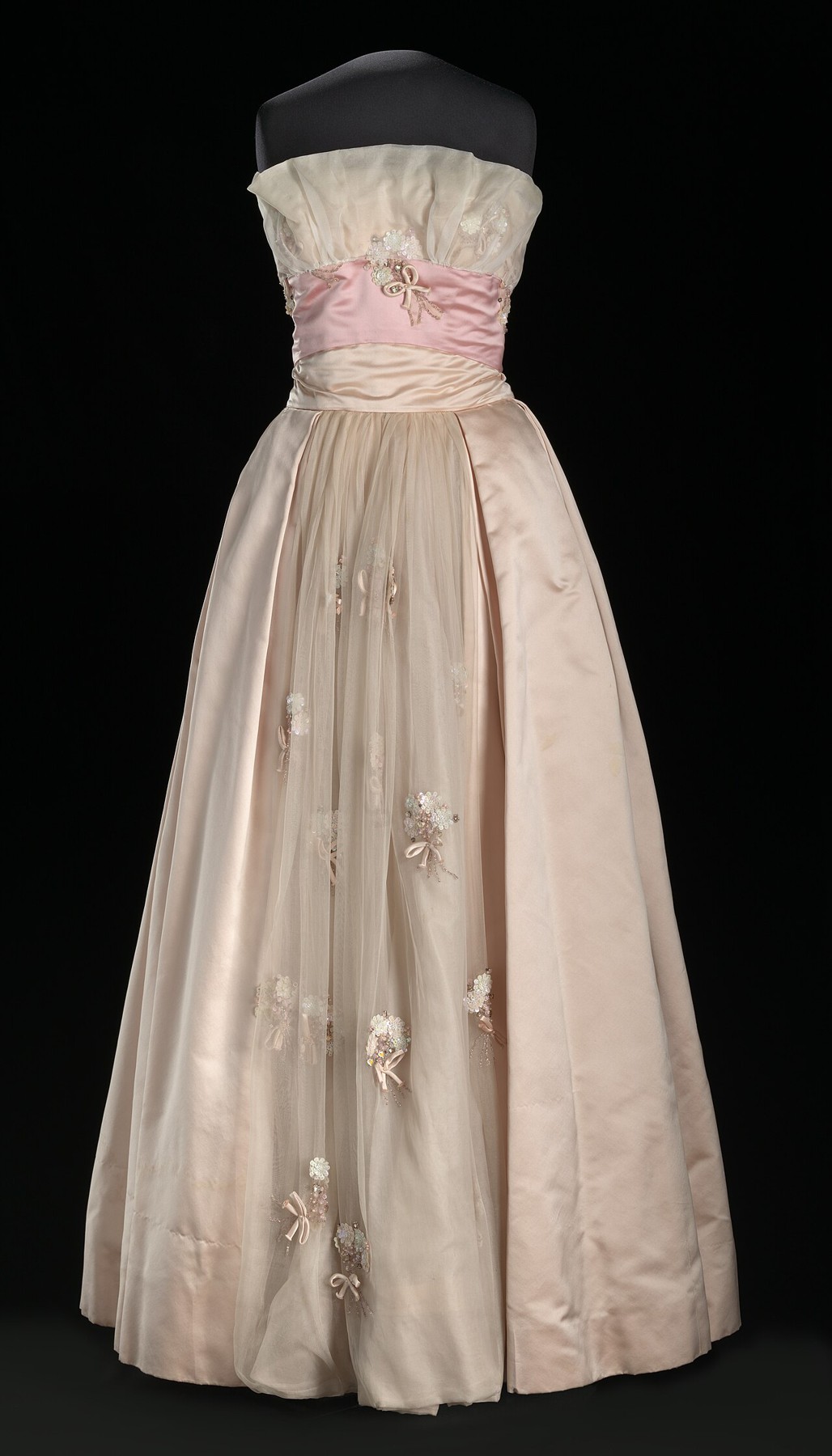
Inside a 1959 gown
Ann Lowe history becomes tangible inside a pink gown dated 1959. The Smithsonian garment, worn by Patricia Schieffer, combines satin and organza with a waist stay, petticoats and a bustle supporting the rear silhouette. Bright pink bands extend down the back while a decorated organza panel opens the front. Such custom dresses required an internal architecture as carefully considered as their surface. Supporting weight at the waist and keeping the skirt lifted made its apparently soft outline possible. No label survives; the museum records its wearer and collection history.
Family knowledge and Tampa spectacle
Born around 1898 in Clayton, Alabama, she learned sewing from her mother Janie Cole and grandmother Georgia Thompkins, experienced dressmakers serving white clients. Ann Lowe history begins with this inherited technical knowledge. Fabric scraps became dimensional flowers, later a recognizable signature. In 1917 she studied in New York under racially segregated conditions. In Tampa, her commissions expanded to Gasparilla festivities. Sara Lykes Keller’s 1924 gown uses yellow and gold silk with pink and green beaded flowers: color and reflected light suited its ceremonial setting. The Henry B. Plant Museum identifies it as an early confirmed surviving work.
A famous wedding and an obscured maker
The 1953 Jacqueline Bouvier wedding gown is central to Ann Lowe history. Its ivory silk taffeta combines a portrait neckline, fitted bodice and expansive skirt. Folded bands form rosettes with small wax flowers at their centers; dimensional flowers turn flat cloth into relief. Yet the garment’s publicity did not immediately bring its maker equivalent credit. A burst water line shortly before the ceremony damaged several dresses, requiring the team to remake them. That achievement also involved replacement materials and additional labor. The visibility of a celebrated garment and the recognition of its maker were markedly different.
Working across New York businesses
After moving to New York in 1928, she alternated independent ventures with work for other businesses. The Depression complicated expansion. Ann Lowe history therefore follows craftsmanship across changing commercial arrangements, including Hattie Carnegie, Sonia Gowns, Saks Fifth Avenue’s Adam Room and Madeleine Couture. A garment’s label did not always identify its actual designer. Her son Arthur Cone helped with finances; his death, deteriorating eyesight and debt destabilized the business. Skill in a workroom could not by itself solve problems of pricing, contracts and overheads. These conditions help explain under whose name a garment reached its customer.
Feathers and the changing life of a garment
Ann Lowe history includes materials beyond floral ornament. A salmon-colored dress made for Madeleine Couture in 1964 used ostrich feathers, whose responsive edges soften the boundary of the silhouette. Winterthur documented the later conservation of this garment: flattened and fragile feathers were replaced after consultation with the lender. Conservator Andrea Goldstein repeatedly adjusted dye and shaping to recover the intended effect. The object seen in an exhibition consequently includes conservation decisions. Distinguishing original manufacture from later treatment clarifies its material history rather than diminishing the designer’s achievement.
A garment remembered by its wearer
Polly Carver Duxbury’s 1967 debutante gown adds a wearer’s perspective to Ann Lowe history. Her recollections describe confidence and maturity, while the Smithsonian emphasizes lace-finished seams, integrated undergarment structures and shaping layers. Later work included partnership with Ida Mitchel and A. F. Chantilly with Florence Cowell. These workroom relationships belong alongside the designer’s own skills. Almost complete loss of sight led to retirement in 1972. Examining support and finishing beneath the decoration helps explain why individual customers remembered their custom dresses so vividly.
Collections rather than a successor house
After her death in 1981, Ann Lowe history continued through collections and scholarship rather than seasonal collections by a successor house. The Black Fashion Museum’s 1986 exhibition and Winterthur’s 2023–24 retrospective helped reconnect garments with their maker. Objects from the museum founded by Lois K. Alexander-Lane are now preserved at the Smithsonian. Research also examines family photographs, memories and unlabeled garments; resemblance alone is insufficient for attribution. Following makers, wearers and custodians beyond one famous wedding reveals a broader history of Black women’s technical labor in American fashion.
Timeline
- c.1898 — Born in Clayton, Alabama.
- 1917 — Studied design in New York.
- 1924 — Created a Gasparilla queen’s gown.
- 1928 — Moved her working base to New York.
- 1953 — Created Jacqueline Bouvier’s wedding dress.
- 1972 — Retired.
- 1981 — Died.
- 2023–2024 — Winterthur retrospective.
Sources
- Smithsonian: 1959 dress, 2007.3.20
- NMAAHC: Ann Lowe and the Black Fashion Museum
- National Museum of American History: Sewing for joy
- Henry B. Plant Museum: Gasparilla gowns
- JFK Library: Jacqueline Bouvier’s wedding dress
- FIT: 1953 wedding dress analysis
- The Met: Ann Lowe, Elizabeth Way
- Winterthur: Ann Lowe, American Couturier
- Winterthur: A Feather in Her Cap
- Winterthur: Research continues
Related reading
Guo Pei: Embroidery, Couture and the Yellow Queen · Iris van Herpen: 3D Printing and Couture in Motion · Rei Kawakubo: Comme des Garçons and the Changing Body · Martin Margiela: Tabi, Deconstruction and Reuse · Fashion History · Designers