Iris van Herpen: 3D Printing and Couture in Motion
Printed shells and hand-shaped water forms lead into a practice joining material experiments, craft and moving sculpture.
ÉPOPLI ·

Can a splash become clothing?
The white Crystallization top of 2010 grew around the shoulders in shell-like layers. Created with Daniel Widrig and Materialise, its polyamide structure posed a question central to Iris van Herpen history: must clothing begin with cloth? 3D printing builds a form layer by layer. Another look in the same collection used transparent plastic bent by hand with a heat gun and pliers to resemble splashing water around a gold minidress. Machine-built shells and hand-shaped waves offered different routes to extending the body into surrounding space.
From Wamel to Arnhem
Born in Wamel in 1984, the designer trained in ballet and recalls discovering older clothing in her grandmother’s attic. Iris van Herpen history continued through fashion study at ArtEZ in Arnhem, graduation in 2006 and internships with Alexander McQueen and Claudy Jongstra. She established her label in 2007 and presented in Amsterdam. Her own account links dance with an understanding of changing bodily form. This helps explain why apparently sculptural clothes are also concerned with trembling surfaces, movement and shifting light.
Umbrella ribs and electrical surfaces
Chemical Crows in 2008 combined children’s umbrella ribs with leather, turning slender rods into wing-like structures. Iris van Herpen history then moved toward the delicate surface of Voltage in 2013, developed with architect Philip Beesley. Here laser cutting shaped polyester film into small projecting elements. In her V&A interview she explained that their slight shifts, rather than perfect rigidity, conveyed energy. The hard line of an umbrella rib and the trembling film demonstrate how similar pointed forms behave differently through material. Experiments with Beesley continued beyond individual collections.
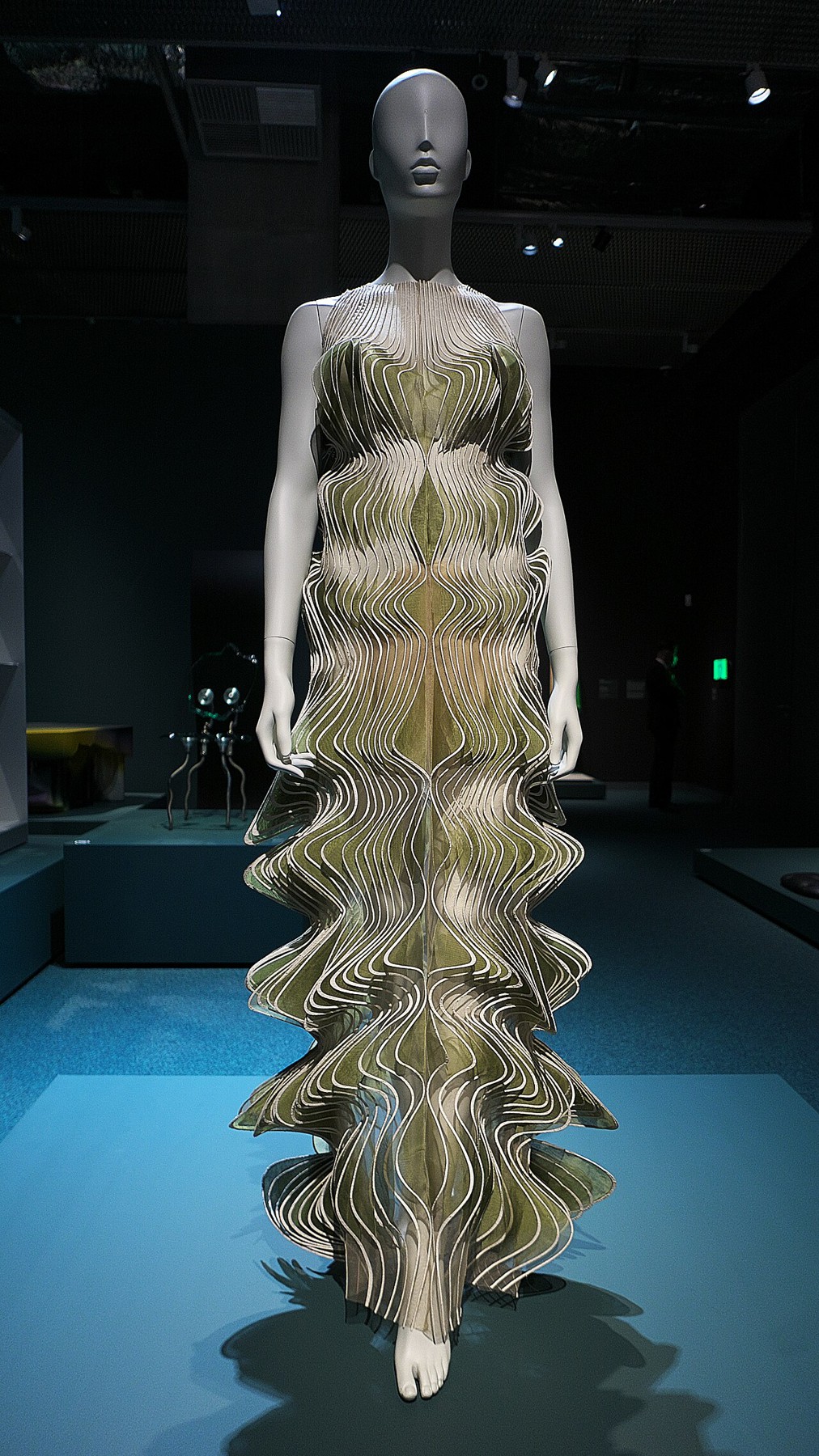

Printing a crystalline body
Magnetic Motion in 2014 included a transparent minidress made with Niccolò Casas and 3D Systems. Photopolymer and resin formed front and back components that joined together. Iris van Herpen history here makes assembly visible in place of conventional seams. Dense lines covered the bust while more transparent areas revealed the body below. 3D printing controlled degrees of exposure as well as complexity. Unlike the earlier hand-heated splash, this crystalline surface emerged through digitally directed material hardening; a shared watery impression concealed distinct construction methods.
When clothing and its setting move
For Hypnosis in 2019, the Infinity dress was developed with Anthony Howe and presented with his rotating Omniverse sculpture. Iris van Herpen history expanded into an encounter between garment and kinetic sculpture as the model passed through its spherical form. Howe’s metalwork and computer-aided design remained a distinct contribution. The V&A subsequently displayed dress and sculpture together, showing how the space around clothing can become part of its experience. Here laser cutting and a moving structure extended the work beyond the silhouette captured in a still photograph.
Sound and retrospective viewing in 2026
Sonic Starquakes, presented in Paris in July 2026, drew on vibrating stars, supernovae and galactic spirals. Iris van Herpen history continued to translate less visible movement into bodily form. Brooklyn Museum’s Sculpting the Senses exhibition opened that year, placing garments beside art and scientific material. In an earlier ArtEZ interview, she explained that exhibitions allow a wider public to approach processes that a brief, invitation-only runway cannot reveal. The exhibition and collection therefore offer complementary encounters with the work.
Read the behaviour of materials
Iris van Herpen history is not simply a sequence of newer technologies. 3D printing and handwork are complementary choices, while kinetic sculpture introduces movement beyond the garment itself. Umbrella ribs, resin and film establish different distances from the body. Asking what bends, what remains rigid and where light passes through makes these choices legible. The architects, makers and artists involved solve distinct problems. Her contribution includes widening the range of people and materials through which clothing can take form, with the body both supporting and transforming the result.
Timeline
- 1984 — Born in Wamel
- 2006 — Graduated from ArtEZ
- 2007 — Established label
- 2010 — Crystallization
- 2019 — Hypnosis collaboration with Howe
- 2026 — Presented Sonic Starquakes
Sources
- ROM — Transforming Fashion, works and construction
- Official career timeline
- Official biography and movement
- High Museum — Transforming Fashion
- Official Hybrid Holism biography (PDF)
- V&A — Interview with Iris van Herpen
- V&A — Infinity and Omniverse
- Official Sonic Starquakes collection
- Brooklyn Museum — Sculpting the Senses
- ArtEZ — Exhibition interview
Related reading
Ann Lowe: Custom Gowns, Flowers and American Fashion · Guo Pei: Embroidery, Couture and the Yellow Queen · Rei Kawakubo: Comme des Garçons and the Changing Body · Martin Margiela: Tabi, Deconstruction and Reuse · Fashion History · Designers