Martin Margiela: Tabi, Deconstruction and Reuse
Read the founding designer’s work through poster waistcoats, Tabi, altered scale and the shared work of building a house.
ÉPOPLI ·
A waistcoat made from a discarded image
A waistcoat from spring/summer 1990 was assembled from torn advertising posters. The material had already carried an image before it became clothing. In Martin Margiela house history, this is an instructive change of function: a surface designed to attract a passer-by becomes a surface worn by a person. Its previous damage is no longer simply a reason to discard it.
The piece belongs to a practice of reuse, but that word alone does not explain its visual effect. Fragments interrupt the original printed message while the garment gives them a new outline. The result asks the viewer to alternate between reading a poster and recognizing a waistcoat. Neither reading entirely replaces the other. This tension is more specific than describing the whole career as unconventional.
Training, work and a shared foundation
Born in Leuven in 1957, the designer graduated from Antwerp's Royal Academy fashion department in 1980. He worked with Jean Paul Gaultier from 1984 to 1987. In 1988 he and Jenny Meirens founded their house in Paris. Martin Margiela house history must include Meirens as a co-founder, not reduce a jointly built company to the biography of its best-known designer.
The first presentation was for spring/summer 1989. The house developed a deliberately restrained public identity, including an unprinted white label. This did not remove the work of branding; it made the refusal of an ordinary logo recognizable. The distinction matters because anonymity can be a carefully maintained collective practice. Pattern cutters, sales staff and production teams still have to turn an idea into clothes that can be presented and supplied.
Looking at the inside from outside
The term deconstruction is useful when it describes something observable: exposed lining, visible basting or a shoulder pad moved into view. These devices show stages that a finished garment normally conceals. Martin Margiela house history offers a way to examine manufacture as part of appearance. A jacket can communicate how it is assembled as well as communicate an image of authority or elegance.
This approach should not be confused with careless sewing. To move a hidden component into view while retaining a wearable shape requires control over assembly. Looking for seams, darts and supports reveals the difference between dismantling a garment randomly and reorganizing its logic. The question becomes which parts must remain in their expected positions, and which can move without destroying the object's identity as clothing.
The split toe and the enlarged garment
Galliera's archive includes white Tabi boots marked with writing in 1991. The separated big toe refers to Japanese tabi, translated into a heeled boot. For Martin Margiela house history, the example demonstrates how a familiar reference can become unfamiliar through material, height and setting. The foot is divided visibly, changing the outline at the point where a dressed body meets the ground.
Other experiments enlarged clothing or translated dolls' garments to human dimensions. Here scale becomes a construction problem. A detail that looks ordinary on a small object can become conspicuous when enlarged: the relationship between a button, seam allowance and the body no longer feels automatic. These experiments are best read by comparing proportions, rather than by assuming that every oversized garment belongs to the same design method.
Different forms of time
The Artisanal pieces and the Replica series pose different questions about an existing object. The former transform found materials into individually made garments; the latter reproduce selected vintage clothes. Both enter Martin Margiela house history, but they should not be collapsed into one generic account of reuse. Transformation preserves one kind of memory, while careful reproduction preserves another.
A 2009 ensemble in Galliera's collection combines blond synthetic hair with ivory taffeta. Hair, usually a feature of the person wearing clothes, becomes part of the clothing itself. The shift is comparable to the poster waistcoat's change of category, although the sensory result is different. Texture and association become as important as the silhouette. Such objects encourage a viewer to ask what a material meant before it arrived in the workshop.
Hermès and the value of continuity
From 1997 to 2003 the designer also created women's collections for Hermès. MoMu describes a gradually evolving wardrobe concerned with comfort and quality. This chapter complicates Martin Margiela house history: the experimental house and an established luxury company were not necessarily opposing worlds. Both could require close observation of how garments are made and how they remain useful.
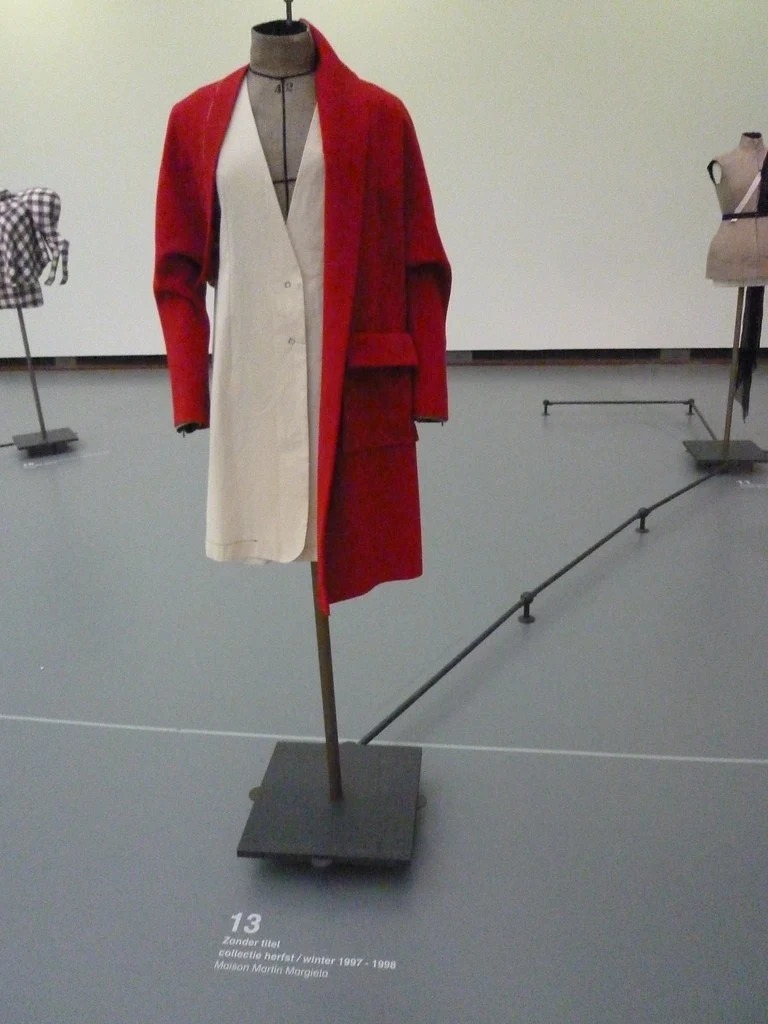
The contrast helps refine the meaning of deconstruction. It is one visible method within a larger investigation, not a requirement that every garment expose its seams. At Hermès, a restrained surface could direct attention toward proportion, fabric and ease. The same viewer who studies an enlarged doll garment can study a quiet coat by asking how its scale relates to a real body and how the garment behaves over time.
After the house
The founder left the company in 2009. Its later collections therefore require separate attribution; MoMu's account records John Galliano's appointment in 2014 and Glenn Martens's in 2025. Meanwhile, Martin Margiela house history continues through the founder's own visual-art practice. Lafayette Anticipations presented his first solo exhibition in 2021, and the official Kudan House programme documents a substantial Tokyo exhibition in spring 2026.
Sculpture, installation and images now extend concerns with surfaces, disappearance and transformation beyond a seasonal wardrobe. This continuity does not make a 2026 artwork a new Maison Margiela garment. Keeping the artist, the historical house and its present design team distinct allows their relationships to be understood. The archive is strongest when it preserves those differences rather than using one famous surname as a universal attribution.
Timeline
- 1957 — Born in Leuven.
- 1980 — Graduates from the Antwerp Academy.
- 1984–1987 — Works with Jean Paul Gaultier.
- 1988 — Founds the house with Jenny Meirens.
- 1997–2003 — Designs womenswear for Hermès.
- 2009 — Leaves the house.
- 2021 — Solo art exhibition at Lafayette Anticipations.
- 2026 — Art exhibition at Kudan House, Tokyo.
Sources
- Palais Galliera — Margiela / Galliera 1989–2009
- MoMu — Martin Margiela collection story
- Lafayette Anticipations — Martin Margiela, 2021
- Martin Margiela at Kudan House — 2026 exhibition
Related reading
Ann Lowe: Custom Gowns, Flowers and American Fashion · Guo Pei: Embroidery, Couture and the Yellow Queen · Iris van Herpen: 3D Printing and Couture in Motion · Rei Kawakubo: Comme des Garçons and the Changing Body · Fashion History · Jean Paul Gaultier · Ann Demeulemeester · Designers