Jean Paul Gaultier: Corsetry, Sailors and the Stage
Corsetry, Sailors and the Stage.
ÉPOPLI ·
A familiar undergarment changes its audience
Madonna’s 1990 Blond Ambition tour supplies a vivid starting point for Jean Paul Gaultier house history. A pointed bust, exposed underwear and sharply defined waist became visible from the back of an arena. The performer did not merely display a garment: movement, lighting and the sequence of songs made it part of an argument about who could direct the audience’s gaze. Clothing that had once been hidden underneath an outfit became its most recognizable surface.
The design had a history before the tour. Pointed bras were already familiar in the 1950s, and the designer had explored exaggerated versions during the 1980s. His achievement was a transformation of scale, placement and cultural setting, rather than the invention of the pointed cup. Looking at those changes connects the clothing to an actual stage, instead of reducing it to a celebrity photograph.
Learning in houses rather than a fashion school
Born in Arcueil in 1952, the designer developed an interest in clothes through family surroundings, television and drawing. Jean Paul Gaultier house history follows a route into fashion that did not depend on a conventional fashion-school diploma. He sent sketches to established houses and entered Pierre Cardin’s studio in 1970. Work at Jean Patou provided another encounter with professional design and production before his own womenswear collection appeared in 1976.
Studio training meant learning how an idea survived pattern cutting, fitting and the practical demands of a collection. It also supplied a vocabulary of respectable clothes that could later be rearranged. Tailored jackets, trench coats and evening dresses remained recognizable even when paired with unexpected materials or worn by unconventional models. The wit of the result often depends on the viewer first knowing the rule being altered. A costume that looks rebellious can still rely on very exact construction.

The body is drawn on the surface
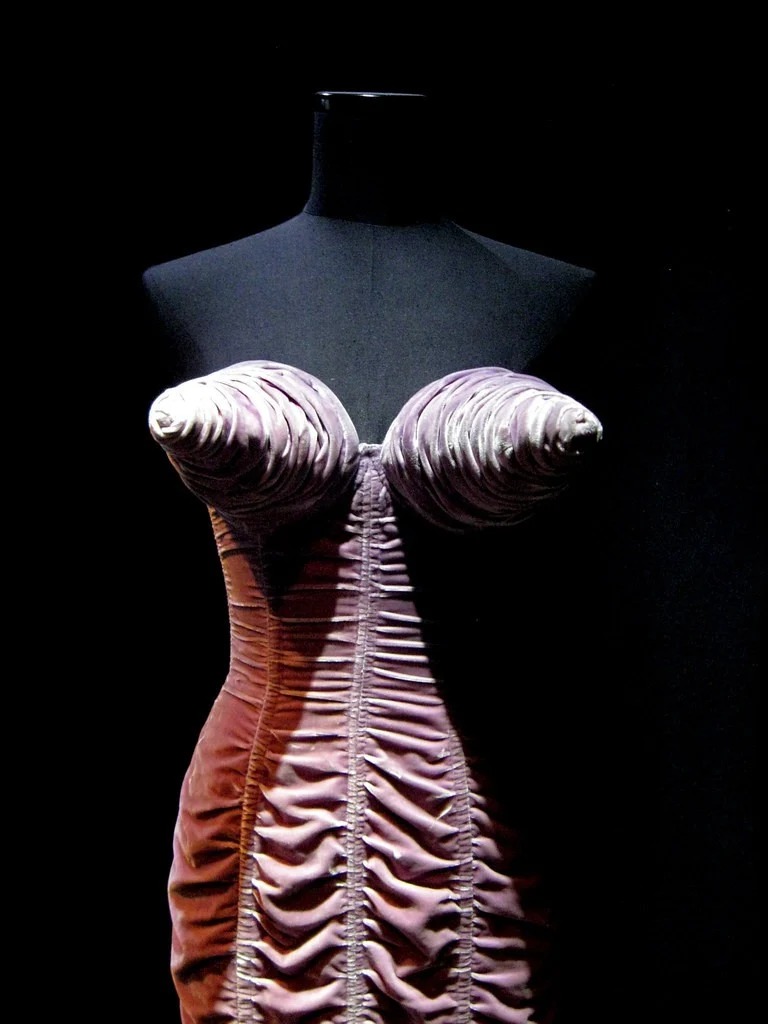
A gathered orange velvet dress from the autumn–winter 1984–85 Barbès collection helps clarify the construction in Jean Paul Gaultier house history. Its shaped panels follow the body, while ruching gathers material into repeated folds. The projecting bust interrupts that close-fitting outline. A corset normally supports and organizes what is worn above it; here its recognizable language becomes the exterior of the dress itself.
The Barbès title referred to a Paris neighborhood with a complex mix of communities. The clothes combined materials and references rather than proposing a single uniform. Such borrowing should be read within that particular collection and period. It is more informative to describe the visible pleats, lacing and juxtaposition of fabrics than to treat different cultures as one interchangeable source of exotic decoration. The dress can be examined as a specific object, with its own construction and date, separately from the later tour wardrobe.
A sailor’s shirt and a skirt for men
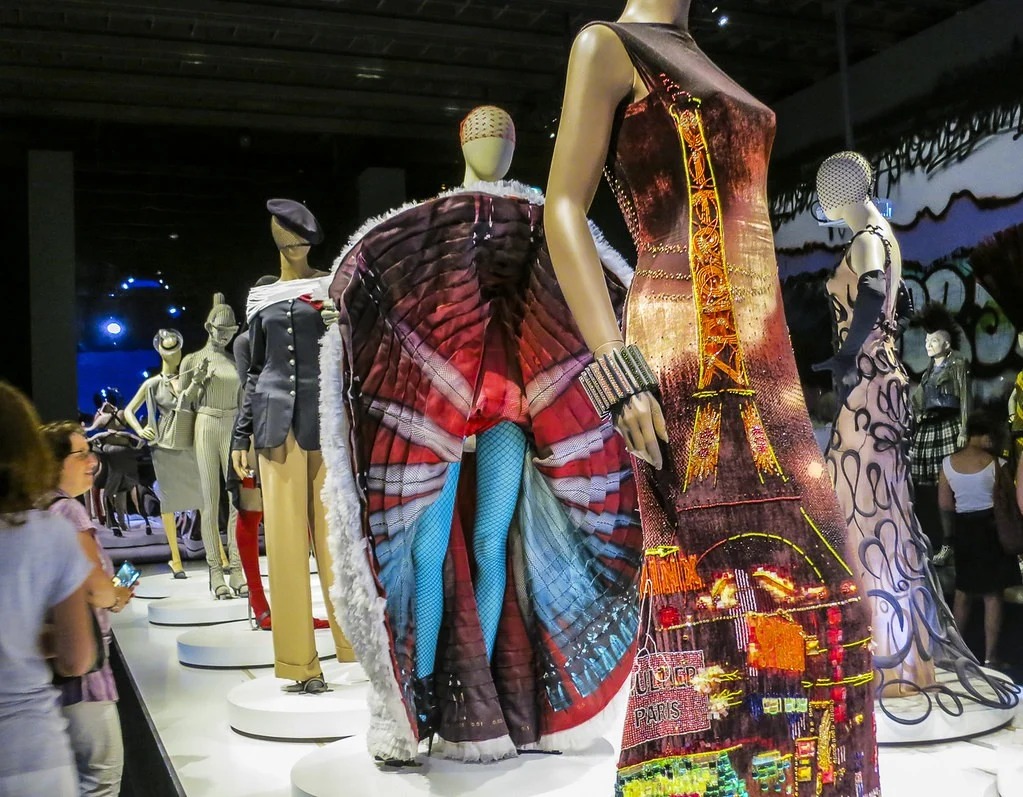
Sailor clothing provides another route through Jean Paul Gaultier house history. Horizontal sailor stripes make an ordinary knitted top immediately recognizable. On a runway, that familiar garment can move between workwear, popular entertainment and an idealized image of France. The effect comes partly from keeping its identity legible while changing the wearer or the rest of the outfit.
The menswear line, introduced in 1983, also questioned the conventional division of wardrobes. Skirted silhouettes placed beside tailored menswear make the distinction between the cut of a garment and the gender assigned to it easier to see. A pleated lower half changes how the legs appear and how cloth moves during walking. It does not erase the body underneath. These experiments were accompanied by casting that expanded the range of bodies and appearances represented on the catwalk. The clothes and the people presenting them were parts of the same public proposition.
Costume is a collaboration
Jean Paul Gaultier house history places stage costumes within a network of performers, choreographers, directors and makers. The Madonna collaboration matters because her performance gave the clothes a specific use, while their silhouette helped create her public image. Later work for performers including Kylie Minogue and Beyoncé continued that movement between fashion and entertainment. Film work offered another scale of viewing, from an entire screen to a close-up of a fastening or surface.
A costume must work through duration. The performer needs to move, the garment may need to change quickly, and its outline must remain intelligible under lighting. These requirements differ from the brief passage of a runway model. The corset and sailor stripes became repeatable signs, but their function changed with each context. The value of the collaboration is therefore not measured simply by identifying a famous garment; it lies in how a design participates in a performance made by many people.
The precision behind the spectacle
The couture line launched in 1997 adds another dimension to Jean Paul Gaultier house history. Made-to-measure work allowed elaborate surfaces and carefully controlled volumes, supported by the skills of specialist workshops. Spectacle does not remove the need for fitting. A dramatic outline still has to be supported, balanced and attached to the body, often through structures that a spectator cannot see.
His work for Hermès from 2004 to 2010 placed that experience inside a house with its own traditions of leather, equestrian equipment and discreet construction. The change of setting is useful for understanding his range. The same designer could work through a recognizable house vocabulary without repeating a concert costume. Conversely, stage costumes can use the precision associated with couture while serving an entirely different audience. Studying both activities helps prevent the familiar theatrical images from obscuring the quieter knowledge of tailoring and materials behind them.
The founder and a continuing house
The founder’s final couture show in 2020 did not end the label. Jean Paul Gaultier house history separates his personal collection-making from the guest-designer program that followed. In 2025 the owner Puig announced Duran Lantink as permanent creative director, with ready-to-wear and couture presentations planned for the subsequent seasons. That appointment identifies a new author working with an inherited vocabulary; it should not be confused with new clothes designed by the founder himself.
The lasting question is how an ordinary or intimate garment acquires a different public meaning. Underwear, a sailor top and a tailored suit each carry memories of other uses. Changing their proportions, wearer or setting makes those memories visible. The clothes are most rewarding when read alongside their construction and the people who wore them. This approach preserves the humor of the work while also recognizing the labor of workshops and collaborators that made the images possible.
Timeline
- 1952 — Born in Arcueil
- 1970 — Joined Pierre Cardin
- 1976 — First own womenswear collection
- 1983 — Menswear introduced
- 1990 — Madonna Blond Ambition collaboration
- 1997 — Couture line launched
- 2004–2010 — Designed for Hermès
- 2020 — Final couture show by the founder
- 2025 — Duran Lantink appointed to the continuing house
Sources
- NGV — The Fashion World of Jean Paul Gaultier
- FIT Fashion History Timeline — 1984 cone bra corset dress
- Puig — Duran Lantink appointment
Related reading
Fashion History · Pierre Cardin · Martin Margiela · Jean Patou · Designers