Jean Patou: Sport, Leisure and the Evening Wardrobe
Sport, Leisure and the Evening Wardrobe.
ÉPOPLI ·
A champion’s clothes enter fashion
Suzanne Lenglen’s tennis wardrobe offers a useful entrance into Jean Patou house history. A champion was not simply a mannequin carrying a new style: she needed to raise her arms, turn and run. A shorter skirt and an unencumbered upper body could therefore be judged through movement as well as appearance. The visibility of tennis made these practical decisions part of a larger public image.
This did not turn every customer into a competitive athlete. The clothes also suggested the leisure, confidence and social life associated with sport. The distinction between tennis clothing and a fashionable outfit inspired by tennis is important. Patou worked across that boundary, translating an active silhouette into a wardrobe for travel, resorts and town. His contribution lies in connecting those uses, rather than in the unsupported claim that one designer invented all sportswear.
Training, interruption and a family business
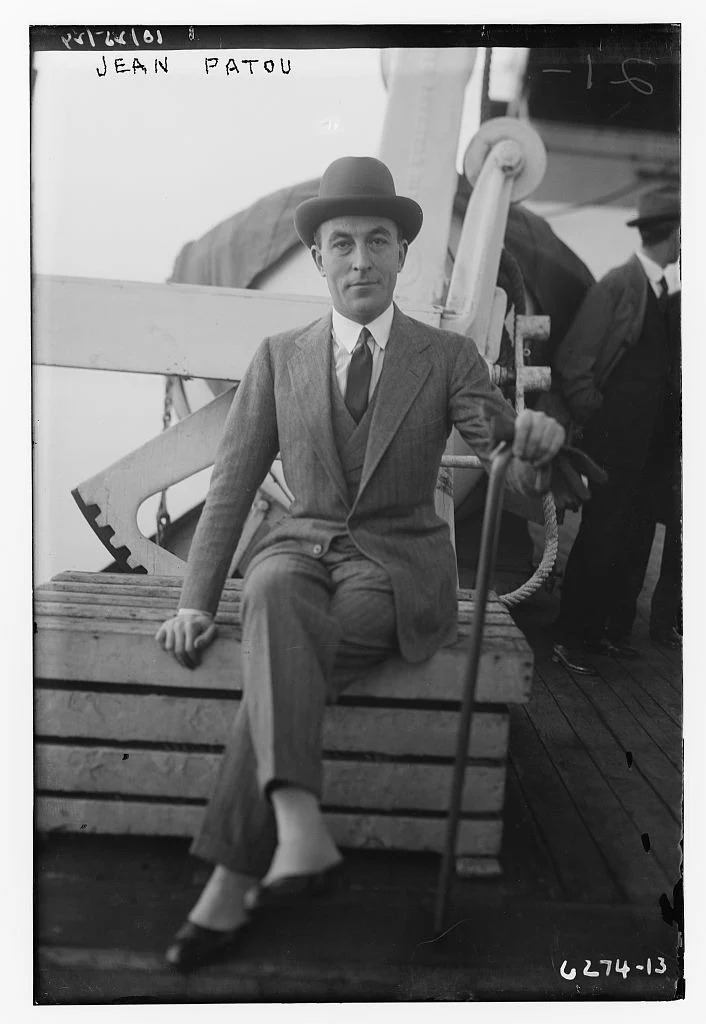
The house’s official biography and the Palais Galliera identify his birth year as 1887. Some older collection metadata gives a different year; this account follows those two biographical sources rather than silently combining incompatible records. Jean Patou house history begins with experience in the fur trade and the opening of his Paris house in 1914. War interrupted the new business before its later expansion.
On returning, he worked with members of his family, including his sister Madeleine and her husband Raymond Barbas. This was both a design practice and an organization. Preparing samples, managing orders and maintaining relations with clients required a structure beyond the founder’s personal style. His family’s work becomes especially significant after his death, when the house continued. The brief span of his own career should not be confused with the much longer life of the label, its perfumes or the collections of later artistic directors.

Pleats, knitwear and a sporting outline
The 1920s jersey ensembles described in the house archive combined a flexible material with geometric pattern. Jean Patou house history considers the relationship between the separate pieces: a cardigan or top could be coordinated with a skirt without making the entire outfit a single fixed dress. The wearer gained options for layering and for moving between indoor and outdoor settings.
Pleats in a skirt perform a different task from a printed motif. They hold extra width in a compact arrangement and open during a step, while a geometric surface directs the eye across the body. A sporting appearance can emerge from both operations, but they should not be mistaken for the same technique. The familiar image of a slim 1920s woman is also only one part of the story. The actual dimensions, fastening and material of an individual garment reveal more than a generalized period silhouette.
Clothing for places of leisure
Jean Patou house history follows the house beyond Paris to the resort wardrobes associated with Deauville, Cannes and Biarritz. Made-to-measure swimwear and bathrobes carried a JP monogram. The small sign joined a personal initial to a commercial identity, allowing a garment to communicate its origin without the maker standing beside it.
Resort clothes show how fashion organizes a day. A swimsuit, a covering robe and an outfit for lunch belong to different activities, yet can be sold as parts of one imagined way of living. That idea depended on customers with the time and resources to travel. It should not be presented as a universal account of women’s lives between the wars. Nor should the use of initials be described as the invention of monograms, which long predated this house. What matters here is the deliberate placement of a recognizable sign on contemporary leisure clothing.
Evening clothes within an active wardrobe
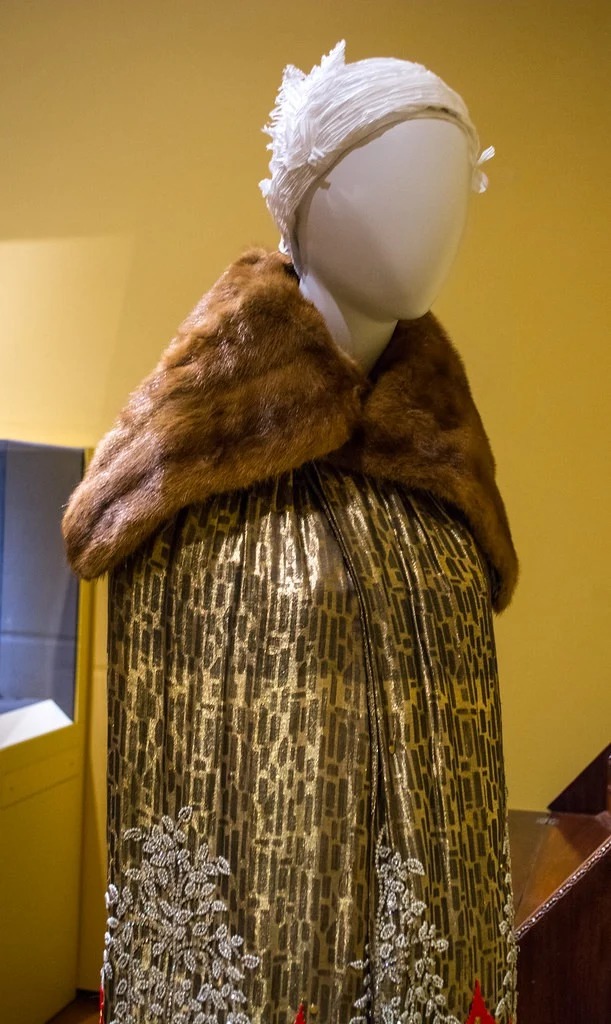
A 1926–28 evening dress in the Metropolitan Museum’s collection reminds us that the founder’s work was not limited to tennis clothing. Jean Patou house history includes garments intended to be read under artificial light and in social interiors. The collection record lists contrasting materials, including glass elements, which help distinguish its decorative surface from the supple knitted outfits associated with daytime activity.
The difference is not a contradiction. An affluent client could require different clothes for sport, dining and formal appearances. An evening dress may emphasize the long outline of the body while concentrating sparkle in its surface. Comparing it with jersey ensembles makes the changing role of material clear. A photograph of a famous wearer cannot by itself reveal the weight of embellishment or the internal construction; object records and close examination remain necessary. The wardrobe, rather than one supposedly defining garment, is the more productive unit of comparison.
A perfume during an economic crisis
The financial shock of 1929 affected the house. Jean Patou house history includes the launch of Joy in 1930, a fragrance promoted through an exceptionally luxurious positioning. The contemporary slogan about its price should be treated as marketing language rather than an independent measure of design quality. Perfume offered another way to circulate the house name beyond individually fitted clothes.
This expansion also separates authorship from branding. A fragrance is the result of perfumery, packaging, production and distribution, not a dressmaking technique transferred unchanged into a bottle. Likewise, the monogram links products without making them equivalent. When the founder died in 1936, his sister and brother-in-law continued the business. The later endurance of the perfume helped preserve public recognition of a name whose couture activity would pass through several other designers. A lasting brand can therefore survive through products different from those that established its original reputation.
A founder and the people who followed
Jean Patou house history distinguishes the founder’s garments from work by Marc Bohan, Karl Lagerfeld, Michel Goma, Angelo Tarlazzi and Christian Lacroix. Their different contributions cannot all be attributed to the man who died in 1936. The house’s later history records a further relaunch following the 2018 LVMH acquisition, with Guillaume Henry entrusted with ready-to-wear. This is a new chapter of stewardship, not the return of the original designer.
The archive’s lasting interest is the relationship between movement and social display. The tennis outfit, coordinated knitwear, resort robe and embellished evening dress answer different needs while proposing a connected life. Looking at who wore these clothes, where they were sold and how they were made gives greater precision than repeating claims of liberation. It also reveals the work of athletes, family members and specialist makers whose activities helped convert a designer’s ideas into a recognizable house.
Timeline
- 1887 — Birth year used by the house and Palais Galliera
- 1914 — Paris house established
- 1920s — Sport and resort wardrobes developed
- 1930 — Joy launched
- 1936 — Founder died
- 2018 — Later house acquired by LVMH
Sources
- Patou — House history and succession
- Palais Galliera — Fashion on the Move #3, 2025 (PDF)
- The Met — Evening dress, 1926–28
Related reading
Fashion History · Gabrielle “Coco” Chanel · Jean Paul Gaultier · Designers