Coco Chanel: Jersey, the Little Black Dress and Tweed
How knitted cloth, black dresses and the postwar suit changed the relationship between movement, making and a luxury house.
ÉPOPLI ·
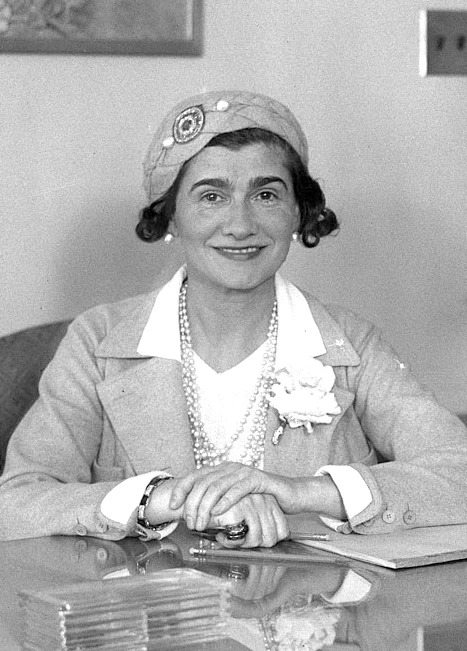
A question posed by a blouse in 1916
A sailor-style blouse from 1916 offers a concrete starting point for Coco Chanel and the history of Chanel. The example discussed by the V&A uses fine silk jersey, a broad collar, an open neckline and a loose waist tie. Its flat T-shaped construction falls around the body. Jersey fabric is knitted from loops, giving it a different flexibility from a firm woven cloth. The important question is not simply how little decoration appears. It is how the material, the shoulder line and the adjustable tie accommodate movement. A loose outline alone does not explain comfort: weight and construction matter too.
From Saumur to a millinery business
Coco Chanel and the history of Chanel began well before the existence of a large luxury house. Born Gabrielle Chanel in Saumur in 1883, she experienced poverty and a convent education, performed on stage and moved into millinery. These experiences should not be treated as automatic explanations for every later design. A black-and-white garment, for example, does not by itself prove that she was reproducing convent clothing. Her professional position developed through products, customers and financial support. Arthur “Boy” Capel helped finance her early business. The house chronology dates Chanel Modes at 21 rue Cambon to 1910. Jersey fabric sportswear followed at Deauville from 1913, a couture house opened in Biarritz in 1915, and she bought 31 rue Cambon in 1918. Shops, salons and workshops brought selling and making together. Moving from hats into clothing also meant responding to more of a customer's daily life.
Black dresses and a name beyond clothing
Coco Chanel and the history of Chanel reached an important public moment in 1926, when American Vogue compared a black dress to a Ford car. This was a comment on recognisability and versatility, not proof that couture prices were accessible to everyone. The little black dress was neither the invention of black clothing nor the work of one designer alone. Changing accessories and outerwear could adapt a dress to different occasions. Reading a little black dress therefore means looking at neckline, sleeve, length and surface as well as colour. Day and evening versions could use different materials and constructions. Another expansion had begun with N°5 in 1921. Perfumer Ernest Beaux supplied specialised knowledge; the perfume company established in 1924 involved a production and distribution structure distinct from the clothing atelier. A designer's name on a product does not mean that the designer made every part of it alone.

Textile makers by day, glitter after dark
British connections extended beyond anecdotes about borrowed menswear. Chanel worked with Linton on lighter, softer tweeds, opened a London salon and atelier in 1927, and established British Chanel Ltd in 1932. Understanding a tweed suit requires attention to textile producers as well as the designer. Moving cloth from outdoor use into city clothing involved adjusting its weight and feel.
Practical daywear does not describe the entire career. The sequinned trouser ensemble made for Diana Vreeland in 1937–38 combined a short bolero, wide straight trousers and a lace-and-chiffon blouse. The V&A's construction study examines small hand-sewn tucks and the direction of the sequins. A tuck is a stitched fold that gives a flat material a small degree of relief. Here, decoration depends on placement and density. Trousers allow movement while the surface catches light. Usefulness and visual drama can operate together.
War, closure and the return
Coco Chanel and the history of Chanel also include conduct that a design success story cannot explain away. The couture business closed in 1939 while perfume and some accessories remained on sale. TIME records her relationship with a German officer, Nazi collaboration and an attempt to use antisemitic laws against her Jewish perfume-business partners. This should not be reduced to a romantic anecdote.
The return on 5 February 1954 is a separate career event. The official chronology emphasises American approval, while the V&A describes mixed early press responses. An account of immediate universal acclaim would erase the difficulty of rebuilding a business and competing again. Postwar fashion included strongly shaped waists and voluminous skirts. Chanel offered another set of proportions and wearing qualities. Assessing the clothes and recording the designer's political and business conduct are compatible responsibilities.
The postwar suit and the moving body
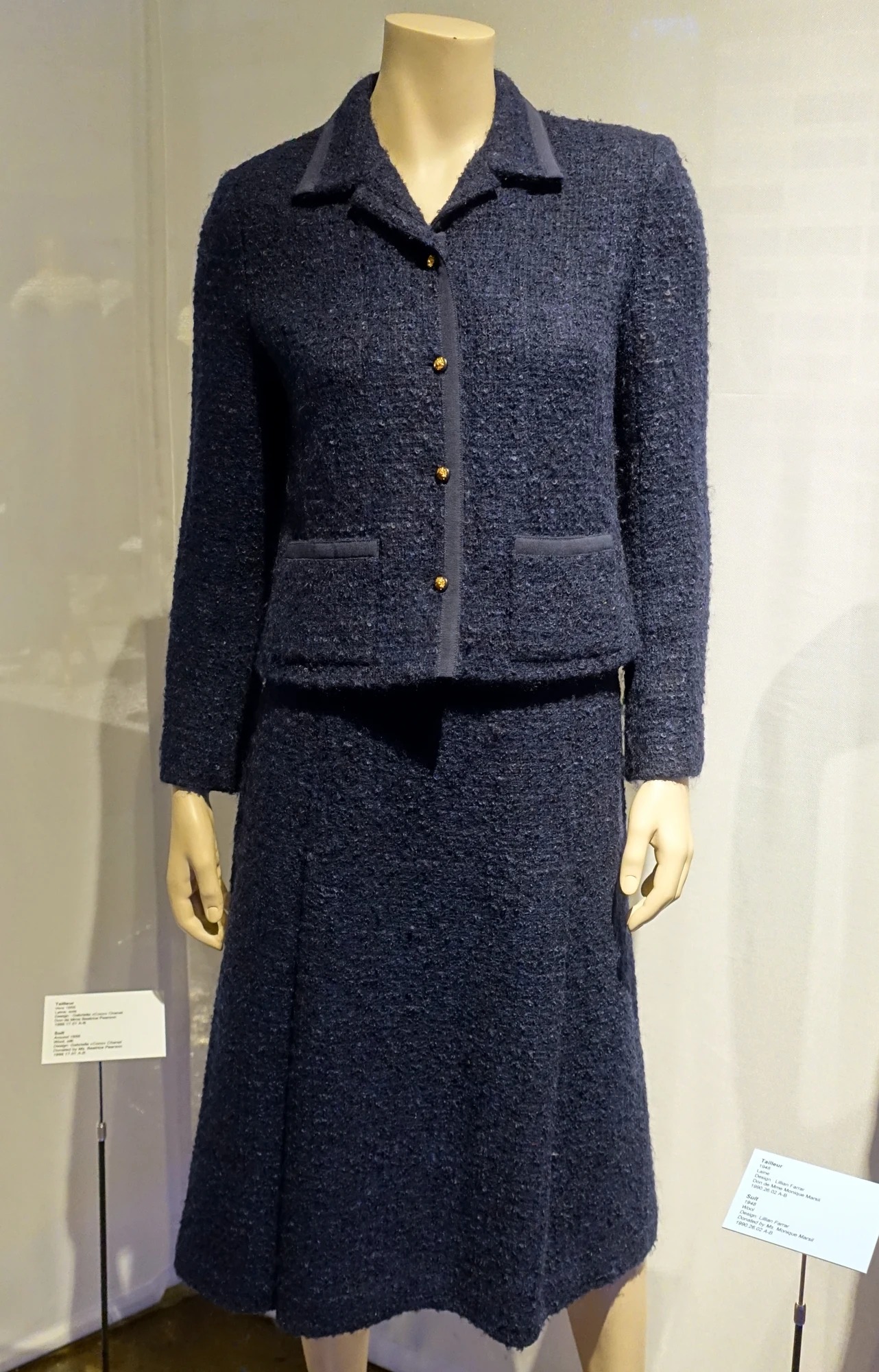
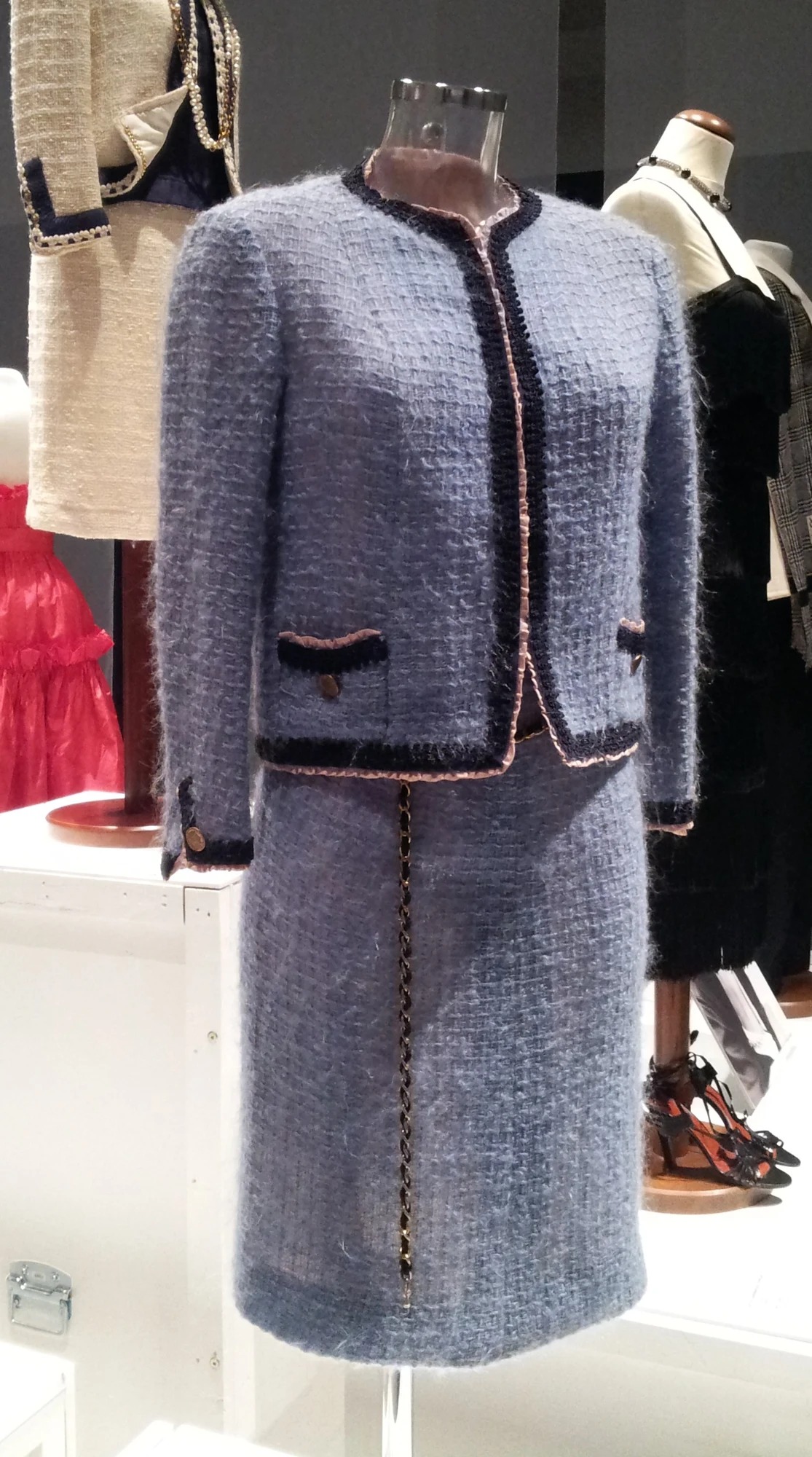
Coco Chanel and the history of Chanel repeatedly return to the postwar tweed suit. A matching jacket and skirt do not always produce the same garment. Collar, fastening, pockets and edging change how its outline is read. Lines around neck and wrist frame face and hands; a vertical front edge makes jacket length visible. These details allow variations within a familiar type. The pictured dark blue suit dated around 1955 has a small collar, front pockets and a straight skirt. In contrast, dark edging outlines the neckline, front and pockets of the purple suit dated around 1965. These exhibition photographs allow the construction and finish of two founder-era examples to be compared.
The V&A describes Chanel constructing clothes on the figure and asking models to move so that restrictions could be identified. A finished photograph rarely reveals that process of adjustment. The soft appearance of a tweed suit should therefore be understood alongside its exacting construction. Looking lightweight is not the same as being simple to make. Founder-era suits and later house collections may share recognisable features but belong to different dates and designers. Labels and collection records help preserve those distinctions.

The 2.55: designing how a bag is carried
Coco Chanel and the history of Chanel extend into the way accessories are carried. The 2.55 bag, introduced in 1955, takes its name from its launch date. A chain allows it to be worn over the shoulder, changing the relationship between an object and the hands. Beyond its appearance, the strap's line over a jacket, the arm's movement and the position against the body affect the complete outfit.
The 2.55 bag should not be used as a blanket name for every later quilted Chanel model. A design's introduction and the manufacture of an individual example are also different dates. A later reissue can refer to an original without being an object made in 1955. Museum records and house documentation are therefore more useful than a loose market nickname. Clothing, bags and jewellery form combinations within a wardrobe; a house's identity exists in these relationships as well as in its logo.
After 1971: a founder and a continuing house
Coco Chanel and the history of Chanel do not end at the same point. The founder died in Paris on 10 January 1971. The house continued, and Karl Lagerfeld became artistic director in 1983. His reinterpretations of earlier materials and forms belong to a separate design career. Calling every later collection Coco's work would obscure who actually produced it.
One way to read this legacy is to compare the early sailor blouse with the postwar suit. Their outlines differ, but each addresses movement through its own structure. Black dresses raise questions of restrained colour and varied materials; evening trousers combine activity with ornament; the shoulder bag addresses carrying. These are specific problems of construction and use rather than a single slogan. Distinguishing what was retained from what changed also makes the contribution of successive makers easier to understand.

Timeline
- 1883 — Born in Saumur
- 1910 — Chanel Modes opens
- 1915 — Biarritz couture house opens
- 1921 — N°5 launches
- 1939 — Couture business closes
- 1954 — Return collection on 5 February
- 1955 — 2.55 handbag launches
- 1971 — Dies on 10 January
- 1983 — Lagerfeld joins the house after the founder’s death
Sources
- V&A: What makes CHANEL so iconic?
- The Met: Gabrielle Chanel and the House of Chanel
- CHANEL: 1910s chronology
- V&A: Gabrielle Chanel in Britain
- CHANEL: 1920s chronology
- V&A: Diana Vreeland’s sequin trouser suit
- TIME: How Poverty Shaped Coco Chanel
- CHANEL: 1950s chronology
- V&A: Dressing the modern woman
- Palais Galliera: Fashion Manifesto exhibition dossier (PDF)
- CHANEL: 1970s chronology
- CHANEL: Karl Lagerfeld’s arrival in 1983
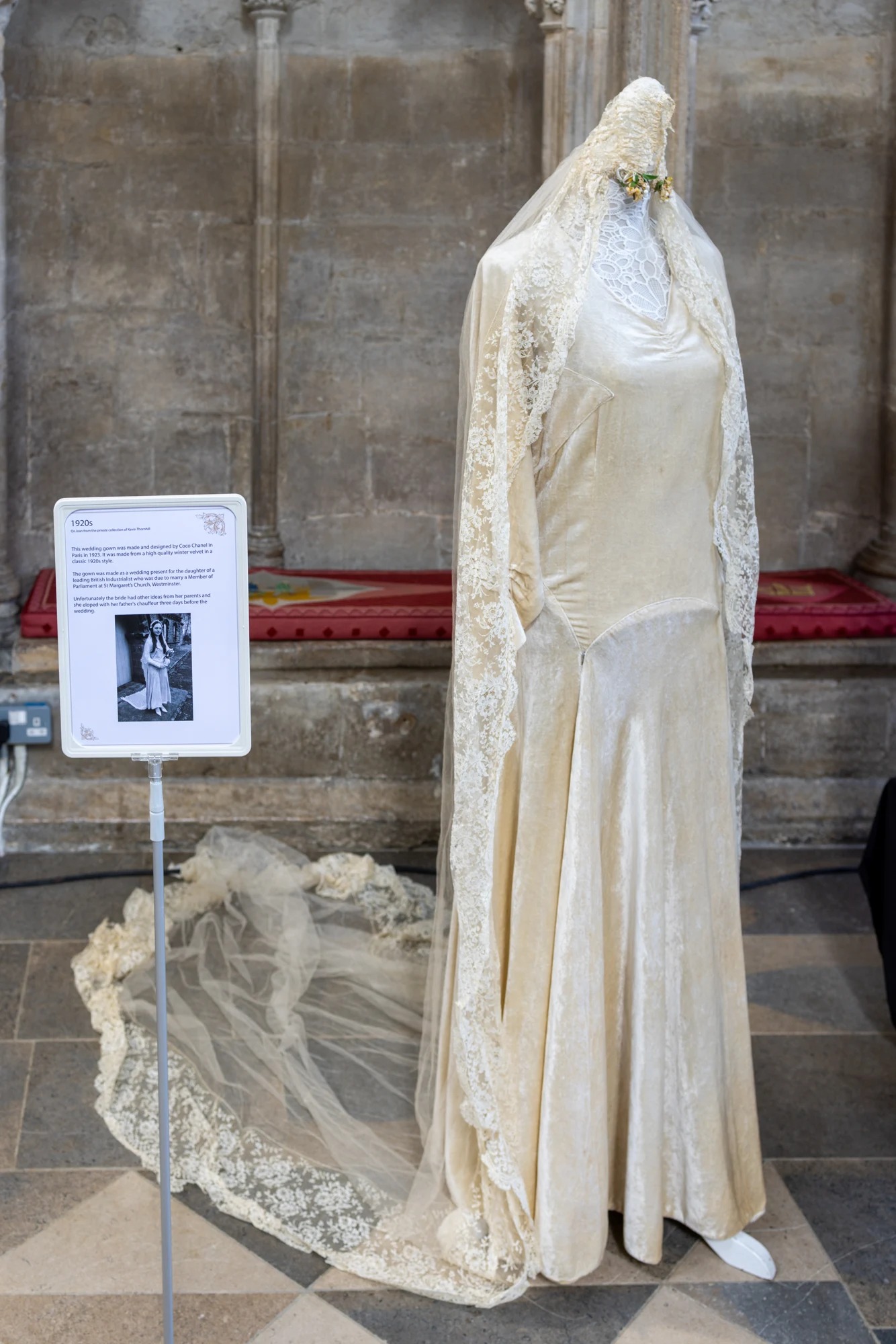
- Coco Chanel, velvet wedding dress, 1923. Kevin Thornhill collection, photographed at Ely Cathedral in 2024.
- Coco Chanel, wool and silk suit, circa 1955. Musée de la mode, Montréal; photographed in 2016.
- Chanel, purple mohair tweed suit, circa 1965. Photographed at Kumu Kunstimuuseum in 2012.
Related reading
Charles Frederick Worth: The House Behind Haute Couture · Christian Dior: The New Look and the 1947 Bar Suit · Yves Saint Laurent: Le Smoking and the Mondrian Dress · Kim Jones: Dior Menswear, Tailoring and Collaboration · 1920s fashion · Designers