Ann Demeulemeester: Strength beside fragility
Strength beside fragility.
ÉPOPLI ·
A shirt dress held by a corset
In an autumn/winter 2009–10 ensemble preserved by MoMu, a flowing white shirt dress meets a rigid black corset. Some straps secure the upper part; others hang below it. Ann Demeulemeester brand history becomes easier to understand through this specific opposition. One material falls while another holds, and the silhouette is produced by the encounter rather than by either part alone.
The outfit also complicates the idea that black-and-white clothing must be minimal. There is little colour, but considerable information in the edges, loose ends and changes of volume. The eye moves between a stable centre and parts that can respond to walking. The garment's restraint is therefore a matter of palette, not an absence of construction or detail.
An Antwerp education and a shared label
Born in Kortrijk in 1959, the designer graduated from Antwerp's Royal Academy fashion department in 1981. She established her label with photographer and creative partner Patrick Robyn in 1985. Ann Demeulemeester brand history includes this sustained collaboration from the outset. A photographer's contribution concerns the way clothes are seen and remembered as well as the production of an individual publicity image.
She became associated with the Antwerp Six, a group whose international visibility did not erase the differences between their practices. In her own work, closely considered tailoring coexists with an apparently relaxed arrangement. A hanging strap or displaced edge can make an outfit look as if it is still being adjusted. That effect depends on where the structure is fixed and where the wearer is allowed to complete it.
When a heavy material becomes supple
MoMu dates the first use of leather in her work to 1993. An autumn/winter 1999–2000 dress shows the material arranged in supple folds, whereas the later corset uses it to establish rigidity. This comparison is central to Ann Demeulemeester brand history. A material does not carry one permanent character; its weight, treatment and construction determine whether it drapes, grips or projects.
In looking at the dress, attention should move from the surface to the points that support it. A fold requires somewhere to begin and enough material to continue. In the corset, by contrast, the outline appears more explicitly controlled. Both involve tailoring decisions. Describing one as strong and the other as vulnerable can be a useful reading, but it should follow observation of the garments rather than substitute for it.
Wearing an image by Jim Dine
The spring/summer 2000 collaboration with Jim Dine placed photographic imagery on rectangular pieces of cloth. A system of ribbons allowed those pieces to be draped and combined around the body. In Ann Demeulemeester brand history, the example makes the collaboration tangible: the image does not simply decorate a conventional finished T-shirt; its attachment and position help determine the outfit.
Because a rectangle can hang independently, its image may be interrupted by a fold or move away from the body. The ribbons are both functional supports and visible lines. This offers a precise way to understand the relationship between art and clothing. The collaboration changes the viewing conditions of an image. It asks what happens when something formerly faced from a stable position is carried, turned and partially concealed.
A garment for a statue
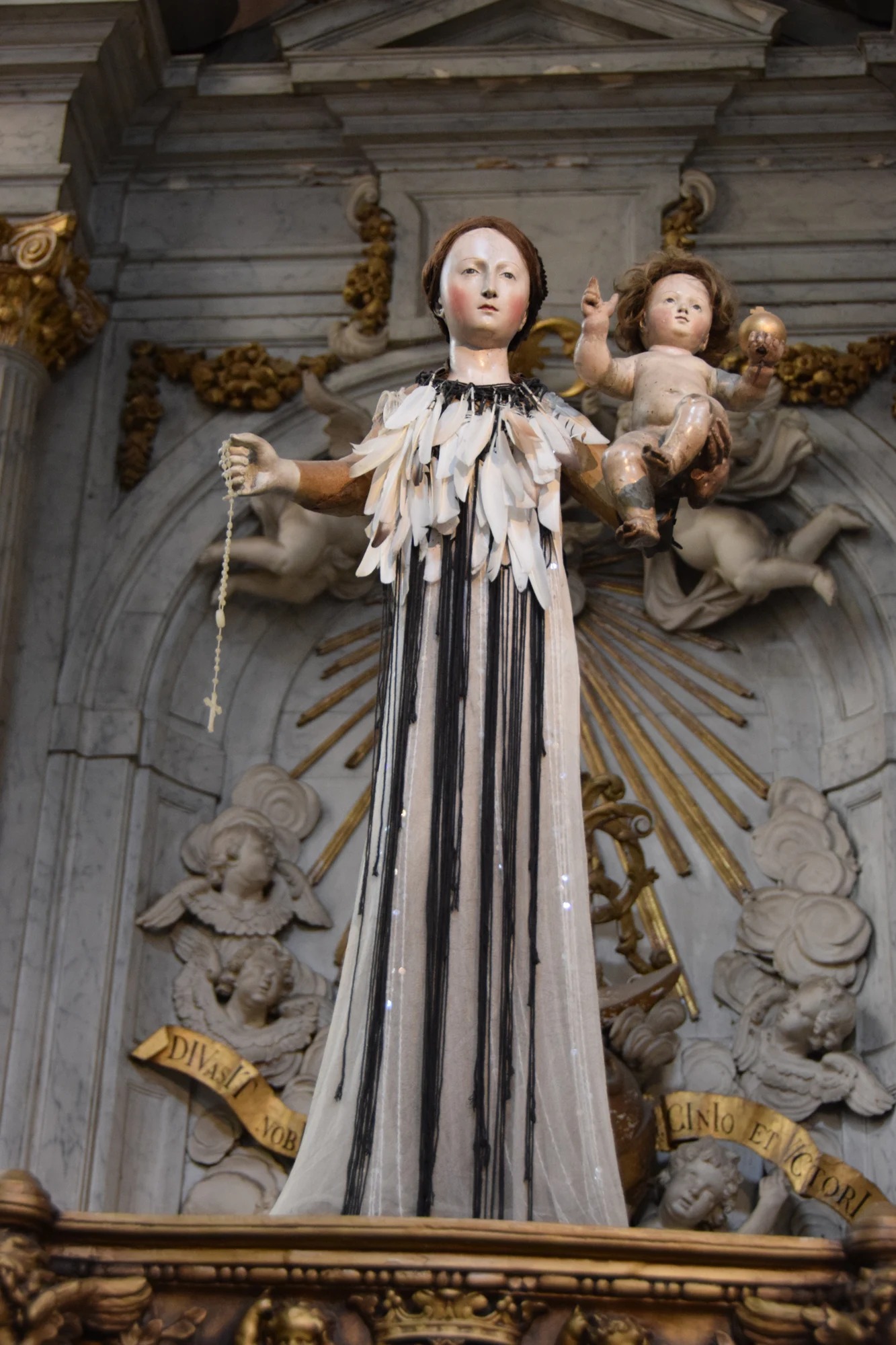
In 2001 the designer created a silk-and-feather garment for the Madonna statue in Antwerp's St Andrew's Church. MoMu's account of the city's later fashion programme records that commission. It introduces a different kind of wearer into Ann Demeulemeester brand history: a fixed religious figure with an existing history of dress and devotion. The photograph accompanying this article shows that commission, not a portrait of the designer.
Feathers give the surface a fine irregular edge and a different response to light from a continuous woven cloth. On a stationary figure, such detail becomes especially visible. This work cannot be understood only as a runway look removed from the runway. Its placement, the statue's established form and the church setting contribute to its meaning. Context changes what a material communicates even when its physical properties remain familiar.
Music, objects and a new medium
Patti Smith appeared in the autumn/winter 2006–07 presentation, making a long artistic relationship visible on the runway. Such exchanges connect clothing to a person's voice and public presence. Ann Demeulemeester brand history also extends beyond fashion: from 2019, work with Serax included porcelain, glassware and cutlery, followed by lighting and furniture. These are identifiable design projects rather than evidence that she returned to directing seasonal clothing collections.
The Dé tableware uses light and dark across curved porcelain surfaces. A darkened area can make an edge appear deeper or alter the apparent balance of a plate. This carries the investigation of contrast into an object held and used differently from a garment. The transition also requires different production knowledge: ceramic form, firing and surface treatment cannot be assumed to behave like cloth.
The setting of the Madonna’s dress
A dress placed on the Madonna at St Andrew’s Church functions differently from clothing on a moving model. Silk and feathers are seen in relation to a fixed pose and surrounding architecture, while long vertical lines draw the eye downward. Intervals of light and dark connect close detail with a distant outline. The dress was made in 2001 and this photograph taken in 2021. Separating those dates avoids mistaking later documentation for a new collection and shows how one work survives across different moments.
Founder and continuing house
MoMu records the designer's departure from the label in 2013; Serax's biography describes the withdrawal as 2014. These sources frame the transition differently, so Ann Demeulemeester brand history preserves the distinction instead of assigning every subsequent work to her. The fashion house's current official information identifies Stefano Gallici as creative director, appointed in 2023, and credits him with its autumn/winter 2026 campaign.
The founder's Serax projects and the house's current clothing thus belong to related but separate records. To look back at her own clothes, compare the 1999 dress, 2000 image-bearing panels and 2009 corset ensemble. Their handling of leather, loose attachments and light and dark shows a method based on relationships between materials. The archive becomes more informative when it follows those relationships through documented objects rather than treating a poetic mood as a complete explanation.
Timeline
- 1959 — Born in Kortrijk.
- 1981 — Graduates from the Antwerp Academy.
- 1985 — Establishes the label with Patrick Robyn.
- 2000 — Spring/summer collaboration with Jim Dine.
- 2001 — Creates a garment for the Madonna at St Andrew’s Church.
- 2013–2014 — Withdraws from the fashion label; sources date the transition differently.
- 2019 — Begins the Serax collaboration.
- 2022 — Furniture collection released with Serax.
Sources
- MoMu — Ann Demeulemeester collection story
- Serax — Ann Demeulemeester and collections
- MoMu — Our Lady of Fashion, historical commissions
- Ann Demeulemeester — autumn/winter 2026 campaign credits
- Museum Boijmans Van Beuningen — Table Blanche and designer record
- Image and object record — Madonna statue wearing Ann Demeulemeester’s 2001 silk-and-feather dress. St Andrew’s Church, Antwerp; photographed in 2021.

Related reading
Fashion History · Dries Van Noten · Martin Margiela · Designers