Dries Van Noten: Clothes in conversation
Clothes in conversation.
ÉPOPLI ·
Dinner becomes a runway
For the spring/summer 2005 presentation, guests dined at a long table before that table became the runway. The occasion marked the designer's fiftieth show. White blouses and generous skirts were followed by patterned and decorated looks. Dries Van Noten brand history can begin here because the event made the relationship between ordinary dressing and ceremony unusually tangible: clothes arrived on the surface around which people had just shared a meal.
The setting did not replace the garments. It altered their distance from the audience and made a blouse, a skirt or a decorated coat part of a social scene. What appeared simple at first could gain richness through combination. This is a useful way to approach the work: examine the relationship between pieces before isolating a single supposedly definitive motif.
A business learned through clothes
Born in Antwerp in 1958, the designer came from a family involved in clothing retail. He trained at the city's Royal Academy and worked independently before establishing his own business. The international breakthrough associated with the Antwerp Six came through the British Designer Show in 1986. In Dries Van Noten brand history, the group identifies a shared moment of visibility, not a single design style that all six members adopted.
His shop moved into Antwerp's Modepaleis in 1989. The company developed from this base while presenting collections internationally. Menswear and womenswear were closely connected: the spring/summer 1992 men's show ended with women's looks, and a dedicated women's show followed for spring/summer 1994. The exchange between wardrobes helps explain why formal tailoring and decorative surfaces can meet without becoming separate categories.
A surface built by several hands
An autumn/winter 1996–97 wrap skirt in MoMu's collection combines beads, sequins and silk threads. It is not simply a flat pattern printed on cloth. Its surface has different densities and reflects light unevenly. The example brings the work of specialist makers into Dries Van Noten brand history, particularly the relationships with Indian producers that developed after Christine Mathys introduced the designer to India in 1989.
Mathys also helped build the company's commercial activity until her death in 1999. The archive therefore needs to credit organization alongside making. The embroidery becomes meaningful in the completed outfit because it meets other textures and proportions. A decorated skirt under a more restrained upper layer is experienced differently from the same skirt surrounded by equally dense ornament. Arrangement is part of the design.
The garden as a staged environment
The spring/summer 2015 show placed the clothes on a moss-like carpet created by artist Alexandra Kehayoglou. Models sat on it at the finale. The setting and the collection's references to a wooded, dreamlike landscape created another kind of gathering. Within Dries Van Noten brand history, this presentation shows how an artist's work can establish the ground on which clothes are read, without becoming a pattern printed directly onto them.
The viewer can compare the carpet's irregular surface with the lightness of the garments above it. The invitation to sit also changes the final image: figures are no longer only passing in a line. The show suggests leisure and community through arrangement, but the actual labour of producing the carpet and clothes remains specific. Its atmosphere was constructed by collaborators, not discovered as a ready-made landscape.
A conversation with Christian Lacroix
For spring/summer 2020, Christian Lacroix collaborated on the collection. The encounter is important to Dries Van Noten brand history because it brought two established design vocabularies into direct conversation. MoMu preserves works attributed to both designers. Shared authorship should remain visible rather than being absorbed into the name printed on the show's programme.
One can read this collaboration through combinations: a structured jacket against a more expansive decorated element, or a controlled line alongside a bright floral passage. Such combinations depend on proportion and spacing as much as abundance. The prints are not interchangeable decoration. Their size, placement and relationship to the cut decide which part of the outfit holds the eye. This is also why translating a runway look into separate items changes the balance.
The method behind the variety
MoMu describes a process that begins with the development of prints, followed by silhouettes and decorative work. In Dries Van Noten brand history, this order prevents a misleading division between serious cut and secondary ornament. The surface can help generate the garment from the outset. A motif may need a wide uninterrupted area, while another can tolerate a fold or the interruption of a seam.
The museum's 2006–07 jacket, with pomegranate motifs and gold embroidery, offers a concrete comparison with the earlier wrap skirt. The jacket gives a decorated surface a different structural support. Across such works, colour contrasts connect pale and saturated passages, while differences in cost and texture bring ordinary and precious materials together. The result depends on decisions about adjacency rather than on a rule that everything must match.
Density in the 2008 coat
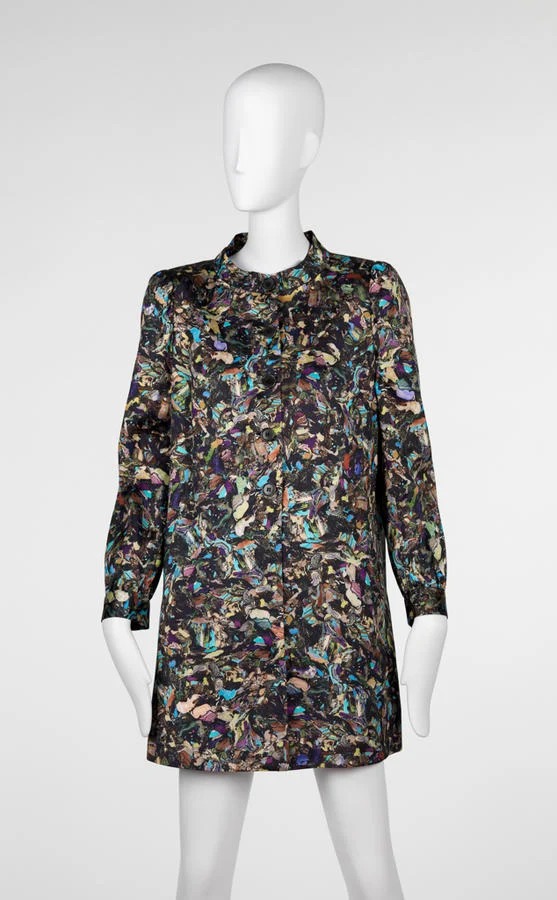
The RISD Museum’s autumn 2008 coat uses Orbis-patterned silk made by Jakob Schlaepfer. Dense colours and lines sit within a comparatively clear, short coat outline. The relative simplicity of the shape makes the density of its surface more legible. Where sleeve and body meet, a flat pattern changes direction with the three-dimensional garment. The example also explains why the textile producer deserves a separate credit: the name attached to the finished coat and the maker of its cloth are different pieces of information.
Leaving the runway, opening a foundation
The founder presented his final collection in June 2024. Julian Klausner subsequently took responsibility for the brand's creative direction. The official biography, checked in October 2026, also records the opening of Fondazione Dries Van Noten in Venice in April 2026. Dries Van Noten brand history now includes two distinct continuations: the company under new design leadership and the founder's cultural work with craftsmanship.
The foundation's first presentation, The Only True Protest Is Beauty, extends an interest in objects made through skill and material intelligence. It should not be confused with a new seasonal collection by the founder. To revisit his clothes, follow the changing balance between texture, volume and colour contrasts. The 1996 skirt, 2005 table show, 2015 carpet and 2020 collaboration demonstrate several ways of creating that balance without requiring a single permanent formula.
Timeline
- 1958 — Born in Antwerp.
- 1986 — Shows in London with the designers known as the Antwerp Six.
- 1989 — Moves the Antwerp shop to Modepaleis.
- 2005 — Fiftieth show, for spring/summer 2005.
- 2015 — Spring/summer collection with Alexandra Kehayoglou carpet.
- 2020 — Spring/summer collaboration with Christian Lacroix.
- 2024 — Presents his final collection in June.
- 2026 — Opens Fondazione Dries Van Noten in Venice.
Sources
- MoMu — Dries Van Noten collection story
- Dries Van Noten — official biography and house timeline
- Vogue — spring/summer 2015, contemporary review
- MoMu — Inspirations exhibition
- Image and object record — Dries Van Noten, Orbis-printed silk coat, autumn 2008. Fabric by Jakob Schlaepfer; RISD Museum.

Related reading
Fashion History · Christian Lacroix · Ann Demeulemeester · Designers