Madame Grès: Form Built from Fine Pleats
Silk jersey, fine pleats and the structure beneath the surface.
ÉPOPLI ·
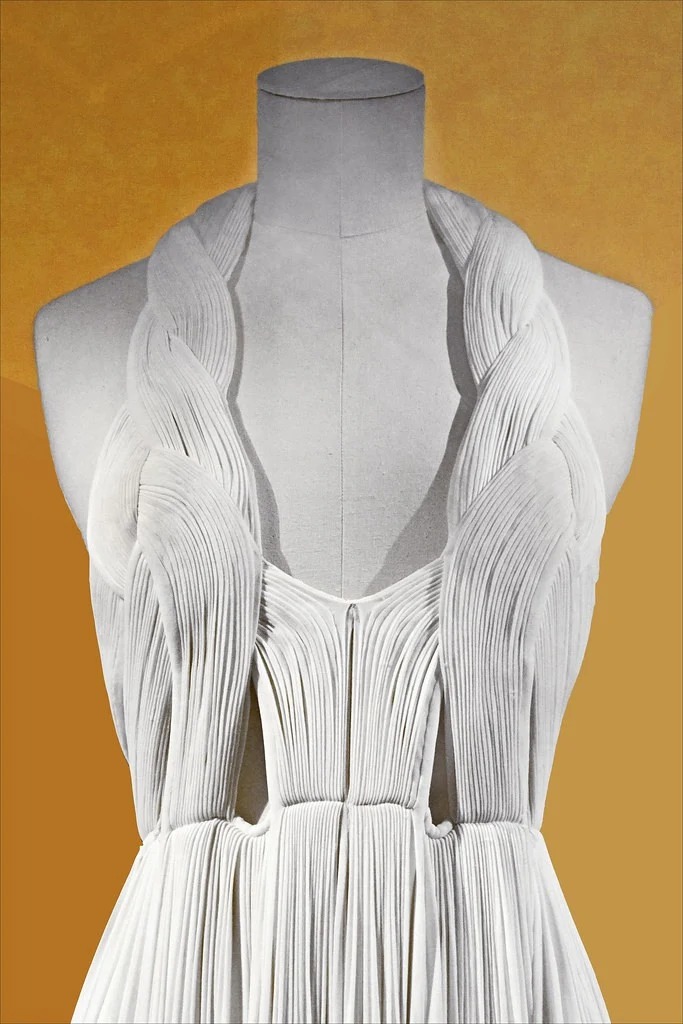
What a white dress alone doesn't show
The ivory and blue evening dress of 1950–51 may seem like a repetition of a classic style. However, reading Madame Grès house history from the movement of the cloth reveals changes that are different from the fixed image. The looped construction of silk jersey allows the fabric to stretch and fall smoothly. The part that surrounds the body and the part that falls down play different roles even if they are made of the same material.
The FIT Museum refutes the common belief that Grès dresses have remained the same for decades. The location of the folds, the area of the body exposed, and the direction of the side lines continued to change. Just because a piece of clothing is reminiscent of ancient sculpture does not mean it is an exact replica of ancient clothing. The first condition is that it is custom-made clothing made for modern customers to wear and move around with. The starting point for reading this clothing is to look at where the weight of the fabric is rather than praising it for being timeless.
From Alix Barton to Grès
Born Germaine Krebs in 1903, she opened Alix Barton with Julie Barton in 1933, and the following year the house operated under the name Alix. In Madame Grès house history, it is necessary to distinguish between the joint business of this period and the later name Grès. A change in name does not mean that the entire work is discontinued, but checking the label and year can help narrow down the production period more accurately.
The name Grès, used since 1942, has become the most widely known name today. Her stated wish to become a sculptor is an important clue in explaining the production, but it is not a basis for arbitrarily adding formal sculptural education or experience in a specific studio. Proficiency in sewing and fitting must be confirmed from the remaining clothes. It is also important to record the existence of Julie Barton and the early workshop. Placing one famous designer at the center should not erase the people who together created the foundation of independence and business.
Small folds that gather cloth
Within Madame Grès house history, the use of fine pleats is a method that gathers wide fabric into narrow sections by repeating small intervals. The difference between the tightly fastened top and the freely loose skirt creates the silhouette. Unlike the method of adding decorative straps, the material of the clothing itself forms both the surface and the structure. When silk jersey gently receives light, folds appear as continuous shadows rather than clear lines.
World War II's textile restrictions also affected work that used large amounts of fabric. As the supply of materials changed after the war, the use of fine pleats expanded again. This change shows that not all forms are determined solely by the will of the creator. Supply and demand, working hours, and the purpose requested by customers work together to create clothes. There is also the same reason why the interval between folds should be examined for each piece rather than being generalized as a single number. Small differences change the way the body is covered and how far it moves, and the sewing work that maintains this is hidden behind the finished surface.
Different volumes from firmer cloth
Madame Grès house history includes soft classic dresses, taffeta coats and clothes with large sleeves. If the choice of material to create a three-dimensional structure varies, the results will also vary. Thin, stiff taffeta keeps its folded shape relatively clear, while heavy fabric creates a large volume around the body. The expression sculptural acquires a specific meaning when describing the reaction of these materials.
The Turandot evening dress introduced by FIT creates a graduated outline by overlapping three circles of different sizes. The basic shape of the pattern is simple, but when worn, the fabric folds and settles to create a complex surface. Dresses with full sleeves also actively utilize the empty space between the body and clothes. It should not be assumed that all works contain the same internal supports. Some clothes rely on the strength and folds of the material, while others use hidden fasteners. Only by examining the actual inside can you find out how to support the exterior.
Flat cloth and trouser ensembles
The work following the 1958–59 trip to India is discussed in connection with the construction methods of various attires, including the sari. In Madame Grès house history, regional influences are not explained solely by patterns or exotic names. It is important to find a way to wear the rectangular and circular fabric while preserving it on the body. Sari, kaftan and kimono have different histories and ways of wearing and should not be grouped into one tradition.
Later trouser ensembles suggested a looseness that could be worn in different situations than evening wear. There are also works combined with miniskirts and short pants, which is different from the impression that only long dresses were always made. The experience of handling three-dimensional structure with precision is not lost even in loose clothing. Although it looks like a large piece of cloth is lightly worn on the outside, the interior finishing and fixing are adjusted to suit the customer's body. Through the work of this period, we can see that classical images and contemporary trends coexisted within one career.
Workshop time and surviving drawings
If you read Madame Grès house history only as a finished product, you will not see the time of repeated fitting and hand sewing. The task of fitting and securing a garment to the body required the skills of cutting and sewing personnel. Designer's drawings and production sketches also have different purposes. The thousands of drawings held at the Galliera show the breadth of this work, which spanned from the 1930s to the 1980s.
By distinguishing between quickly drawn notes of thoughts and pictures organized so that others can read the production information, you can follow the process of turning creation into the language of the workshop. Although it is not possible to restore the thickness of the material or all seams from just one picture, missing clues can be made up by comparing it with the remaining clothing. Customer order and wearing records are also important data. Even if two dresses are similar in shape, their meaning changes depending on who wears them, when and for what purpose. This is why the workshop is not explained solely through one person’s mysterious intuition.
Finding change in repetition
Her long career lasted until the end of the 1980s, and she died in 1993. After her death, Madame Grès house history was reconsidered through museum research and collections assembled by other designers. The Azzedine Alaïa Foundation's collection is a resource for comparing clothing from different periods. In order to accurately record the author of a work, one must distinguish between products sold under the name Grès in later generations and custom-made clothing made during her lifetime.
The silk jersey dress, the tiered Turandot form and later trouser ensembles are not replicas of one style. There are different answers as to how the fabric is collected and where it is released. If you refer to this work today, it is more useful to look at the relationship between the material and the body rather than the appearance of the folds. The space left when moving, the points that support the body, and the finishes that are not visible on the outside must be read together. When viewed in that way, the evaluation of a classic as a classic does not mean that there have been no changes, but rather that repeated questions have been newly solved over a long period of time.
Timeline
- 1903 — Born
- 1933 — Co-founded Alix Barton
- 1934 — House operated as Alix
- 1942 — Adopted the name Grès
- 1958–59 — Travelled to India; explored further construction methods
- 1993 — Died
Sources
- FIT — The Grecian gown
- FIT — Sculpting with fabric
- FIT — Regional construction influences
- Fondation Azzedine Alaïa — Madame Grès
- FIT — Evening dress, 1950–1951
- FIT — Grès, Chic Chicago
- Palais Galliera — Madame Grès drawings
Related reading
Fashion History · Madeleine Vionnet · Azzedine Alaïa · Designers