Karl Lagerfeld — Rewriting the House Codes
From a Chloé shower dress to Chanel’s stage: revising the signs of a house.
ÉPOPLI ·

Making an inherited language current
Karl Lagerfeld Chanel history begins with a question about revision rather than faithful copying. His work for the house from 1983 retained recognizable signs while changing their proportions and combinations. A chain, pearl or tweed jacket was not a complete answer: length, scale and styling determined how it would be read.
An inherited fabric could suggest formal respectability or everyday movement. This was a method of adjusting use, not simply preserving an original shape. Gabrielle Chanel’s earlier work and the continuing production team must remain visible in that account.
An education across working houses
Karl Lagerfeld Chanel history also requires the decades before Chanel. Born in Hamburg in 1933, he moved into the Paris fashion world, won the coat category of the 1954 International Wool Secretariat competition and joined Pierre Balmain in 1955. Work for Jean Patou and Chloé followed.
These different environments supplied practical knowledge of customers, production and the movement from drawing to garment. Sources count some early appointments differently, so an uncertain contract period should not become a confident title. His own label, established in 1984, was a separate enterprise from the houses that employed him.
A shower drawn across the body
Karl Lagerfeld Chanel history can be compared with the Buée dress made for Chloé in autumn/winter 1983–84. An embroidered shower and water descend across the garment, while a hose curves around the body. The term trompe l’oeil describes an illusion that makes a surface resemble something it is not.
Here a bathroom object enters evening dress. Follow the curved hose against the vertical water: decoration directs the eye through the silhouette. This trompe l’oeil is therefore more than a joke applied after construction.
The dress belongs to Chloé, and retaining that attribution helps distinguish a recurring interest from a single house identity.
Fendi and material knowledge
Karl Lagerfeld Chanel history runs alongside a separate collaboration with the Fendi sisters, begun in 1965. He was a designer entering an established family company, not its founder. Treating fur as a lighter and more varied surface depended on material preparation and the expertise of specialist makers.
A drawing could not settle weight, flexibility or finishing by itself. Official accounts describe the technical ambition, but promotional claims and observable properties deserve separate treatment. The ethical debate around fur is another question, not something that a claim of technical novelty resolves.
Different houses supplied different resources and purposes for his work.
From a sketch to a garment
Karl Lagerfeld Chanel history becomes incomplete when the designer’s idea replaces the work of the production team. A sketch still required decisions about thickness, placement and movement. A tweed is an interlaced material, not just the pattern visible in a photograph.
Embroidery and flower makers, cutters and sewing teams helped determine the finished result. The Metropolitan Museum’s exhibition examined the relationship between drawings and garments. That comparison invites close looking, but resemblance does not prove that every construction problem was settled in advance.
Inspecting the inside as well as the surface restores the process hidden by the final image.

A supermarket inside the Grand Palais
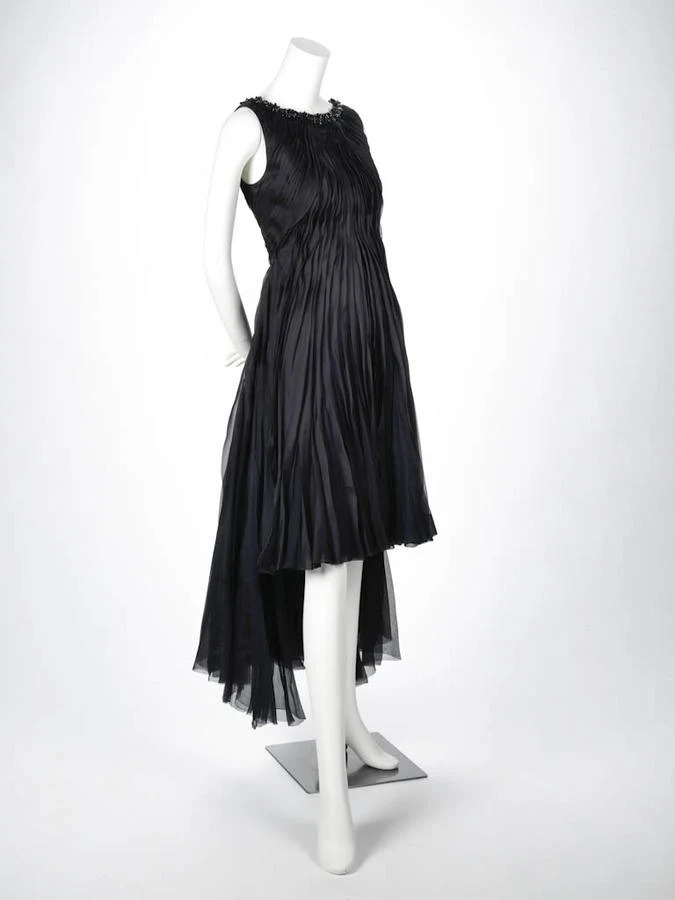
Karl Lagerfeld Chanel history includes the autumn/winter 2014 supermarket show, which placed clothes inside an elaborate image of everyday consumption. Shelves, packages and models’ movements influenced the pace at which the audience encountered the collection. Pairing tweed with trainers suggested an encounter between a house tradition and ordinary activity.
Yet a memorable setting is not proof of successful clothing. Looking again at jacket lengths, trouser proportions and bag sizes, without the scenery, helps separate garment design from theatrical memory. The scene can be read as an extension of daily life or an exaggeration of consumption; those interpretations need not agree.

Separating the work from its afterlife
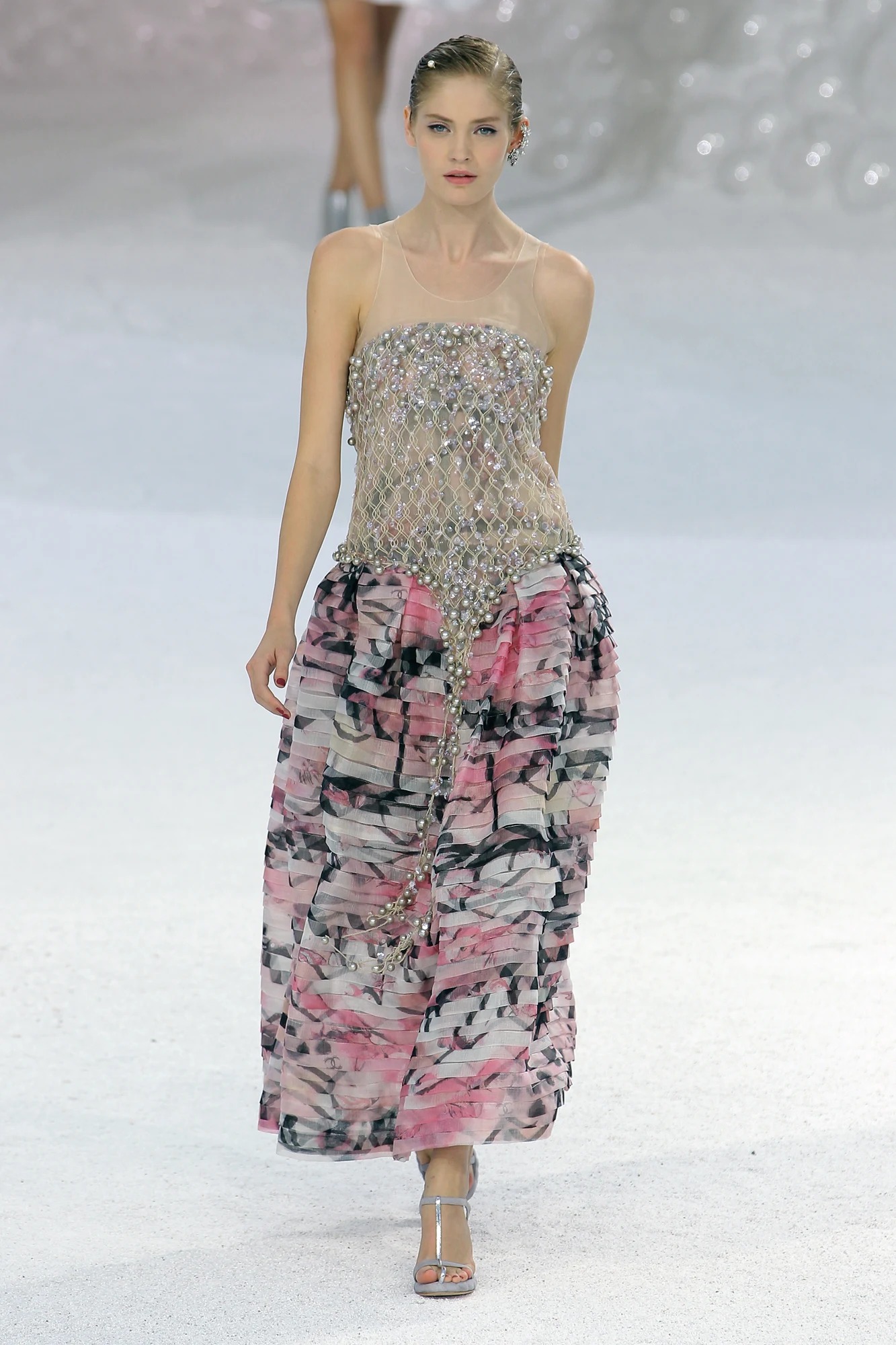
Karl Lagerfeld Chanel history reaches a clear boundary with his death on 19 February 2019. Chanel, Fendi and his own label followed separate organizational paths afterward; new products are not automatically his designs. Nor should his familiar personal uniform replace analysis of the clothes.
Ask which house commissioned a work, when it was made and what its material does. The Chloé shower dress, a Chanel presentation and Fendi’s material experiments belong to one career without sharing an identical purpose. His influence lies partly in making an inherited vocabulary available for repeated change, supported by the makers who turned those revisions into wearable forms.
Timeline
- 1933 — Born in Hamburg
- 1954 — Wins a coat design competition
- 1965 — Begins working with Fendi
- 1983 — Presents collections for Chanel
- 1984 — Establishes his own label
- 2019 — Dies on 19 February
Sources
- The Met — Karl Lagerfeld: A Line of Beauty, visiting guide
- KARL LAGERFELD — The Real Karl
- Vogue — Shopping for vintage Karl Lagerfeld
- The Met — Chloé, Buée, 1983–84
- Fendi — Fur atelier
- Vogue — Chanel Fall 2014 ready-to-wear
- TIME — Karl Lagerfeld obituary