Louis Vuitton Speedy history
Explore Louis Vuitton Speedy history from the 1930 Express to flexible Monogram canvas, Audrey Hepburn and the 2011 Bandoulière, tracing changes in daily carrying.
A name for faster movement
Louis Vuitton Speedy history begins with the Express in 1930. The house associates Gaston-Louis Vuitton’s design with an era fascinated by speed. A compact bag that could fold represented a different relationship to travel from a rigid trunk. Its name made that association explicit. The significant change was not merely a reduction in size, but a shift towards something a traveller could carry close to the body.
From travel form to daily bag
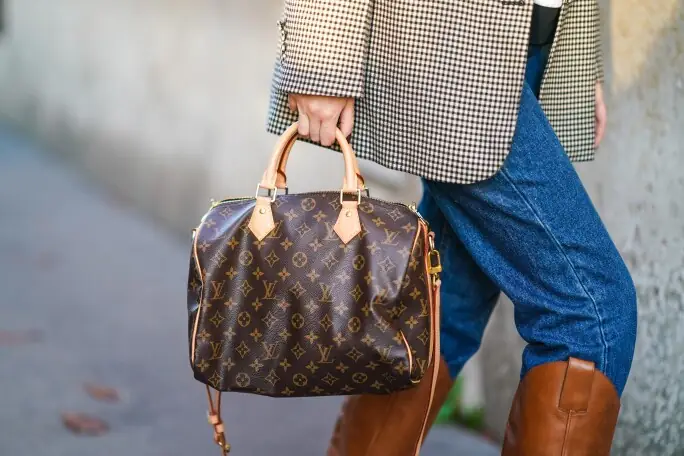
The rounded upper outline, broad base and two short handles organise the bag as a small volume. An opening along the top separates access to its contents from the act of carrying it. This is not simply a trunk scaled down. A flexible body and economical handle arrangement create a different kind of object, retaining a travel association while fitting into a daily wardrobe.
Flexible canvas and Monogram
The official chronology dates the Speedy’s transformation into a Monogram handbag to 1959. It also describes a coating process that made canvas more flexible. Monogram canvas therefore belongs to a history of material behaviour as well as recognisable pattern. Some later retail histories give a different adoption date; this article follows the house chronology. The creation of the pattern and its application to this bag are separate events.
Audrey Hepburn and a smaller format
Audrey Hepburn is part of the bag’s documented public image. The house mentions her adoption of it, while Sotheby’s links the smaller 25-centimetre format to a request from her in 1965. That more specific anecdote is attributed to the auction house. Beyond the anecdote, scale matters: reducing a familiar body changes its proportion against the wearer and moves its visual emphasis towards personal, everyday carrying.
A different way to carry, in 2011
The Speedy Bandoulière introduced another change in 2011. Contemporary coverage describes a dedicated shoulder strap rather than an accessory clipped to existing handles. Side reinforcements and attachment points gave the side panels a different task. The familiar front outline could remain while the relationship between load and body changed. A shoulder strap is thus a construction decision, not simply a styling addition.
A persistent structure beneath changing surfaces
Louis Vuitton Speedy history continues through differences in size, material and surface. Monogram canvas is one important expression, not the entire definition. A recognisable structure allows new treatments to be read against something familiar. The Express origin, flexible material, smaller format and dedicated carrying attachments address different problems. Together they show how the language of travel persisted inside an increasingly versatile everyday bag.
Timeline
- 1930
- The design began as the Express.
- 1959
- The official chronology records its transformation into a Monogram handbag.
- 2011
- The Bandoulière introduced dedicated shoulder-carrying attachments.