Louis Vuitton Alma history
Louis Vuitton Alma history separates the 1934 predecessor from the 1992 name and 2010 BB, exploring domed shape, surface treatments and changing ways of carrying.
A shape older than its present name
Louis Vuitton Alma history requires more than a single launch date. The official chronology identifies a Squire bag in 1934, followed by design changes and names including Champs-Élysées and Marceau, before Alma in 1992. The first date belongs to a predecessor; the second establishes the familiar name. Keeping them separate avoids suggesting that one unchanged object has remained in production throughout. Product history includes the life of a shape and the life of its naming, and those timelines do not always begin together.
The balance of dome and base
Seen from the front, the rounded top meets a horizontal base. This domed form is echoed by the two handles, while the lower band gives the body visual stability. The house relates the lines to Art Deco. The useful observation is the meeting of geometric surfaces and curves, rather than an unsupported claim that the bag copies a particular building. Its outline is economical: a few strong boundaries establish an object that can remain recognisable when its colour or surface changes.
From travel goods to an everyday scale
Sotheby’s places the predecessor within a movement from travel equipment towards a compact handbag for daily use. The shift invites a comparison of scale: what works for carrying luggage is not identical to what accompanies a person through a city. The article also presents a Chanel commission story as fashion lore. That is different from an established entry in the house chronology. It is better to retain the documented model sequence than to let an appealing anecdote stand in for the evidence.
A surface can change the same outline
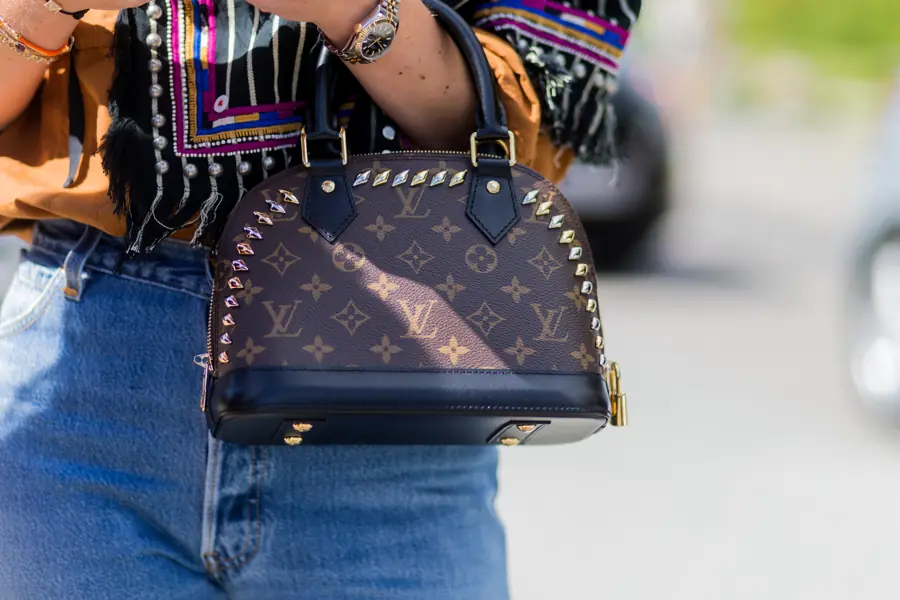
Monogram canvas adds a repeating pattern to the body, while textured Épi and glossy Vernis offer other ways for the shape to catch the eye. Sotheby’s also illustrates artistic variations associated with Stephen Sprouse and Takashi Murakami. The domed form holds the family together as surface treatments diverge. Looking at a patterned example beside plain leather separates two design roles: construction establishes the perimeter, while material controls colour, texture and reflection. Monogram canvas is therefore one expression of the model rather than its only possible identity.
The smaller format becomes a new chapter
The official timeline dates the Alma BB to 2010. A reduction in scale changes the proportion between handle and body and the position of the bag against the wearer. The detachable strap discussed by Sotheby’s introduces another way to carry the shape. Reading the Alma BB only as a miniature misses that relationship between dimension and movement. It is more useful to ask how the bag is held and where its volume sits. Size is not just a catalogue label; it can affect the everyday experience of a familiar design.
Using a recent photograph carefully
Louis Vuitton Alma history can be illustrated by a later model, provided its date and variant are not confused with the predecessor. A contemporary photograph shows a specific material and format, not the entire development of the family. The documented sequence of names supplies a framework within which those objects can be compared. Following changes in surface and scale reveals how a repeated design accommodates new choices. Continuity of a name does not mean that every physical detail has stayed the same.
Timeline
- 1934
- The official chronology identifies the Squire bag as a predecessor.
- 1992
- The evolving design became known as the Alma.
- 2010
- The smaller Alma BB format was introduced.