Louis Vuitton trunk history
Explore Louis Vuitton trunk history through flat tops, wooden construction, wardrobe trunks and Stokowski’s travelling desk, examining how luggage organised life.

A container for a travelling life
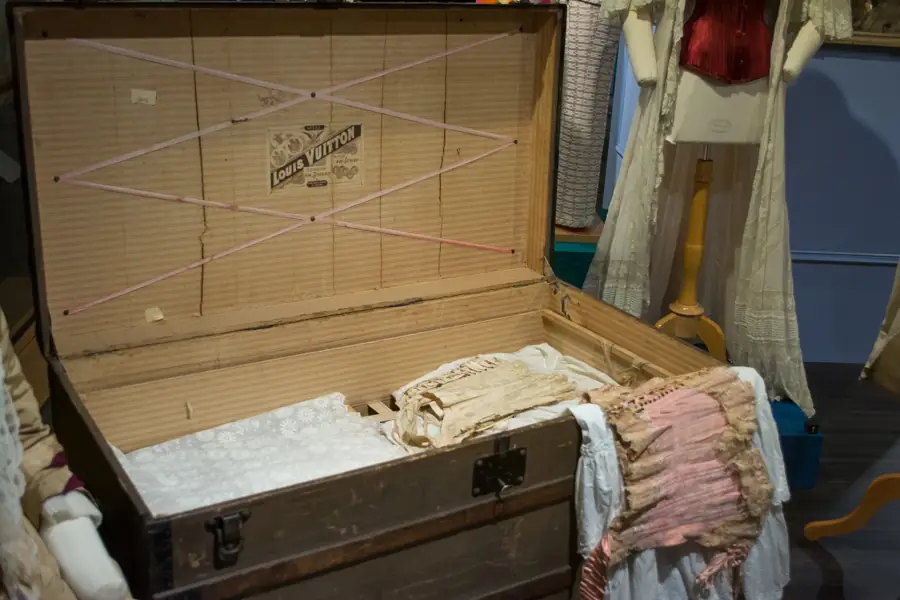
Louis Vuitton trunk history concerns both the shape of a container and the order preserved inside it. The business opened in Paris in 1854 with a background in packing and protecting possessions. A trunk is not worn, yet it influences how clothing survives a journey. Its role extends beyond surface pattern to compartments, openings and the position from which it can be lifted.
Flat tops and stacking
A flat top changes how luggage occupies shared transport space: cases can be stacked rather than balanced around curved lids. Official pages give differing milestones for the early flat trunk, so no single first date is asserted here. The practical point is the relationship between adjoining objects. A personal container also had to function as one piece among other luggage.
Construction in the workshop
The published construction sequence begins with wooden panels, followed by canvas or leather, metal fittings and protective edging. The wooden frame maintains the outline; the covering and reinforced corners perform different protective tasks. Evenly spaced nails also contribute to the exterior rhythm. This describes the process presented by the house today, rather than claiming an identical method for every historical example.
Luggage that opens into a room
The wardrobe trunk, recorded in the house chronology in 1875, could stand upright and open like a cupboard. A travelling secretary made for conductor Leopold Stokowski in 1929 incorporated drawers, shelves, typewriter space and a folding table. These are different answers to life away from home: one organises clothing, the other work. Neither is adequately described as an empty box.
An exterior that identifies its owner
The exterior also identifies a possession. The house traces personalisation to the 1860s. Painted initials or motifs connect a shared construction language with an individual owner. Repeated brand markings and a personal commission communicate different information: one signals a family of objects, the other distinguishes a particular example. The protective surface becomes a place where those identities coexist.
A method rather than a single model
Louis Vuitton trunk history is consequently larger than one model. A wardrobe trunk and a working secretary share hard-sided construction but address different needs. A wooden frame, covering and closure establish a framework that can accommodate those differences. The continuing interest of these objects is not only their recognisability. Their interiors preserve an approach to design in which moving from place to place did not mean abandoning the organisation of everyday life.
Timeline
- 1854
- Louis Vuitton opened his first Paris shop.
- 1859
- The Asnières workshop story began.
- 1875
- The house chronology records the wardrobe trunk.
- 1929
- A travelling secretary was created for Stokowski.