Louis Vuitton history: Travel, trunks and visual identity
Louis Vuitton began in Paris in 1854 as a travel-goods business. Protective construction, repeated surface patterns and changing ways of travelling are central to its development.
ÉPOPLI ·
Louis Vuitton Product histories →
- Brand
- Louis Vuitton
- Origins
- Founded in Paris, France
- Focus
- Travel goods, leather goods and fashion
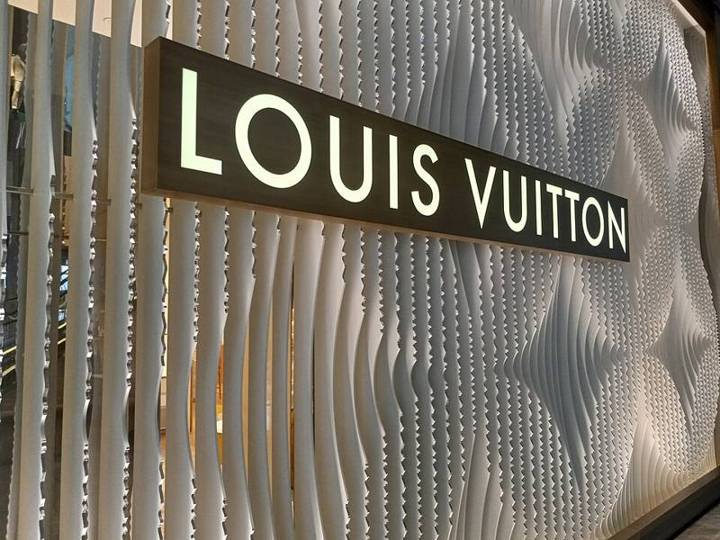
The importance of a stackable box
Louis Vuitton history is easier to understand when luggage is treated as a box occupying space rather than simply a decorative possession. It must be loaded, stacked and moved without crushing its contents. The flat-topped trunk makes that problem visible. In trunk making, protected corners, fastening positions and the line between lid and body matter alongside appearance. Parts that later became visual signatures were not necessarily conceived only as ornament. A frontal photograph emphasizes surface pattern; side views and interiors reveal dimensions and divisions. This article follows how the practical action of travelling generated a recognizable vocabulary that could subsequently move beyond luggage.
From packing to an independent business
Louis Vuitton history dates the independent business to 1854. The official account describes an apprenticeship in packing and box making before the founder established his own workshop. Understanding a customer’s belongings was different from merely supplying a standard container: volume and protection affected the interior. The move to Asnières in 1859 joined family residence and production. The Asnières workshop matters not just as a historic building but as a place connecting design, assembly and special orders. This trunk making can begin with the object that needs protection, allowing contents to determine structure. That sequence helps distinguish functional origins from later uses of similar details in fashion.
Who created the pattern?
Louis Vuitton history should not attribute the Monogram canvas directly to the founder. The house chronology dates Georges Vuitton’s combination of initials and floral motifs to 1896. The founder’s name is present, but a successor developed this surface. Its effect depends on spacing and repetition as well as individual shapes. On a large trunk and a small handbag, seams and cropped motifs produce different compositions. A pattern is therefore an element negotiating the scale of an object, not simply a badge applied afterward. Canvas should also not be confused with leather: body, handles and trim may use different materials. Distinguishing material from motif makes description more precise.
A softer way of carrying
Louis Vuitton history includes softer travel forms such as the Speedy, which operates differently from a rigid trunk. Upper handles, a long opening and rounded ends suggest an object carried directly by a person. A flexible body responds to contents and handling instead of preserving a fixed box-like volume. Precision has not disappeared; it is located in curved seams, aligned openings and load-bearing attachments. Luggage loaded onto a vehicle and luggage carried in the hand address different situations, even within the same culture of travel. Comparing those structures is more informative than comparing fame. Present-day dimensions and materials should not be projected backward onto every earlier version.
The object inside determines the case
Louis Vuitton history turns attention inward through special-order cases. The official Asnières workshop account connects the protection of belongings with objects requiring individual solutions. The question is not merely what fits, but where an irregular object needs support so it does not move. Compartments, supports and the opening sequence affect the exterior dimensions. A trophy case, for example, must both protect and reveal its contents. Closed, it is equipment; opened, it becomes a frame. Such work should not be treated as identical to every standard retail product. It is useful because it makes the relationship between contents and construction especially easy to observe.
The Noé of 1932 offers another example: the official account connects it to a request for a carrier for five champagne bottles. Its later development as a city bag should be distinguished from that original brief.
When construction becomes a fashion code
Louis Vuitton history does not mean that clothing and luggage share identical construction. Rather, corners, straps, locks and repeated motifs can become recognition devices across different objects. When Monogram moves onto clothing, protection and storage are no longer the governing functions; bodily movement and silhouette introduce other conditions. Later designs cannot be assessed only by how faithfully they repeat an original. Ask what a borrowed element does at another scale or in another material. Multiple designers and workshops have worked under the house name. Keeping the founder’s travel goods distinct from subsequent fashion makes change clearer than presenting everything as one person’s continuous authorship.
Read the surface and the interior together
Louis Vuitton history is best read with product name, date, material and use recorded together. A familiar name can reappear in a different size or construction, so a photograph alone may not establish its period. Official chronologies identify origins and milestones, but corporate praise need not be adopted as independent judgment. An observer can describe seams, bases, joins and motif placement directly. Such descriptions reveal differences more effectively than fame alone. A history of travel asks what people carried and how, not just which vehicles existed. Maintaining that question connects early manufacture with contemporary imagery while preserving the distance between them.
Timeline
- 1854 — The business is founded in Paris
- 1859 — Production expands to Asnières
- 1896 — Georges Vuitton introduces the signature canvas
Questions and answers
When did Louis Vuitton begin?
The independent business began in Paris in 1854.
Did the founder create the signature canvas?
The official chronology attributes the signature canvas introduced in 1896 to Georges Vuitton, the founder’s son.
How can travel goods be examined?
Look beyond the surface to protected corners, closures, internal compartments and load-bearing attachments.