Hermès scarf history: a world printed on silk
Hermès scarf history follows the carré from its 1937 beginnings to Bouquet Final, exploring silk, finished edges and the artists behind a changing printed square.
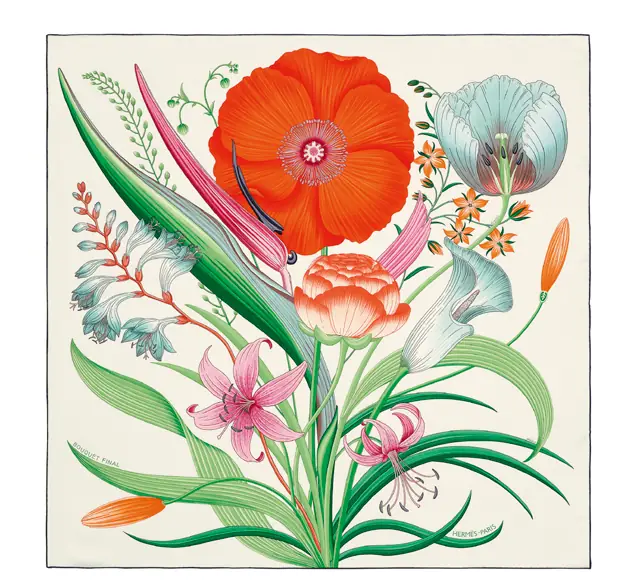
A picture that changes when folded
An Hermès carré is encountered in two states. Laid flat, it resembles a framed picture; folded around the neck, only selected lines and patches of colour remain visible. The wearer therefore edits the composition through an ordinary gesture. This distinction is important to Hermès scarf history: the square is a recurring format, rather than one unchanging design. Bouquet Final offers a recent example. Its concentrated flowers can be read as a complete arrangement, while a knot turns them into fragments. The following discussion separates the enduring object from the changing illustrations placed upon it.
A format established in 1937
Hermès introduced silk scarves in 1937. Auction-house accounts connect the early designs with Robert Dumas, printed imagery and the house’s equestrian background. The subject range subsequently expanded. A vintage scarf is consequently not dated simply by recognising the brand: its design name, artist and colour edition matter. Nor should a contemporary square be called a replica of the first scarf. Continuity lies in a format and a practice of image-making, while individual illustrations have their own histories. This distinction makes an archive more useful than a list of famous wearers.
Fabric and the finished edge
The official Bouquet Final product description specifies silk twill, a weave with a diagonal structure. Its surface carries the printed image, but the edge is equally worth observing. Hand-rolled edges turn the textile’s perimeter into a narrow finished border. The product called a scarf 90 is listed at approximately 88.5 centimetres square, with variation attributed to manual finishing. A useful product history records that difference between a commercial size name and an actual measurement. Silk twill and hand-rolled edges describe material construction; they should not be treated merely as decorative words for luxury.
From a floral arrangement to a drawing
Bouquet Final began with a collaboration involving floral artist Azuma Makoto and London illustrator Katie Scott. For the 2024 Lanterne project, an arrangement combining flowers from different climates became a drawing; the scarf followed in 2025. This is a translation between media, from objects occupying space to marks on a plane and then to printed fabric. Naming the collaborators helps explain why one scarf differs from another. It also prevents the preparatory project and the retail object from collapsing into a single date.
Reading a changing object
A design may appear in different colour editions or textile formats, and those changes affect how it is seen. A narrow Twilly and a large square do not fold in the same way. An image prominent in a flat product photograph may disappear when worn. Comparing those views is a practical way to read the object without reducing it to a logo. The illustration on this page represents a 2025 design, not the first scarf of 1937. Hermès scarf history is most revealing when such differences remain visible: an established format can support changing pictures and distinguishable creative contributions.
Timeline
- 1937
- Hermès introduced its silk scarf.
- 2024
- Azuma Makoto and Katie Scott collaborated for the Lanterne project.
- 2025
- The project became the Bouquet Final scarf.