Hermès Birkin history
Explore Hermès Birkin history from the 1984 encounter to Jane Birkin’s 1985 bag, its documented ownership and later auction, separating one object from its family.

A bag begins with a user
Hermès Birkin history begins with a user describing a problem. The house dates Jane Birkin’s encounter with Jean-Louis Dumas on a flight to 1984, when the conversation turned to a roomy bag suitable for her life with young children. The significant starting point is not just a celebrity name. A request concerning capacity became a discussion about what a bag should be able to contain and how it should accompany its owner.
Conception and the surviving original
The date of that conversation must be distinguished from the surviving object. Sotheby’s catalogued the original bag made for Birkin as a 1985 piece in black Box leather with brass hardware. It has her initials and a non-removable shoulder strap. Its recorded width is 36 centimetres. Applying the names of familiar later sizes to this original bag would conceal differences that make it valuable as evidence of an early design.
Space and the act of closing
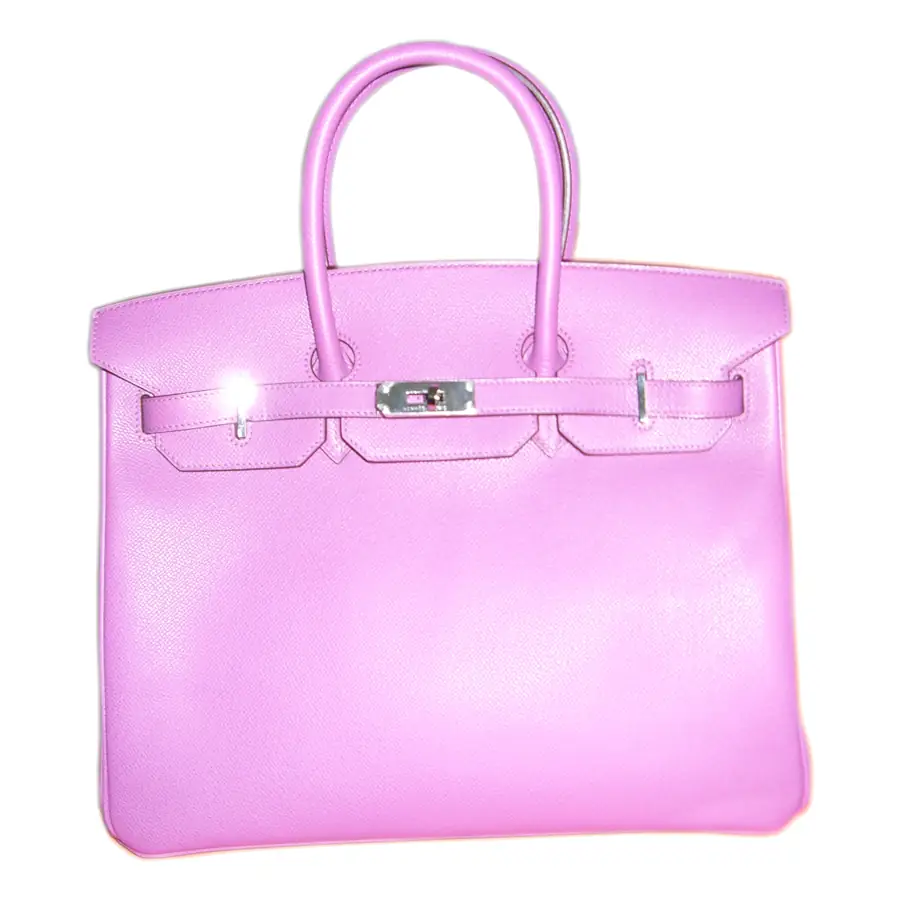
The arrangement of flap, side straps and handles makes opening and closing part of the bag’s visible identity. A broad body suggests capacity, while the fastening gathers attention towards the front. This is a formal reading of the object, rather than a claim that every later version behaves identically. The relationship between usable space and a defined exterior is more historically useful than treating the silhouette as an abstract status sign.
Documents attached to one object
The original bag comes with a documented life beyond its manufacture. The auction lot lists a charity-auction certificate signed by Jane Birkin in 1994 and a catalogue from a 2000 sale. Such documents track a particular possession, not simply a product name. The distinction matters: a repeatable design can have many examples, but the ownership history of one example cannot be transferred to the others. Initials and an attached shoulder strap make that specificity visible.
From used possession to cultural object
The 2025 Paris auction placed the object in another setting: that of a collectible with an extensively narrated past. Exhibition catalogues listed with the lot also connect it with museum contexts. An auction result for this singular possession cannot establish the value or future return of the entire product family. Its cultural interest lies in the accumulation of manufacture, personal use, transfer and display around one material object.
Reading the original beside the family
Reading Hermès Birkin history across the wider family requires attention to different dimensions and materials. The official presentation distinguishes several formats rather than describing one immutable bag. A continuing name can therefore hold a series of choices within a recognisable framework. Set beside that family, the early example clarifies three separate layers: an individual’s practical request, the making of a particular object, and the subsequent life of a design. Keeping these layers visible makes its history more precise than a simple account of scarcity or celebrity.
Timeline
- 1984
- The house dates the encounter and conception to 1984.
- 1985
- The original bag made for Jane Birkin dates to 1985.
- 1994
- A surviving certificate documents a charity auction of the original.
- 2025
- The original appeared at Sotheby’s Paris.