Hermès history: From harness workshop to everyday objects
Hermès began as a Paris harness workshop in 1837 and expanded into leather goods, silk, clothing and objects for the home. Its history connects changing uses with specialized making.
ÉPOPLI ·
- Brand
- Hermès
- Origins
- Founded in Paris, France
- Focus
- Leather goods, silk and clothing
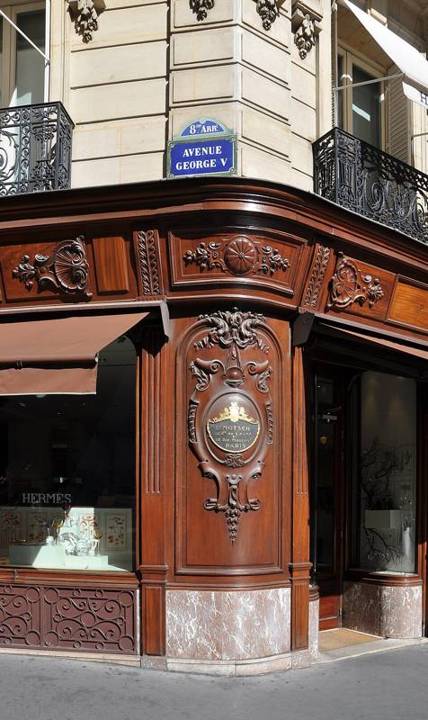
Equipment before status
Hermès history begins with the construction of harnesses rather than the fame of handbags. Thierry Hermès opened his Paris workshop in 1837. Equipment linking a horse and carriage had to transmit force as well as look finished: thickness, fastenings and joined surfaces mattered. Contemporary products are not direct copies of that equipment, but they invite a related examination of working parts. In this sense, leather craft describes more than a claim of handwork. Look at the position of a handle, the sequence of opening a flap and the way a base supports its contents. These relationships explain an object more precisely than its logo alone.
Changing travel, changing needs
Hermès history developed through successive generations rather than one uninterrupted act of invention. Charles-Émile moved the business to 24 Faubourg Saint-Honoré in 1880. Émile subsequently broadened its attention to changing travel and everyday needs. The official chronology discusses his adoption of the zipper; it does not establish that the house invented the device itself. As leather craft moved into different objects, openings, compartments and carried weight required different decisions. Tradition can therefore be read as knowledge capable of addressing new problems, not simply the preservation of an old silhouette. This distinction makes the expansion beyond equestrian equipment more intelligible.
A design and its public name
Hermès history separates the origin of the Kelly bag from its later celebrity. Robert Dumas designed its predecessor in the 1930s, while photographs of Grace Kelly carrying it brought wider attention in 1956. The actress did not design the original simply because the bag eventually carried her name. Examine the tapered body, upper handle and straps crossing its flap. Closed, the parts produce an orderly surface; opened, they reveal a sequence of separate components. The Kelly bag demonstrates that a restrained silhouette can depend on many carefully positioned elements. Its photographic identity and its operation as a container are related but different subjects.
Reading the Birkin through use
Hermès history dates the Birkin to 1984 and connects it with a meeting between Jean-Louis Dumas and Jane Birkin. This is the house’s account of its origin, not evidence that every subsequent size or variation existed at the outset. Two handles, a broad body and closing straps organize a set of carrying and opening movements. Compared with the Kelly, the proportions and handle arrangement make different demands on the user. Treating both only as scarce status symbols obscures those distinctions. A structural reading asks what folds, what supports the contents and which surface rests against the body.
Colour changes when a square is folded
Hermès history took another material direction with the introduction of silk scarves in 1937. A finished image conceals a sequence of colour separations and printing operations. The house’s making guide describes preparing screens, printing silk twill in stages and finishing the textile. Spread flat, the composition has a centre and border; folded or tied, those relationships change. These silk scarves are therefore both drawings and objects altered by movement. The edge deserves attention as a structure finishing a thin fabric, not just an ornamental outline. Unlike a bag, the work begins as a plane whose visual emphasis changes with the wearer.
The workshop is a network
Hermès history becomes narrower if it is reduced to a family succession. Drawing, separating colours, cutting and stitching require different forms of expertise. Corporate strategy documents connect creation, skilled making and distribution; these are the company’s account of its operating model, not an independent verdict on every product. They nevertheless help explain why design relies on coordinated work. An attractive drawing still needs accurate printing, just as expressive leather needs appropriate joins to retain its shape. Considering training and collaboration connects the appearance of a finished object with the organization necessary to produce it consistently.
A practical way to read continuity
Hermès history is most useful when it encourages comparison across objects. Examine load and closures in bags, folding and colour in textiles, and contact between hand and surface in objects for the home. Skills do not transfer unchanged between these fields, but each involves organizing a human action through form. Keep the brand’s origin stories distinct from visual interpretation, and do not treat a current variation as identical to an earlier model. Dates, dimensions, materials and hardware help establish the differences. Read this way, continuity becomes a record of decisions and revisions rather than an unchanging image, and the archive becomes a guide to observation rather than a prediction of value.
Timeline
- 1837 — Thierry Hermès opens a harness workshop in Paris
- 1937 — The first silk scarf is introduced
- 1984 — The Birkin bag is introduced
Questions and answers
Did Hermès begin by making handbags?
No. Thierry Hermès opened a harness workshop in Paris in 1837. The business later expanded into leather goods and other fields.
Were the Kelly and Birkin introduced together?
No. Robert Dumas designed the Kelly’s predecessor in the 1930s; the official chronology dates the Birkin to 1984.
How should a scarf be examined?
Compare its full composition with the colours and borders visible when folded, and look at how the fabric edge is finished.