Hermès Kelly history
Explore Hermès Kelly history from Robert Dumas’s 1930s design to Grace Kelly’s 1956 photograph, tracing the handle, closure and evolution of the wider bag family.
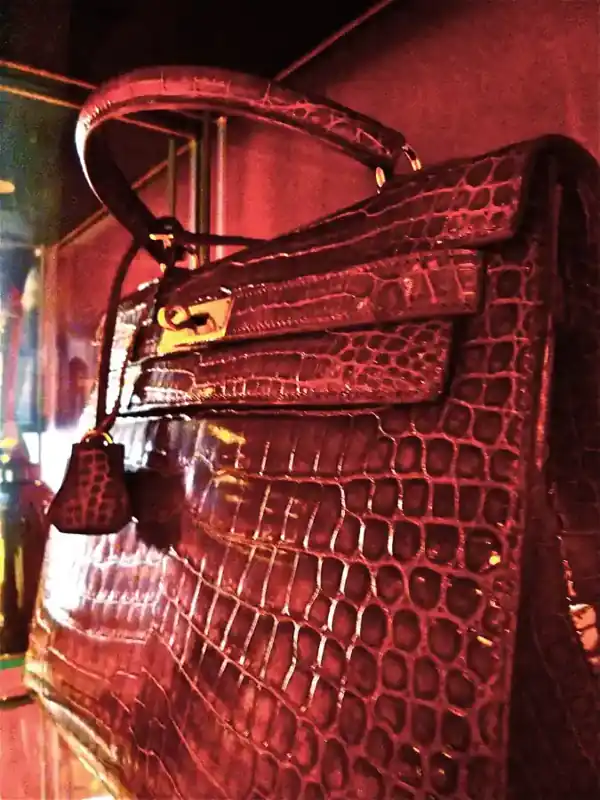

A bag older than its famous photograph
Hermès Kelly history begins before the photograph most closely associated with its name. The house describes a ladies’ bag with straps designed by Robert Dumas in the 1930s. Grace Kelly’s later association belongs to a different stage of the story. Separating the making of a design from its public recognition avoids turning a famous wearer into its inventor. The object and the name did not arrive at the same moment.
Robert Dumas and the design
Robert Dumas appears in the official account as the designer and Émile Hermès’s son-in-law. The trapezoidal body and single top handle establish a readily legible arrangement. Seen together, they create a relationship between a narrow upper edge and a broader base. This is an observation about the form: even where a later example adds a shoulder strap, the top handle remains an important visual point around which the body is organised.
Closing becomes visible
The front fastening joins the side straps at a rotating metal component, described by the house as a touret. A padlock completes this fastening system. Instead of disappearing into the construction, the act of closing is made visible at the front. Horizontal straps and the outline of the body perform different tasks while forming one composition. The fastening system is consequently difficult to classify as either pure decoration or an invisible practical detail.
The image and the name
The official chronology identifies 1956 as the year a photograph of Grace Kelly carrying the bag circulated widely. The association gave an existing design another way to be remembered. It need not be elaborated into speculation about her private feelings or an undocumented advertising strategy. What the record establishes is a significant connection between object and public image. The name did not change the authorship of the design, but it changed the vocabulary surrounding it.
A structure across different formats
The family later extended into different sizes and uses. The official presentation distinguishes small and large formats, travel pieces and handheld variations. Shared components do not make all of these the same as a 1930s example. Changing the body or reducing a handle alters how an object is held and approached. A useful history therefore compares what persists with what changes, rather than flattening every variation into a single timeless outline.
Beyond the celebrity association
Hermès Kelly history becomes clearer when a name and a structure are examined together. Establish the date and format of a particular bag, then compare handle, straps and closure. Focusing only on the famous photograph obscures the designer’s choices and later variations; focusing only on construction misses how a design becomes publicly memorable. The Kelly sits where these readings meet. Its continuity has been shaped both by a repeated arrangement of parts and by the images through which that arrangement became familiar.
Timeline
- 1930년대 / 1930s
- Robert Dumas designed the ladies’ bag with straps.
- 1956
- The official chronology links Grace Kelly’s photograph with the bag’s naming.