Dior Saddle bag history
Dior Saddle bag history follows its 1999 design, 2000 debut and 2018 return, examining shape, materials and craft through museum records and designer interviews.
A bag recognised by its outline
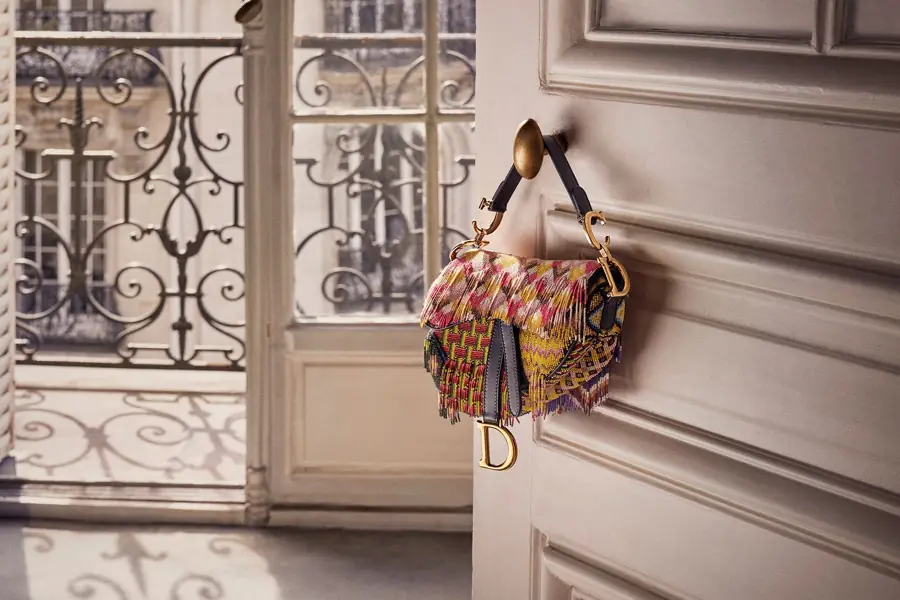
Dior Saddle bag history begins with an outline that refuses the ordinary rectangle. One side descends into a curve while the upper edge follows another direction. This asymmetric silhouette makes the object recognisable before its surface pattern comes into focus. Galliano translated an association with equestrian equipment into a small accessory carried close to the torso. The NGV distinguishes its design in 1999 from its debut in the spring–summer 2000 collection: the season’s name and the calendar date should therefore be kept together.
An object preserved from 2000
The NGV example dates to 2000 and entered the collection in 2002. Its recorded materials include cotton, leather, metal and Velcro. That combination is a useful reminder that a familiar model name does not describe a single unchanging construction. A fabric body, metal fittings and a fastening each perform different jobs. The museum’s material and inscription records anchor discussion in one surviving object. They cannot be automatically extended to every subsequent Saddle, even when the asymmetric silhouette remains immediately familiar.
Outline and surface carry different histories
The compact curve and short strap place the bag near the wearer’s arm. The language of equestrian equipment is thus transformed through scale and position rather than copied as a usable saddle. Surface adds another historical layer. Dior Oblique, created by Marc Bohan in 1967, predates Galliano’s design. When the pattern covers this new body, an established house vocabulary meets a later designer’s proposal. Comparing patterned and plain examples is revealing: the former gives the eye repeated signs, whereas the latter exposes the contour and seams more directly.
What the 2018 return changed
Dior Saddle bag history acquired a new chapter when Maria Grazia Chiuri returned it to the autumn–winter 2018 collection. Her contemporary interview discussed treatments including patchwork and beaded embroidery. Dior Oblique could become a ground for additional handwork instead of simply repeating an earlier surface. The exercise demonstrates how a reissue can preserve recognition while changing texture. A continued name does not erase the distinction between Galliano’s initial versions and Chiuri’s later interpretation; those are separate moments in the house’s design history.
Construction beyond the original shoulder bag
Dior’s 2019 film on making the men’s Saddle offers another view of the design’s development. The working process brings attention to cutting, joining and finishing: a curve that looks effortless depends on the meeting of separate surfaces. Examining the position of a strap and fastening helps explain how a familiar motif can accompany a different body position. This is a more useful comparison than assuming that all bags in the family share the same dimensions or materials. The film documents a particular later construction rather than the manufacture of the 2000 museum object.
Reading a return without flattening time
The story connects a seasonal accessory, a preserved museum piece and a later runway revival. Each changes the way the same form is encountered. A photograph of a recent bag should not be presented as evidence of an original object, just as the first design date should not be assigned to a later manufacture. Keeping those layers visible makes the Saddle useful as fashion history: it shows how recognisable contours can survive while their surfaces and methods of carrying continue to evolve.
Timeline
- 1999
- John Galliano designed the Saddle for the spring–summer 2000 collection.
- 2000
- Date of the example held by the NGV.
- 2018
- The bag returned in Maria Grazia Chiuri’s autumn–winter collection.
- 2019
- Dior published a making-of film for the men’s Saddle.