Lady Dior history
Explore Lady Dior history from Diana’s 1995 gift to cannage, atelier construction and her satin evening bag, tracing exhibitions and artists’ reinterpretations.
A gift and public image in 1995
Lady Dior history has an important turning point in a gift to Diana in 1995. Dior links her Paris visit for a Cézanne exhibition with later public appearances carrying the bag, including an official visit to Argentina. Bernadette Chirac presented the gift; the name subsequently honoured Diana. An existing object acquired a powerful association through use and imagery, rather than appearing fully formed with all its later meanings.
A defined body and moving charms
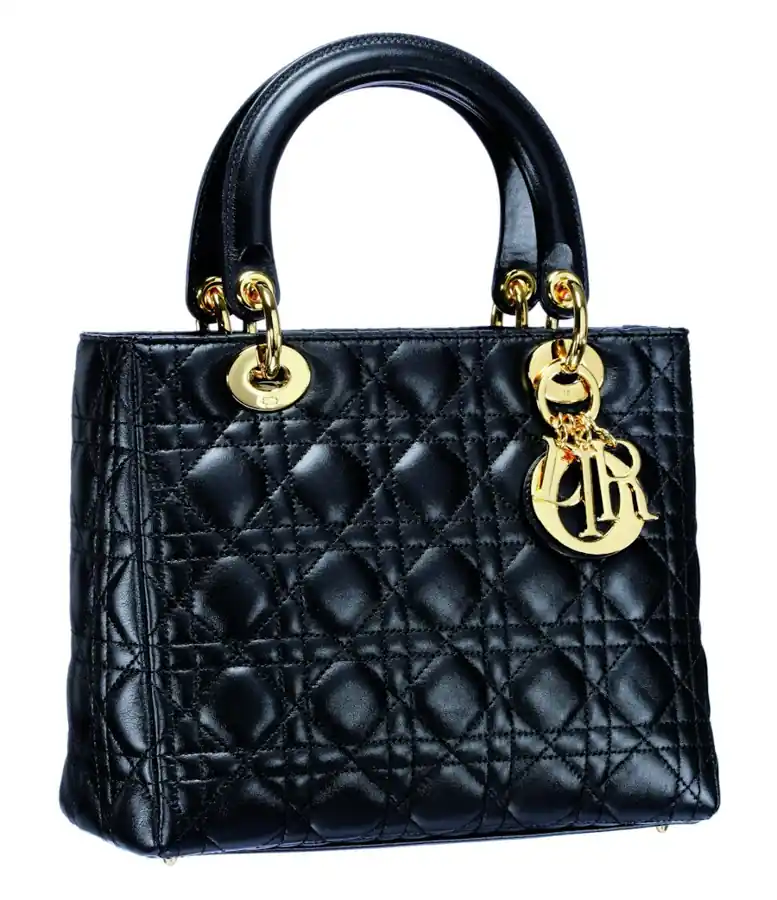
The design juxtaposes a defined body, curved handles and hanging letters. The body establishes an outline while the Dior charms move as the bag is carried. Charms are small suspended ornaments. Here they are simultaneously a name and moving elements within a relatively stable composition. The contrast can be understood by looking at the object in motion, not only as a still product photograph.
Cannage and the atelier
The house identifies the geometric surface pattern as cannage and presents its making in Italian ateliers. The cannage divides the surface into a repeated organisation of lines. Visually, it can lend soft material an architectural order. Handle attachments, body proportions and the finishing Dior charms each perform a different task, but their placement determines how the finished bag reads as a whole.
An evening variation in 1996
At the 1996 Met Gala, Diana carried a midnight-blue satin variation with her John Galliano dress. La Galerie Dior records sparkling decoration on its charms. The bag participated in an evening ensemble rather than merely repeating its role in daytime photographs. Colour and surface connected accessory to clothing. This example shows how a recognisable shape can take on a different character when the material changes.
Exhibitions and artists’ interpretations
Lady Dior As Seen By began in Shanghai in 2011, inviting interpretations by visual artists, photographers and video makers. Dior Lady Art followed in 2016 with artists reworking the bag itself. The two projects are related but distinct. One object can be a subject represented in another medium, or become the three-dimensional support for a new interpretation.
How a name continues
Lady Dior history is consequently held together by more than a single photograph. Pattern, outline, handles and suspended letters can be recombined across different settings. Diana’s use explains the name, atelier work explains the object, and the art projects explain later acts of reinterpretation. These layers reveal a product family as something maintained through both repetition and change, rather than an original design whose story stopped when it became famous.
Timeline
- 1995
- Diana received the bag and carried it at public engagements.
- 1996
- A satin version accompanied her Met Gala dress.
- 2011
- Lady Dior As Seen By began in Shanghai.
- 2016
- The Dior Lady Art project began.