Dior Bar suit history
Explore Dior Bar suit history through the 1947 silhouette, atelier construction, New Look debate and 1955 photograph, ending with Yohji Yamamoto’s reinterpretation.
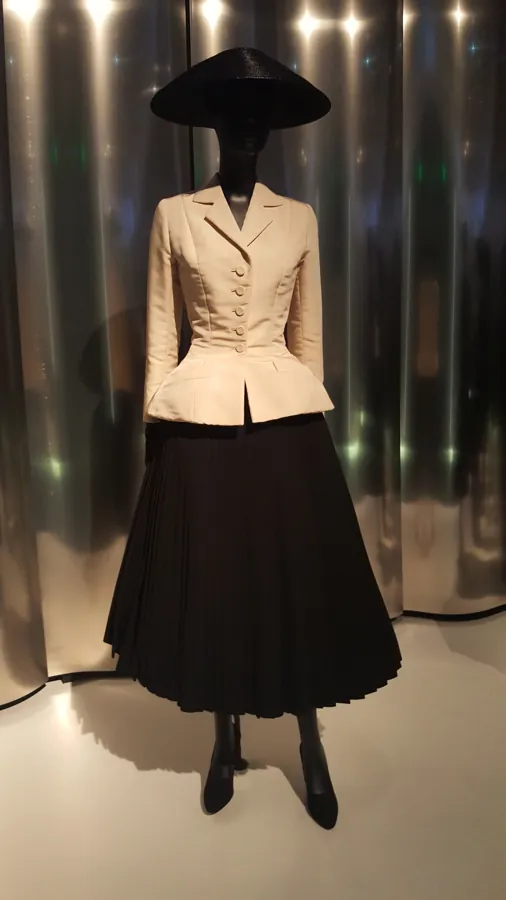

A silhouette in two colours, 1947
Dior Bar suit history becomes legible in the contrast between a pale jacket and a dark skirt. The ensemble appeared in the spring/summer 1947 Corolle line. La Galerie Dior records ivory shantung, five buttons and a pleated black wool skirt. Shantung is a fabric with an uneven, textured surface. The division between the two colours sharpens the transition from a narrow waist to a broader lower outline.
The making of a curve
The curve was constructed rather than simply revealed. The Museo del Traje explains the rounded shoulders, fitted waist and padding at the hips. Padding adds volume where the design requires it; the peplum, or flared section below the waist, works with the skirt to shape the outline around the body. Reducing the image to a small waist overlooks the material work needed to create that contrast.
Designer and atelier
La Galerie Dior credits atelier head Pierre Cardin with making the ensemble. Christian Dior’s authorship of the collection coexists with the work of a cutting and sewing atelier. This is a concrete example of collaboration rather than a reason to replace one name with another. The Met’s surviving 1947 jacket provides a material point of reference for the work behind the familiar image.
Clothing becomes an argument
The New Look name is associated with Harper’s Bazaar editor Carmel Snow, but the response was not uniformly admiring. NGV research also describes opposition to long skirts, constriction and lavish fabric use. After war, abundance could suggest renewal while also raising questions about expense and mobility. The New Look therefore concerned an imagined way of living as well as a change in fashion silhouette.
The 1947 design and a 1955 image
Willy Maywald’s widely reproduced photograph dates to 1955, not the original 1947 presentation. NGV distinguishes its softer staging from the first appearance. A pose, hat and setting help shape what viewers remember of a garment. The photograph gave the suit another public life; separating those dates allows the history of the image to sit beside the history of the actual clothing.
A later designer reads the suit
Dior Bar suit history also includes later designers’ responses. NGV reads Yohji Yamamoto’s 2000 jacket and skirt as a dialogue with the earlier silhouette, changing texture and the treatment of the body rather than simply copying it. The suit becomes a proposition that can be questioned. Its legacy lies in how tailoring and volume construct a bodily image, and how that image can be revised by another designer for another moment.
Timeline
- 1947
- The Bar suit appeared in the spring/summer Corolle line.
- 1955
- Willy Maywald photographed a later presentation of the suit.
- 2000
- Yohji Yamamoto presented a jacket and skirt engaging with the silhouette.