Sarah Burton: Making Clothes from McQueen to Givenchy
Royal needlework, the working atelier and the proportions of the body.
ÉPOPLI ·
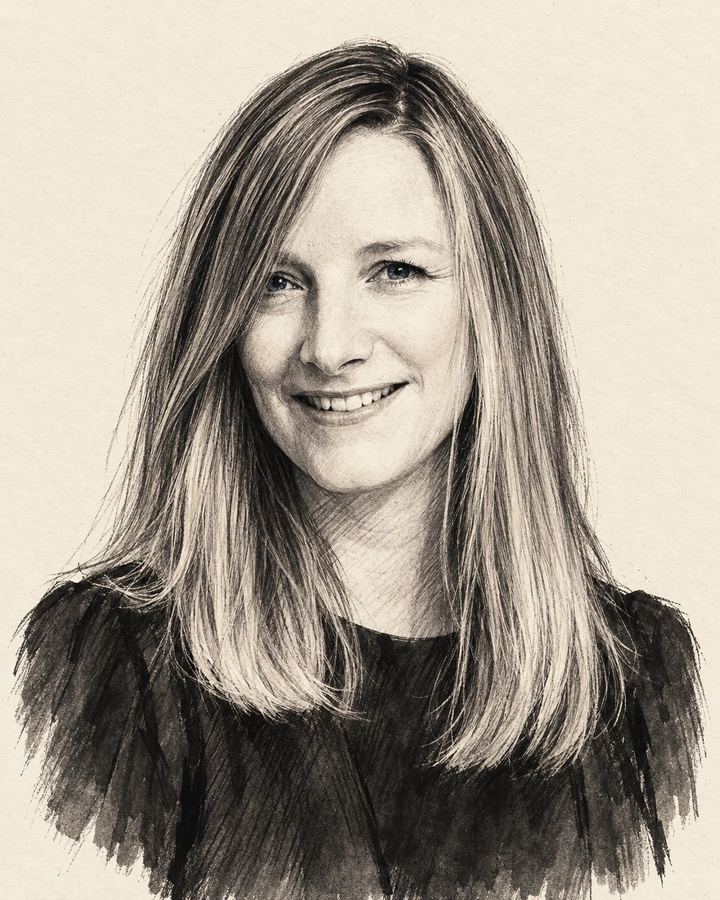
A successor unfolds the patterns
For her autumn/winter 2025 Givenchy debut, rediscovered 1952 patterns became a starting point rather than instructions for copying old dresses. Sarah Burton Givenchy history asks how a designer develops a method within an already powerful house. At Alexander McQueen she had worked beside the founder before taking responsibility for the brand. The continuity involved people and making as much as recognisable imagery. The atelier is a place where patterns become cloth and fittings lead to revisions. Continuing a house can mean reactivating its way of working with the body rather than repeating decoration.
Learning inside a working house
Born in 1974 in Macclesfield and educated in Manchester, Burton studied fashion at Central Saint Martins. She joined Alexander McQueen in 1996 while studying, graduated in 1997 and became Head of Design in 2000. Sarah Burton Givenchy history rests on this long practical apprenticeship as well as her later move to Paris. Working within another designer’s organisation involved turning a vision into garments through successive decisions. Appointed creative director in May 2010, she directed womenswear and menswear. Her spring/summer 2011 collection was presented in 2010, an important distinction between the season’s name and the date of its making.
The flowers on the 2011 wedding dress
Catherine Middleton’s dress for her marriage on 29 April 2011 is a major work preceding Sarah Burton Givenchy history. Satin gazar supported a full skirt, a narrowed waist and padded hips. Individual lace flowers were cut and applied to silk tulle rather than simply covering the dress with a sheet of lace. The Royal School of Needlework participated, with Burton and the McQueen team coordinating the whole; the bride helped formulate the design. Roses, thistles, daffodils and shamrocks connected the small-scale surface to the larger silhouette. Ceremony and close handwork operated at different viewing distances.
Leaving McQueen and entering Givenchy
Burton directed McQueen for thirteen years and received an OBE in 2012. The spring/summer 2024 show, presented in 2023, concluded her work with the house. Appointed to Givenchy in September 2024, she assumed responsibility for women’s and men’s creative direction. Sarah Burton Givenchy history therefore involves a new archive and team as well as an established understanding of cut. Presenting her first collection at the historic Avenue George V address kept the clothes close to their audience. The atelier provided a practical point of continuity through a substantial career transition.
Strong shoulders and a surface of powder compacts
The autumn/winter 2025 collection combined assertive shoulders with a narrow waist, wrapped fabric and open-backed constructions. Sarah Burton Givenchy history began by negotiating masculine techniques and feminine shape within the same garment. Short Chantilly dresses changed the proportions associated with delicate materials, while expanded sleeves enlarged the space around the body. A dress assembled from powder compacts turned intimate cosmetic objects into an entire surface. These pieces asked different materials to shape or expose the figure. Their relationship to the archive was a conversation about proportion rather than literal reproduction.
The makers become part of the image
Collier Schorr photographed stylist Camilla Nickerson and makeup artist Lucia Pieroni among the participants in the autumn/winter 2025 campaign. Sarah Burton Givenchy history made collaborators visible in front of the lens as well as behind it. The campaign presented a multigenerational group rather than a single ideal muse. It remained a carefully constructed advertisement, but widened the people through whom the clothes were interpreted. The needleworkers of the wedding dress and the campaign collaborators occupy different stages of production; both make the social organisation behind an image easier to see.
The present wardrobe
By October 2026, Givenchy’s official archive presented Burton’s spring/summer 2027 womenswear collection. Her stated interest was balance and clarity in dressing amid multiple roles and constant movement. Sarah Burton Givenchy history thus continues beyond royal commissions or the identity of McQueen’s successor. The atelier connects inherited skill to present needs. Comparing the 2011 ceremonial dress, the contrasting surfaces of 2025 and the recent wardrobe proposition means asking where the waist narrows and how fabric opens around the body. Different uses remain distinct, while construction provides the connecting thread.
Timeline
- 1974 — Born
- 1996–1997 — Joined McQueen and graduated
- 2010 — McQueen creative director
- 2011 — Catherine’s wedding dress
- 2023 — Final McQueen show
- 2024 — Joined Givenchy
- 2026 — Presented spring/summer 2027 womenswear
Sources
- Givenchy — Appointment and biography
- British Fashion Council — Spring/summer 2011
- Royal Household — The wedding dress, 2011
- Kering — Conclusion of McQueen collaboration
- Givenchy — Fall/winter 2025
- LVMH — First collection details
- Givenchy — Fall/winter 2025 campaign
- Givenchy — Spring/summer 2027