Mariano Fortuny: Light, Pleats and a Shared Workshop
Light, Pleats and a Shared Workshop.
ÉPOPLI ·
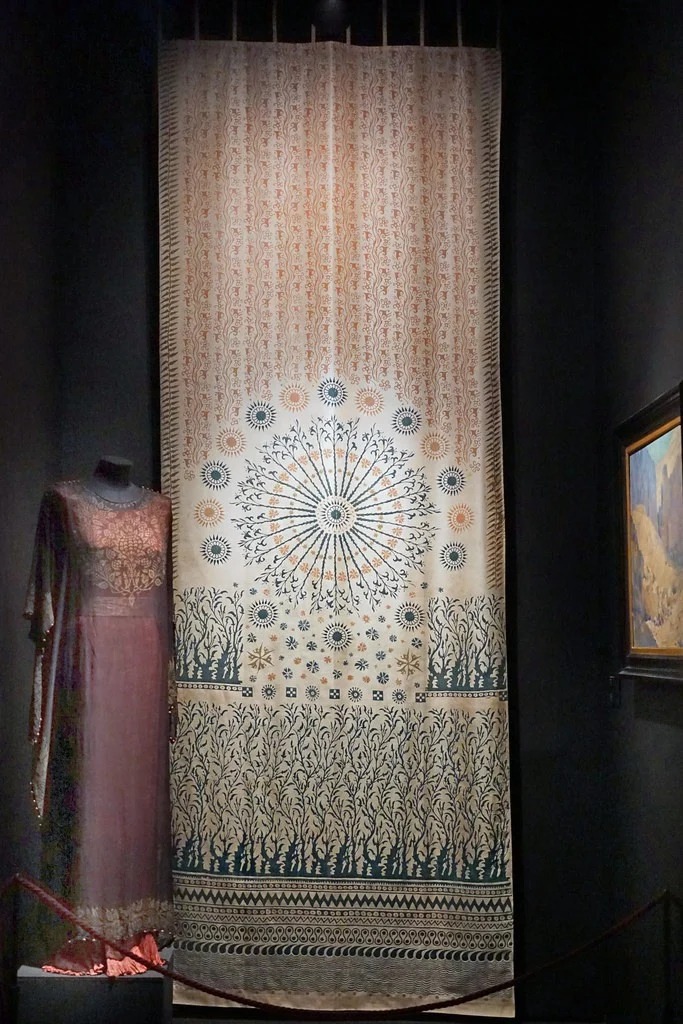
A dress that expands around its wearer
The narrow folds of a Delphos gown spread and contract as the wearer moves. Mariano Fortuny house history begins here, with a fabric surface that helps determine the shape of the garment. The silhouette recalls an ancient tunic, yet its effect depends on a modern workshop, carefully prepared silk and an adjustable relationship to the body. It should not be understood simply as a Greek costume transferred into a twentieth-century wardrobe.
The gown also raises a question of authorship. Venice’s Fortuny Museum identifies Henriette Nigrin’s contribution to its conception and describes the workshop she directed. Calling her only an inspiring companion leaves out practical creative work. The pleating, silk cords and glass beads are parts of a functioning garment, not merely a decorative vocabulary. Shoulder adjustments and the weight of the material affect how the folds fall. Surviving examples should therefore be studied from more than a single frontal photograph.
An artist’s house becomes a laboratory
Born in Granada in 1871 into an artistic family, the designer grew up among paintings and collected objects. His father, also named Mariano Fortuny, was a painter; the two must not be confused. Mariano Fortuny house history follows the younger artist into a practice that connected painting, photography, stage lighting and textiles rather than a conventional apprenticeship within a Paris couture house.
He established a studio in Venice’s Palazzo Pesaro degli Orfei and gradually acquired further parts of the building. Its large rooms became both a home and a working environment. This matters because different experiments could be considered together: how light travels across a painted surface, how a printed motif repeats, and how cloth changes when it is folded. The family’s textile collections supplied material for observation, but they do not license attributing every later motif to a specific antique object without documentary evidence.
Henriette and the working atelier
The couple installed a small textile workshop in the palace in 1907. Mariano Fortuny house history places this collaboration alongside the patents and commercial identity usually associated with his name. Henriette managed work in the atelier while the practice expanded into silk garments, printed velvet and other textiles. The museum explicitly credits her idea in its account of the famous pleated gown.
This distinction changes how a visitor reads the surviving clothes. A designer’s name on a label can encompass the activities of several people: developing processes, preparing samples, overseeing production and solving problems on individual pieces. An exact division of every operation cannot be reconstructed from a name alone. Nevertheless, the documented partnership should remain visible. It is more useful than inventing a romantic story in which one person merely inspires and the other performs all the technical work. The workshop was an organized place of making, not an extension of a solitary sketchbook.
Three ways of shaping a textile
The Delphos, Knossos scarf and printed velvet outer garments demonstrate related but distinct solutions. Mariano Fortuny house history reads the gown through vertical folds, the scarf through wrapping and the outer layer through a broader decorative surface. A scarf can be repositioned on the head or body; the resulting silhouette depends partly on the wearer’s decisions. A velvet coat creates another rhythm when its pattern interrupts the sheen of the pile.
The museum describes silk cords and Murano glass beads on the gown, with adjustable openings rather than a rigid corseted framework. Fine pleating gives a relatively narrow stored object room to open around the body. It does not mean every surviving example has identical sleeves, color or construction. Dates and details vary. Comparing individual museum records avoids turning a long-running type of garment into one timeless object. The same care is necessary when identifying an outer garment as a coat, tunic or cape.
Print, light and the theatre
Mariano Fortuny house history connects textile printing to an established interest in theatrical light. His stage apparatus, including the dome associated with his name, explored indirect illumination and the transformation of a performance space. Clothing presented another surface on which light could operate. This is a documented overlap of practices, not evidence that every textile pattern was designed for a particular stage production.
Printed velvet can evoke older woven fabrics while being made by another process. The difference between a pattern woven into cloth and one applied to its surface affects production, texture and the way light is reflected. Reinterpreting historical textiles was therefore a technical and visual decision. The workshop’s range included garments with varied regional associations; those references should not be collapsed into a single supposedly exotic tradition. A caption must identify only what the object’s record supports. The larger question is how collected examples became new material rather than literal copies.
From silk garments to industrial cloth
A factory established on Venice’s Giudecca in 1919 developed industrial textile printing on cotton. Mariano Fortuny house history distinguishes this activity from the silk clothing atelier in the palace. A business name can link them without making their processes interchangeable. Scale, repeat patterns, intended uses and the handling of fabric differ between a garment and furnishing cloth.
The distinction also helps explain the role of distributors and later custodians. Elsie McNeill became an important figure in the commercial continuation of the textiles. After the artist’s death in 1949, Henriette worked to preserve and distribute his legacy. She donated the palace to Venice in 1956 under conditions concerning its cultural use; the city took full possession after her death. These dates describe a process of preservation rather than an instantaneous conversion from private workshop to public museum. The museum eventually opened to visitors in 1975.
Reading the work without erasing its makers
Mariano Fortuny house history ends with objects that remain useful for asking how a garment is made. The gown, scarf and velvet outer layer show that a recognizable visual world need not rely on one identical pattern. Textile printing creates a surface, folding changes its behavior, and wrapping lets the wearer participate in the final form. Each operation leaves different evidence for a conservator or historian.
The present-day textile company, the museum and historical clothing collections preserve different parts of this story. Their continuing work should not be credited as designs personally made by a man who died in 1949. Equally, the palace’s paintings and machinery should not distract from Henriette’s documented contribution. Studying the partnership alongside the surviving material makes the archive more precise. Its value lies less in a mysterious lost formula than in the relationship between experiments, skilled labor, commercial production and the changing body inside the cloth.
Timeline
- 1871 — Born in Granada
- 1907 — Textile atelier installed with Henriette Nigrin
- 1919 — Cotton textile factory established on Giudecca
- 1949 — Died in Venice
- 1956 — Henriette donated the palace to Venice
- 1975 — Museum opened
Sources
- Museo Fortuny — The building and its history
- Museo Fortuny — Museum house and collections
- Museo Fortuny — Henriette Fortuny, 2015 exhibition
- The Met — Delphos gown
Related reading
Fashion History · Paul Poiret · Madeleine Vionnet · Designers