Hedi Slimane: Saint Laurent, Music and the Narrow Line
A narrow jacket changes the stage.
ÉPOPLI ·
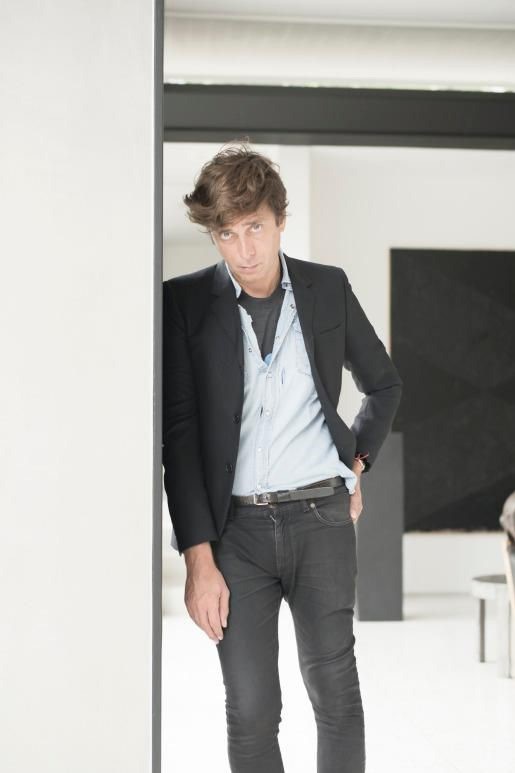
A narrow jacket changes the stage
Narrowing a black jacket changes its relationship to shirt, tie and trousers. Hedi Slimane Saint Laurent history can be read through these linked proportions rather than a single product. Tailoring, the cutting and shaping of clothing around the body, brings the authority of formal dress into contact with the tension of a young performer. Texture and shoulder angle make black clothes communicate differently.
The designer did not invent narrow trousers or androgynous appearance. Music culture and street dress offered precedents. His contribution involved organizing an image through a major house’s production and advertising. The useful question is how jacket, shoe, body and pose work together.
Art history and working practice
Born in Paris in 1968, he studied art history at the Ecole du Louvre; MoMA’s exhibition record also notes training as a tailor. Early work included assisting Jean-Jacques Picart. Fashion and image-making preceded Yves Saint Laurent menswear and the move to Dior in 2000. Hedi Slimane Saint Laurent history crosses institutions rather than following one company’s promotion ladder.
Education alone cannot establish the psychological intention behind a garment. The work offers a firmer connection: clothes deal with a moving volume, while a photograph presents it on a plane. Cutting and composition both organize proportion. Their coexistence can be examined without treating personal taste as representative of an entire culture.
Dior Homme’s 2001 proposition
Dior Homme’s fall 2001 Solitaire collection offers an early reference. Looking backwards through Hedi Slimane Saint Laurent history reveals that exact tailoring did not exclude ornament. A flower on the jacket in Richard Avedon’s campaign supplies a small volume against a narrow outline; its placement matters as much as its size.
The result is not the designer’s contribution alone. Pose, light and the garment’s actual shape work together. In black and white, differences in brightness and texture replace some of the information colour would supply. Yet one celebrated photograph cannot demonstrate the comfort or every customer’s experience of an entire collection.
Saint Laurent in 2013: disagreement matters
Following the return to Saint Laurent in 2012, the fall 2013 womenswear collection combined checked shirts, short dresses and substantial boots. This moment in Hedi Slimane Saint Laurent history was contested. Tim Blanks’s contemporary Vogue review questioned its novelty. The disagreement matters when familiar signs of music culture enter a luxury runway.
A deliberately worn-looking combination may be newly and carefully manufactured. A photograph does not establish whether a shirt is old or new, inexpensive or costly. Similar styling can conceal different production conditions. Neither claiming the house invented the look nor calling its products simply street clothing adequately describes that translation.
Night returns at Celine
Departure from Saint Laurent in 2016 was followed by arrival at Celine in 2018. The spring 2019 debut introduced menswear beside short, glittering dresses and narrow suits. Seen alongside Hedi Slimane Saint Laurent history, it demonstrates the persistence of music culture and nocturnal dress across house appointments. Continuity with a predecessor was not the organizing priority.
The accompanying explanation said clothes worn by male models would also be offered to women. Product categories and actual fit are different matters, however. Availability across gender categories does not guarantee the same fit on every body. Examining length, width and shoulder construction allows admiration of the image without turning it into a universal bodily ideal.
Photography is not an appendix
The 2004 Berlin exhibition at MoMA PS1 establishes photographic work as more than an interval between fashion jobs. In Hedi Slimane Saint Laurent history, images can promote garments while also offering an independent way of observing. Photographs of the city were projected onto a large cube, making the viewer’s movement part of the encounter.
Curator Klaus Biesenbach, the Berlin residency and the publishing context belong to this history too. Comparing photographic work with clothing campaigns can reveal continuities without reducing every depicted person to a subcultural type. A recorded moment remains narrower than a complete life.
An image beyond a house appointment
Celine announced his departure in October 2024. A Beyond Noise feature checked on 10 October 2026 credits him as photographer beside Sarah Richardson’s fashion direction. Bringing Hedi Slimane Saint Laurent history up to date requires distinguishing this photographic work from former house appointments. Unconfirmed speculation about another job is not a current position.
The interaction of tailoring and imagery leaves a practical way of looking. Follow the jacket through tie width, shirt exposure and the end of the shoe, then observe the effect of pose and light. Recognizing the force of a slender outline need not mean accepting one body as the only standard. His influence also concerns the consistency of the entire process through which clothes are selected and shown.
Timeline
- 1968 — Born in Paris
- 2000 — Joins Dior menswear
- 2004 — Berlin exhibition at MoMA PS1
- 2012–2016 — Creative and image director at Saint Laurent
- 2018–2024 — Directs design and image at Celine
Sources
- Jay McCauley Bowstead — Hedi Slimane and the reinvention of menswear (PDF)
- MoMA — Hedi Slimane: Berlin
- Vogue Italia — Hedi Slimane biography
- Vogue — Saint Laurent Fall 2013
- Kering — Hedi Slimane departure, 2016
- Vogue — Celine Spring 2019
- Vogue — Hedi Slimane exits Celine
- Beyond Noise — Hedi Slimane and Sarah Richardson, credits
Related reading
Fashion History · Yves Saint Laurent · Christian Dior · Designers