Gianfranco Ferré: The White Shirt as a Structure
The White Shirt as a Structure.
ÉPOPLI ·
A shirt can occupy space
A white shirt is a useful place to begin Gianfranco Ferré house history. Freed from a busy print, a collar, fold or enlarged sleeve becomes easier to see. A familiar garment can be made ceremonial by changing its proportions, or appear almost abstract when its edges extend beyond the torso. The wearer remains present inside that arrangement; the cloth does not behave like an independent building.
This distinction matters for a designer frequently associated with architecture. The comparison is grounded in his actual education, but it should not replace observation. Fabric bends, gathers and responds to movement. A seam directs that movement, while a cuff or neckline establishes where the volume stops. His shirts reward a close look at the relationship between the cut pieces and the space they create, rather than a quick description of them as simply architectural.
An architect enters fashion through small objects
Born in Legnano in 1944, he studied architecture at the Politecnico di Milano and graduated in 1969 with Franco Albini as his supervisor. Gianfranco Ferré house history first enters fashion through jewelry and accessories made during his university years. The attention of boutique owner Rosy Biffi and editors including Anna Piaggi helped bring that work into the fashion press.
This early scale is revealing. An object placed on a wrist, neck or waist must negotiate the body through weight and proportion. Those questions also apply to clothing, even when the materials and construction change. The move into fashion was therefore a professional development supported by people who could recognize and circulate the work. It should not be narrated as a mysterious abandonment of one discipline for another. Drawings, prototypes, commercial contacts and production experience all contributed to the transition.
India, factories and an independent company
In 1973 he began traveling to India for San Giorgio Impermeabili, working on the Ketch collection. The following year brought the Courlande and Baila collections. Gianfranco Ferré house history connects these activities to practical experience with production as well as exposure to textiles and dress. India was a place where he worked with real materials and makers, not simply a decorative theme applied from a distance.
Businessman Franco Mattioli, associated with Baila, became his partner in the company established in 1978. The first own-label womenswear presentation that October introduced the spring–summer 1979 collection. The date of the show and the season of the clothes are different, a useful distinction when reading an archive. His recollection of a small backstage team also counters the illusion that a finished runway image reveals the size or complexity of the organization that produced it.
Three ways of constructing an outline
Gianfranco Ferré house history can be followed through three related design problems. The white shirt isolates a line against the body: an expanded collar frames the face, while a folded front creates depth without relying on a printed pattern. In tailored ready-to-wear, the relationship of shoulder, waist and hem establishes a larger silhouette. An accessory then supplies a smaller point of emphasis or closure within that outline.
These are not interchangeable operations. A broad belt may visually divide the figure without altering the seams of the jacket above it. A shaped sleeve changes the garment itself. Looking separately at structural cutting, surface treatment and styling prevents every dramatic appearance from being attributed to the same technique. The archive’s photographs and surviving patterns make it possible to ask what is built into a piece and what results from the way it is worn.
Couture in Rome and at Dior
An own-label couture collection appeared in Rome in 1986. In 1989 the designer became creative director at Christian Dior, remaining until 1996. Gianfranco Ferré house history therefore includes two houses whose names must be kept separate. His first Dior couture collection, autumn–winter 1989–90, received the Dé d’Or. The award records contemporary recognition; the garments still need to be understood through their material and making.
At Dior, the founder’s legacy offered a vocabulary of shaped silhouettes, luxurious textiles and attentive fitting. Working with an established atelier meant directing expertise already present in the house. A drawing had to become a garment through cutters, fitters and specialist hands. His own account emphasized this collective process. It is more precise to identify a piece as Dior designed by Ferré than to assign it either to Christian Dior, who had died decades earlier, or to the Italian designer’s separate label.
Large gestures require exact decisions
The contrast between a restrained surface and a substantial outline is central to Gianfranco Ferré house history. A crisp textile can hold an edge away from the body, while a softer one collapses into folds. Choosing between them changes the result before embellishment is added. The same drawn shape cannot simply be transferred to every fabric and retain the same behavior.
His accessories likewise participated in the complete outfit rather than functioning only as a final decoration. A substantial necklace can change the visual weight around a neckline; a belt may organize generous cloth into a controlled waist. Such effects help explain why structural cutting need not produce a rigid or uncomfortable appearance. The wearer, the fabric and the supporting details all participate. His teaching and lectures, preserved by the research center, also reveal design as a method of repeated decisions rather than a single spontaneous sketch.
Thin and dense surfaces in 1989
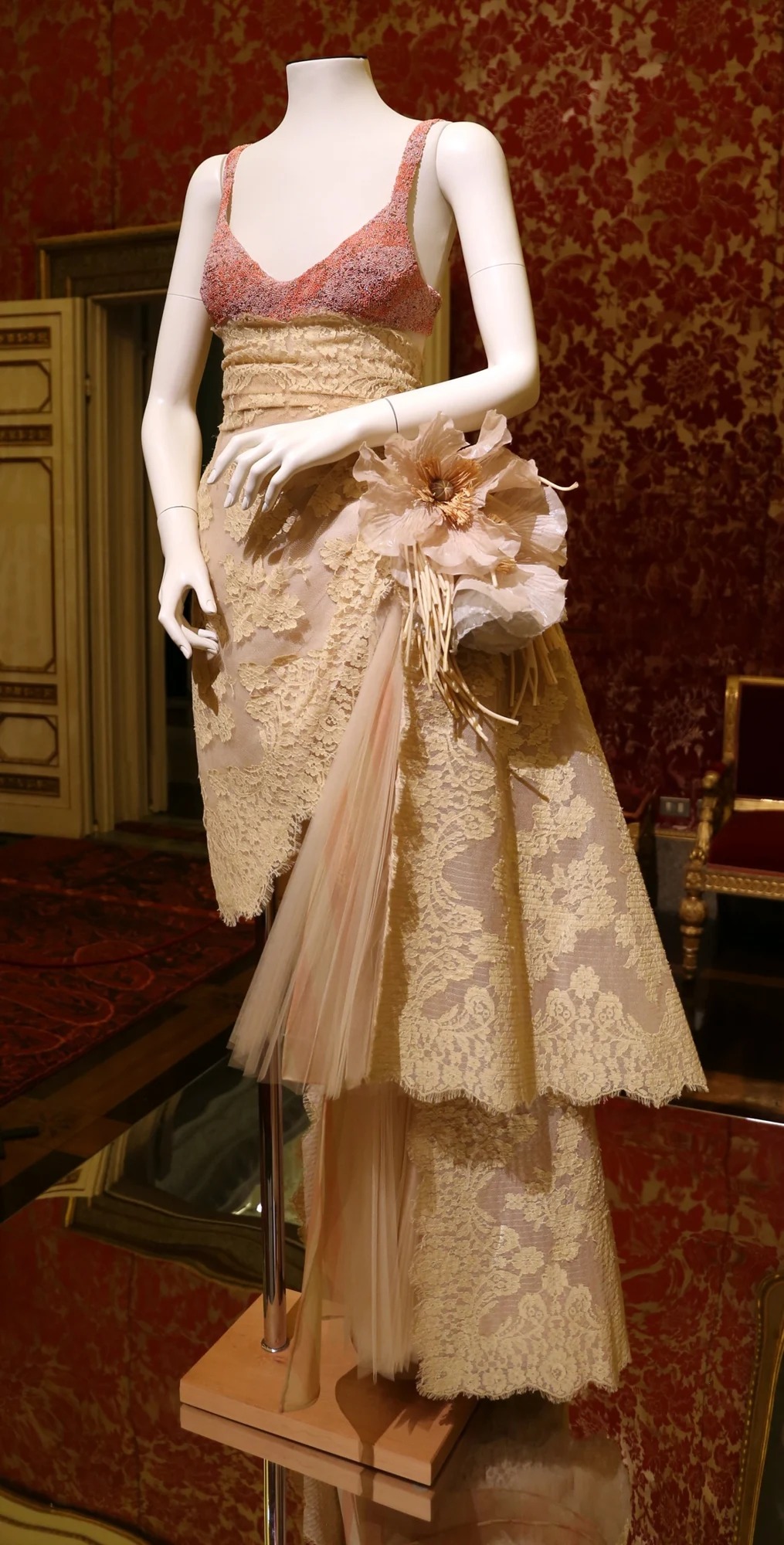
The photographed spring–summer 1989 couture ensemble combines tulle, lace, beads and organza. The close-fitting upper part and the descending layers have different densities. A thin textile does not necessarily make every area appear light: concentrated layers and ornament can create visual weight, while more transparent areas interrupt it. This offers a comparison with the formal questions raised by the white shirts. The object is identified here under Ferré’s own name and season, rather than being assigned to Dior without evidence.
A working archive after the designer’s death
The designer died in 2007. Gianfranco Ferré house history now depends on separating his lifetime work from subsequent products carrying the name. The Gianfranco Ferré Research Center at the Politecnico di Milano preserves and studies the archive, connecting garments with drawings, photographs and other records. The exhibition devoted to his shirts demonstrates how one recurring garment can support a detailed investigation of construction.
That focus provides a productive way to read the legacy. Instead of treating a striking image as proof of a fixed style, compare the neckline, sleeve, material and internal support from one example to another. Changes within a familiar format become visible. The connection to architecture then acquires a concrete meaning: not that a dress is literally a building, but that the designer approached proportion, organization and the transformation of a drawing into a physical object with sustained attention.
Timeline
- 1944 — Born in Legnano
- 1969 — Graduated in architecture, Politecnico di Milano
- 1973 — First working trip to India
- 1978 — Company founded with Franco Mattioli
- 1986 — First own-label couture collection
- 1989–1996 — Creative director at Christian Dior
- 2007 — Died in Milan
Sources
- Gianfranco Ferré Research Center — Biography and archival notes
- Gianfranco Ferré Research Center — La camicia bianca secondo me
- Image and object record — Gianfranco Ferré, couture bodysuit and skirt in tulle, beads, lace and organza, spring–summer 1989.
