Saint Laurent Mondrian dress history: painting in cloth
Saint Laurent Mondrian dress history explores the 1965 collection, wool jersey and seams concealed in a grid, comparing museum examples and later reinterpretation.
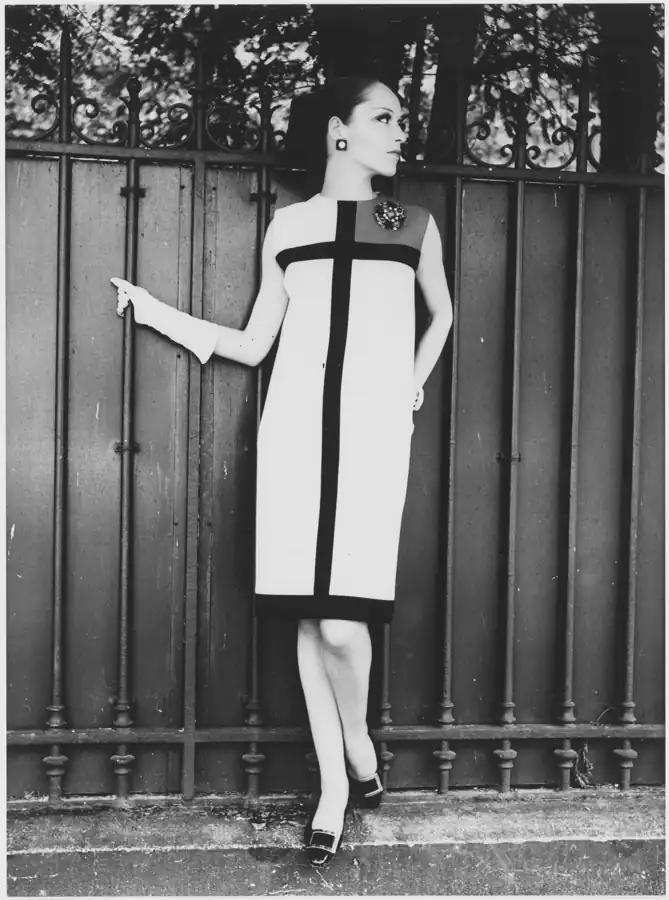
Not simply a printed painting
Saint Laurent Mondrian dress history begins with the spare dresses of autumn/winter 1965–66. Their grids and divided fields evoke Piet Mondrian, but the garments did more than reproduce a painting as a print. The Metropolitan Museum describes a construction assembled from separate pieces. A visual order became involved in the practical organisation of cloth. That distinction changes the story from one of borrowed imagery to one of making a body-sized object.
In Saint Laurent Mondrian dress history, colour blocks act as divisions as well as decoration. Their position can stretch or interrupt the perceived proportions of a body. The material, wool jersey, is not a rigid board, so its planes respond to movement. A line fixed on a canvas changes orientation when carried by a person. Translating the image therefore involves accepting the difference between a stable picture and an object that moves through space.
Planes and bodies in 1965
The relatively straight shift silhouette provides the period context for Saint Laurent Mondrian dress history. A broad front offers a legible field for a grid without the same interruption that dense folds would introduce. Yet apparent flatness does not remove the need to accommodate a three-dimensional wearer. Cloth still has to surround the body. Cutting and assembly, including the seams, make that possible while preserving an outward impression of directness and graphic clarity.
The black line’s double role
The most telling technical relationship in Saint Laurent Mondrian dress history is between the dark grid and the seams. The Met explains that shaping is absorbed into the grid of joins. A black line divides the visible colours while also helping to organise construction. The colour blocks are consequently more than isolated decorative patches. This is the point where an easily recognised image depends on work that a frontal photograph may make almost invisible.
What different museum objects show
Different museum objects expand Saint Laurent Mondrian dress history beyond one endlessly reproduced view. LACMA catalogues a wool-knit dress dated 1965; the Met preserves its own autumn/winter 1965–66 example. The objects belong to a common subject without needing to be identical. Comparing them allows variation to remain visible. The term wool jersey describes a material and construction context, but each museum record still matters for identifying the particular garment being discussed.
A recurring theme
The Paris museum also documents a Mondrian-related dress from spring/summer 1997 rive gauche. That later return gives Saint Laurent Mondrian dress history a second chronological point. A subject can be revisited without the later garment becoming an original 1965 object. The continuity belongs to a visual language; each dress has its own date and form. Repetition creates a comparison across time rather than erasing the time between the two works.
Translation between painting and dress
The importance of Saint Laurent Mondrian dress history lies in the differences between media as much as their resemblance. A canvas occupies a wall, while a dress encloses a moving person. Seams perform part of the work needed to cross that gap. Seen this way, the relationship between art and fashion is not only an exchange of famous names or recognisable images. It is also a practical negotiation between flat composition, flexible material and a body.
Timeline
- 1965–1966
- Mondrian-inspired dresses appeared in the autumn/winter collection.
- 1969
- The Met received the dress now catalogued as C.I.69.23.
- 1997
- The Mondrian theme returned in spring/summer rive gauche.