Saint Laurent Le Smoking history: tailoring the evening
Saint Laurent Le Smoking history examines the 1966 women’s tuxedo, its couture reception and rive gauche context, following a new vocabulary for eveningwear.
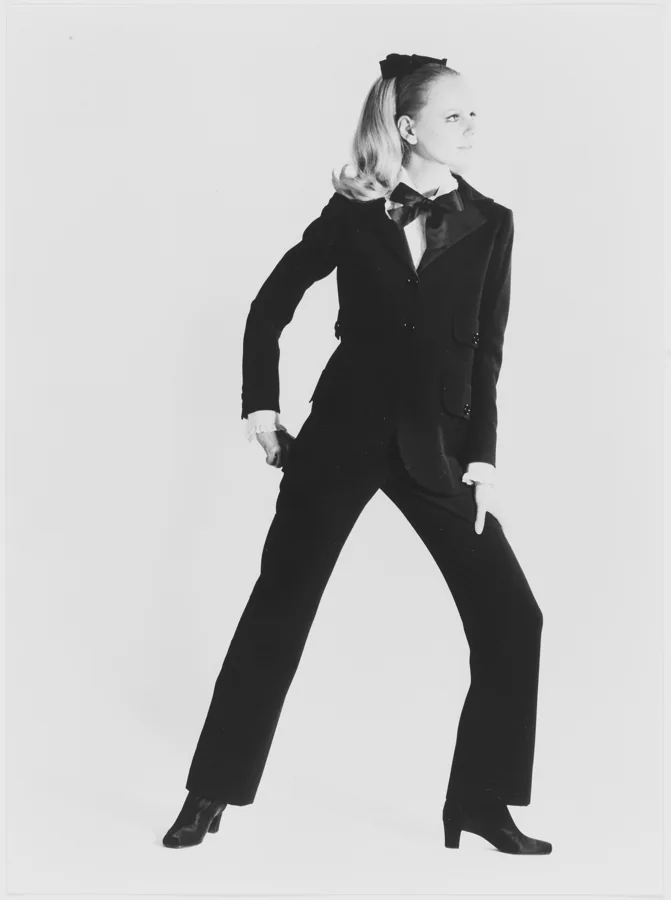
Another choice for evening
Saint Laurent Le Smoking history begins in the autumn/winter 1966 collection. Alongside the dress as an established form of eveningwear came a jacket-and-trouser proposition. The women’s tuxedo drew on masculine formal dress but was recut for a female body. Its significance does not require claiming that Saint Laurent invented women wearing trousers. The more precise development was a forceful proposition about what could constitute a woman’s formal evening wardrobe.
Reading Saint Laurent Le Smoking history through construction begins with the division between upper and lower garments. Where a dress can present a continuous length, a suit establishes a junction between the jacket hem and the trousers beneath it. Opening the jacket changes that relationship again. Shirt, lapel and trouser line each contribute to the whole. The apparent simplicity of the ensemble should not obscure the number of decisions involved in establishing its proportions.
Reception and another audience
The museum records only one sale of the initial couture model, followed by success in ready-to-wear. That contrast is central to Saint Laurent Le Smoking history: a work’s later reputation need not resemble its first reception. The women’s tuxedo was not immediately an ordinary choice for every client. Considering rive gauche adds another dimension to its development, because the route by which clothing reaches an audience affects how a new proposition becomes wearable.
A distinct ready-to-wear collection
The boutique that opened at 21 rue de Tournon on 26 September 1966 forms part of the setting for Saint Laurent Le Smoking history. The museum describes rive gauche as a separate collection rather than merely cheaper copies of couture. Commissioning a made-to-measure garment and choosing a developed garment in a shop involve different systems. A designer’s visual language could consequently enter another context without every object being the same as its couture counterpart.
Recutting the body
Tailoring in Saint Laurent Le Smoking history cannot be explained as simply making a man’s suit smaller. The shoulder, waist and trouser line establish relationships across the entire body. In eveningwear, formality need not depend only on the quantity of decoration. Direction, proportion and the organisation of a central opening can also carry it. This analysis keeps the garment visible as a made object while recognising that its choice of clothing type had cultural implications.
A design developed through repetition
Saint Laurent continued to revisit the tuxedo through 2002. Saint Laurent Le Smoking history therefore concerns a recurring subject rather than the preservation of one immutable 1966 specification. Jacket length and trouser volume are meaningful variables when comparing dated examples. Continuity of a design idea does not remove the particularity of each iteration. It is the relationship between these levels—the enduring proposition and the individual garment—that makes repetition a creative process rather than simple duplication.
A legacy larger than one suit
The legacy of Saint Laurent Le Smoking history extends beyond one black suit. It widened the available vocabulary of formal dress while remaining grounded in the construction of jackets and trousers. Later interpretations belong to their own designers and dates; they should not be retrospectively assigned to the founder. Holding that distinction preserves the long life of the idea without turning many different garments into one undifferentiated image or claiming that social change followed a single outfit.
Timeline
- 1966
- Le Smoking appeared in the autumn/winter collection.
- 1966-09-26
- The Paris rive gauche boutique opened.
- 2002
- The tuxedo remained part of the founder’s work through his final couture collection.