Saint Laurent history: Tuxedos, art and ready-to-wear
Saint Laurent grew from the Paris house established by Yves Saint Laurent and Pierre Bergé. Its history connects tailoring, artistic references and ready-to-wear with changing wardrobes.
ÉPOPLI ·
Saint Laurent Product histories →
- Brand
- Saint Laurent
- Origins
- Founded in Paris, France
- Focus
- Couture heritage, ready-to-wear and accessories
Rethinking evening dress
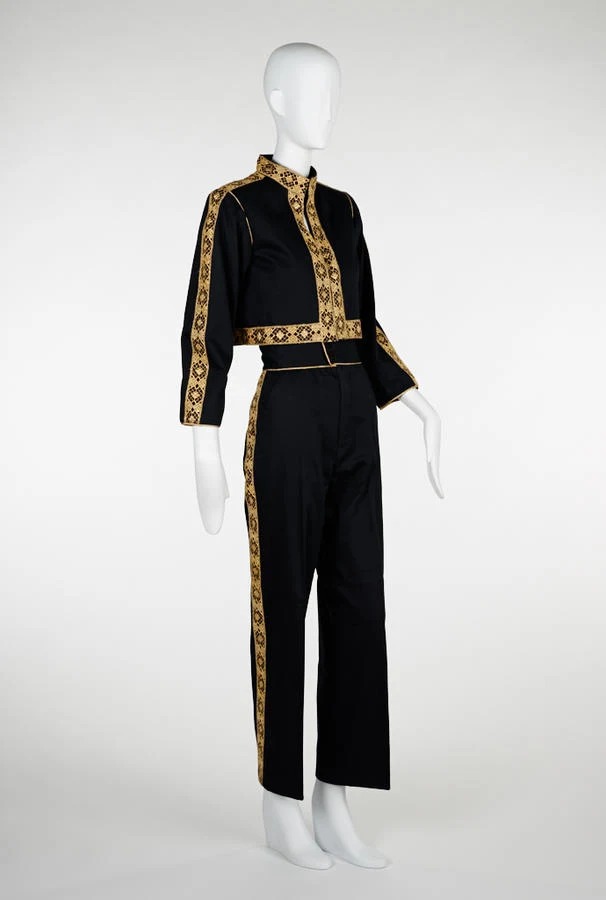
An evening outfit built around trousers rather than a dress provides a concrete starting point for Saint Laurent history. Le Smoking, introduced in 1966, transferred a masculine formal vocabulary into a woman’s wardrobe. It was not simply a smaller men’s suit: shoulder, waist, jacket length and trouser line required adjustment. The museum account documents both a garment and a challenge to convention. That does not mean every woman immediately gained the same freedom to wear it everywhere. Social settings changed unevenly. Structure and context must be examined together. Dark cloth against a light shirt concentrates attention on line and posture rather than abundant ornament.
Two roles behind one name
Distinguishing the house’s establishment in 1961 from its first collection in 1962 clarifies Saint Laurent history. Yves Saint Laurent and Pierre Bergé founded the business together, combining design with management. A designer’s name on the label does not mean that the enterprise was built alone. Workshops, fittings, premises and a commercial structure were necessary to realize the proposals. The founder’s previous career matters, but a brand account should examine what the independent house offered and how it operated rather than repeat a biography. Couture and the subsequent expansion into ready-to-wear addressed different scales of production and access, broadening the identity carried by the same name.
Painting translated into construction
The Mondrian dress of 1965 asks what it means to translate painting into clothing. The museum discusses colour blocks and black lines realized through construction. Saint Laurent history here distinguishes naming an artistic source from analyzing a garment. Recognizing the painter does not explain where seams meet or which parts of the body a line crosses. A Mondrian dress cannot remain a perfectly flat picture once worn: the body and movement alter it. That difference creates tension between media. Studying colour in relation to cutting is more precise than saying that the garment borrowed an artist’s fame. Translation involves retaining some relationships while changing others.
Tailoring for another body
Returning to Le Smoking reveals a change of composition rather than a simple addition of decoration. Lapels direct lines toward face and chest; trousers establish a vertical emphasis. Its recurrence in Saint Laurent history cannot be explained by fame alone, because the format permits continued changes of material and proportion. Separate the dated original from later versions. This suggests a wardrobe grammar rather than one permanently fixed answer. It does not establish that every women’s tuxedo originated with this house. A specific documented collection and its development are the subject. Symbolic importance and tangible tailoring should remain visible together.

A different route to the wardrobe
The rive gauche store and ready-to-wear venture of 1966 changed how customers encountered the label. Museum documentation contrasts this development with individually commissioned couture. Saint Laurent history loses something if rive gauche is described only as cheaper clothing. Standard sizes reorganize the process of selecting and wearing a designer’s proposal. They still require cutting and fitting knowledge, now directed toward repeatable production. Store setting and the objects displayed together also affect interpretation. Couture and ready-to-wear are therefore better understood as different production and distribution systems than as a simple hierarchy. The expansion changed the relationship among designer, garment and customer.
The founder and the continuing brand
A house name can outlast the people and structures producing its clothes. Saint Laurent history therefore separates the founder’s couture, early ready-to-wear and later designers’ collections. A recurring tuxedo or artistic reference is not automatically a new work by the founder. Successors select existing elements and alter scale, mood and context; that is both inheritance and individual work. The museum preserves and explains the founder’s contribution rather than documenting every current retail product in the same way. Recognizing the different roles of sources connects past and present without confusing authorship, especially where a person’s name also identifies a continuing company.

Three changes to the wardrobe
Saint Laurent history leaves three distinct changes: tailoring asks who can wear a formal convention; a colour-blocked dress asks how an artistic image can occupy a body; ready-to-wear retail changes how that clothing is selected. Form, meaning and distribution influence one another. No single black suit or portrait can explain the whole house. Record an object’s date, making and presentation before comparing later versions. Familiar clothing may have entered a very different set of rules when first proposed. Understanding that distance makes the archive evidence for the construction of today’s wardrobe, rather than simply a catalogue of past trends or a sequence of flattering descriptions.
Placed together, the examples connect changes in form with changes in access.
Timeline
- 1961 — The house is established
- 1962 — The first collection is presented
- 1965 — Colour-blocked dresses reference painting
- 1966 — The tuxedo and ready-to-wear store mark new directions
Questions and answers
Who established the house?
Yves Saint Laurent and Pierre Bergé established it together; founding in1961 and the first collection in1962 are distinct events.
Are the colour-blocked dresses merely printed images?
The museum explains the relationship between colour blocks, lines and garment construction; individual object records should be consulted.
Why does the ready-to-wear venture matter?
It connected the designer’s proposals to wardrobes through a production and retail system different from individual couture commissions.