Gucci Jackie 1961 history: design and change
Gucci Jackie 1961 history follows the original silhouette and its 2020 return, tracing the piston closure, vintage references, craft and changing ways of carrying.
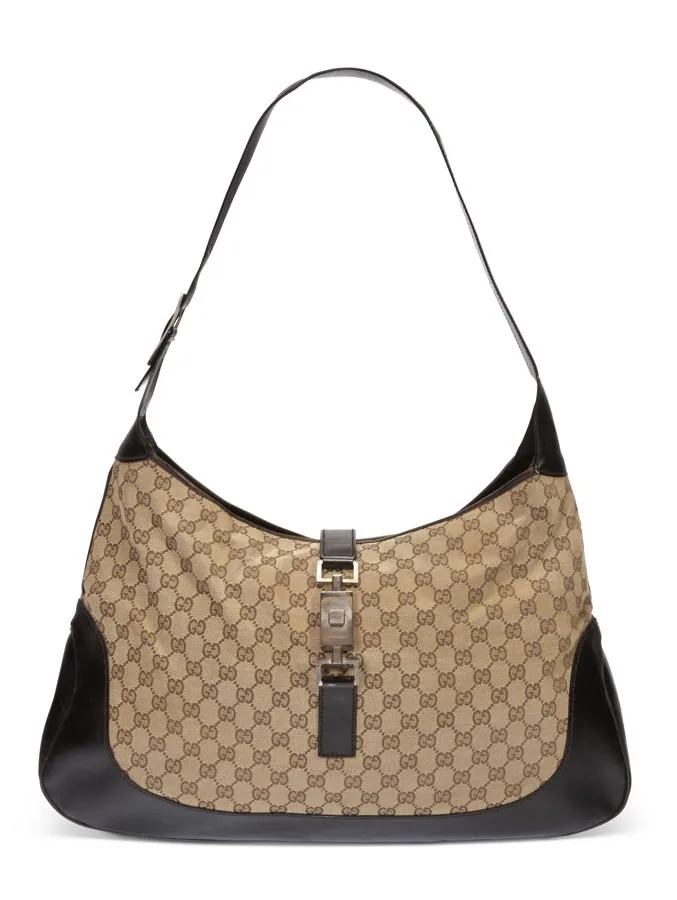
Two moments inside one name
Gucci Jackie 1961 history has two distinct dates at its centre: the original bag’s appearance in 1961 and Alessandro Michele’s reinterpretation in 2020. A historical year in a contemporary name does not make the contemporary object an exact copy. The curved silhouette remains recognizable, while decisions about size, strap and colour establish another moment in its development. Continuity and revision need to be described together.
A curve interrupted by a fastening
The piston closure gives the curved body a vertical point of emphasis. It is a fastening before it is a recognizable sign. Rather than describing the design only through the absence of a large logo, one can observe how a working component organizes its front. The relationship between opening, strap attachments and body also affects how this shoulder bag appears beside the person carrying it.
A Gucci archive example from the early 1970s, documented by Christie’s, combines GG fabric, brown leather and a Web ribbon. Repeated motif and stripe intersect on the curved body. An oversized GG canvas Jackie dating to around 2000 later appeared in André Leon Talley’s collection, offered in 2023. These examples connect changing scale and surfaces with the wardrobes of identifiable people and with the broader fashion record.
A 2020 return through vintage
Gucci explains that Michele worked from a vintage bag in his own collection. His Jackie 1961 appeared at the men’s Fall Winter 2020 show in mini, small and medium versions, presented across men’s and women’s styling. A longer detachable strap also drew on an older example. The vintage bag thus supplied a practical reference as well as a silhouette, connecting archive research with a different range of carrying possibilities.
Craft and the scale of the object
The making film returns the completed shoulder bag to work on its constituent parts. Curves emerge through cut surfaces and edges; fastening and strap turn those surfaces into something carried on the body. When a front looks simple, the placement of each component has particular visual weight. The piston closure concentrates that relationship between working mechanism and overall composition in a single point near the centre.
Scale changes the relationship with the body even when the outline remains familiar. A longer strap moves the bag to a different height; a smaller body changes how much of an outfit remains visible around it. Colour affects the contrast between the leather and the fitting. These observations explain variation without turning Gucci Jackie 1961 history into a ranking of sizes, colours or supposed investment prospects.
What it means to retain the past
A product history is therefore more than its first release date. Original form, later archival interpretation and contemporary production constitute different layers of evidence. Each photograph should retain the date and version it actually depicts. Read this way, Gucci Jackie 1961 history records a continuing conversation between recognizable shape and new decisions, rather than claiming that one unchanging object has passed intact through every decade.
Timeline
- 1961
- The original Jackie bag appeared.
- 2020
- Alessandro Michele presented Jackie 1961 at the men’s Fall Winter show.