Gucci Horsebit 1953 loafer history: design and change
Gucci Horsebit 1953 loafer history, from its 1953 debut to later interpretations: explore equestrian hardware, leather construction and a lasting design language.
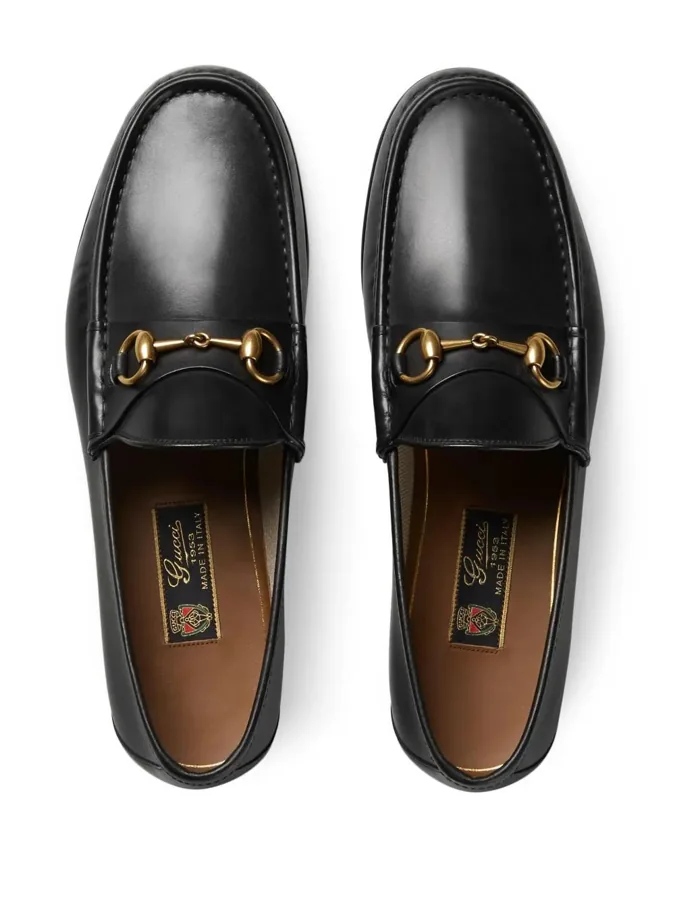
A small fitting across the foot
Gucci Horsebit 1953 loafer history begins with a small fitting across the foot. Gucci dates the design to 1953 and credits Aldo Gucci with its introduction. The leather loafer uses equestrian hardware as a visual reference, not as functioning riding equipment. That distinction matters: an everyday shoe borrows the appearance of a bridle fitting and gives it a new setting, proportion and purpose.
Where a loafer meets an equestrian code
Founded in Florence in 1921, Gucci extended its vocabulary into footwear through Aldo’s design. The leather loafer sets a relatively quiet upper against a reflective metal ornament. A short transverse line directs attention across the instep rather than along the toe. The upper is not covered in pattern: one small fitting becomes recognizable precisely because it is isolated against a broader expanse of leather.
The Metropolitan Museum of Art holds a pair dated around 1972, made from leather and metal and donated by Barbara and Gregory Reynolds in 1984. This surviving object places the familiar equestrian hardware in a particular historical example. A museum record adds a different kind of time to the campaign image: footwear once belonging to daily life becomes material preserved for examination and comparison.
Construction changes the meaning of decoration
Gucci’s making film returns the finished silhouette to a sequence of material operations. It encourages a close view of leather and assembly rather than treating the fitting as a logo pasted onto an anonymous shoe. Width across the vamp, the leather visible beneath it and the distance to the toe work together. The making sequence gives the familiar sign a material setting, showing how it belongs to the larger composition of the upper.
Changing proportions after seventy years
The seventieth-anniversary material and the Spring Summer 2024 menswear release show the design being revisited rather than simply preserved as a replica. The number 1953 identifies an origin; it is not the manufacturing date of a present-day pair. Sole, upper and finish belong to the particular version being discussed. This separation allows an archive to describe continuity without erasing the decisions made by later design teams.
Proportions remain important even when the familiar fitting survives. A thicker sole changes the distance between upper and ground; an extended toe changes the fitting’s apparent position. These are visual observations, not claims that one interpretation is necessarily more comfortable or durable. Gucci Horsebit 1953 loafer history can consequently be read through what changes around the recognizable sign as well as through the sign itself.
Reading the house through a shoe
The object matters because it brings together a borrowed image, leatherworking and a moving body. Historical photographs and current product images should therefore retain their own dates and descriptions. The metal ornament connects successive moments without making them identical. Gucci Horsebit 1953 loafer history is most revealing when that recognizable detail helps the reader notice changes in the surrounding shoe, rather than distracting attention from them.
Timeline
- 1953
- Aldo Gucci introduced the Horsebit loafer.
- 약 1972 / c. 1972
- The date assigned to the loafers held by the Metropolitan Museum of Art.
- 2023
- The house revisited its history and construction for its seventieth anniversary.