Gucci Bamboo bag history
Gucci Bamboo bag history traces the 1947 handle, its craft process and later revivals, with documented vintage transformations and collaborations across cultures.
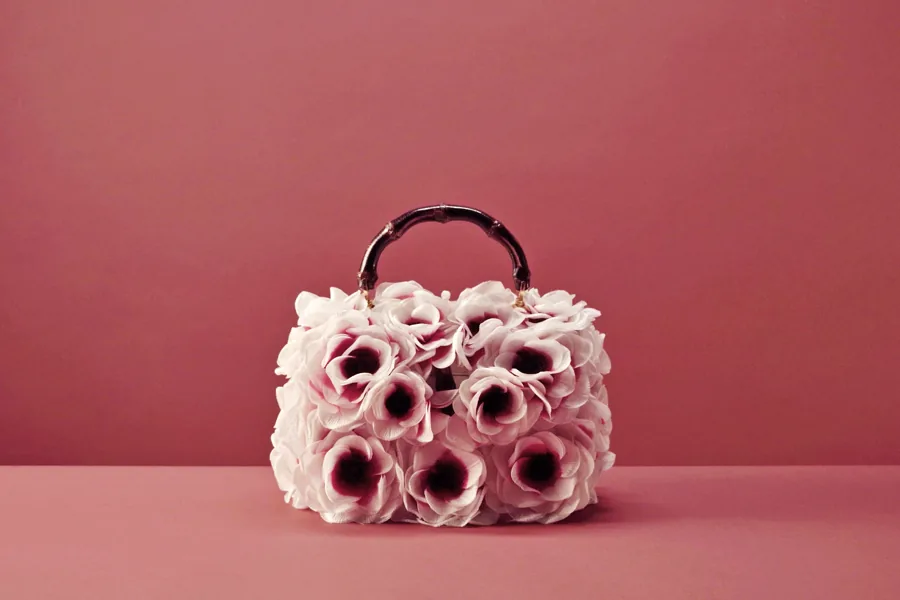
A different material above leather
Gucci Bamboo bag history begins with the decision to make a handle from something other than leather. The house places the design in post-war Italy in 1947, when access to traditional raw materials was constrained. Guccio Gucci worked with Florentine artisans on the idea. A rigid curved element above a leather body created a practical grip and a strong visual distinction. The bamboo handle concentrates attention at the point where hand and object meet, making construction itself part of the bag’s identity.
The curve is made, not found
The official making account describes selecting bamboo, softening it over flame, bending it and applying layers of finish before further heating. Here, heat shaping turns a length of natural material into a controlled curve. The grain and nodes still retain differences between individual pieces. Looking at those variations explains why the bamboo handle does not resemble a perfectly uniform metal component. The visible result combines an organic material with repeated, skilled decisions. In this process, heat shaping is both a technical operation and part of the finished object’s appearance.
A number before a familiar name
Christie’s identifies the first model by the number 0633 and situates its subsequent popularity in the 1950s and 1960s. The date now included in the Bamboo 1947 name refers to an origin, not to the manufacture of every bag bearing it. Colour, material and proportion vary across examples. Reading an archive photograph means examining those differences rather than treating a famous wearer as the whole story. The upper curve and the lower leather volume establish a relationship that can remain legible even as individual details change.
A recognisable form returns
Gucci Bamboo bag history includes a 2022 reissue in several sizes and colours. Its significance lies in the ability to retain recognition while accommodating new choices around the body, strap and fittings. An archive model can supply a vocabulary without dictating every later specification. Comparing contemporary examples is most useful when it separates a recurring principle from a particular product’s dimensions. The persistent curve gives the family continuity; it does not turn every version into a duplicate of the original.
Old bags become new collaborative works
Special pieces presented by Christie’s in 2023 paired vintage bags with newly made interventions. Their records distinguish the date of an earlier object from the date of its reworking. Handles in gold or Murano glass could replace the expected material, changing the visual weight of a familiar component. Such works make an archive active in a literal sense: an existing object becomes the support for further making. Keeping both dates visible is essential, because the intervention and the original bag belong to different historical moments.
A meeting of craft traditions
Gucci’s 2024 report describes a Ginza exhibition of sixty vintage Bamboo bags reinterpreted with Japanese artists and artisans. Participants worked across disciplines including metalwork, ceramics, lacquer, photography and painting. Rather than explaining these pieces only through the prestige of a name, one can ask what each intervention preserves and what it transforms. That approach turns the product into evidence of a conversation between techniques. A repeated form becomes a place where makers from different settings can leave specific and identifiable contributions.
Timeline
- 1947
- The bamboo-handled bag appeared.
- 2022
- The Bamboo was reissued in different sizes and colours.
- 2023
- Special reinterpretations of vintage bags appeared at Christie’s.
- 2024
- A Ginza exhibition presented sixty vintage bags reworked with Japanese artists and artisans.