Fendi Peekaboo ISeeU history: form and reinvention
Fendi Peekaboo ISeeU history separates the original Peekaboo from its 2020 evolution, exploring the opening, accordion frame, Selleria stitching and campaign.
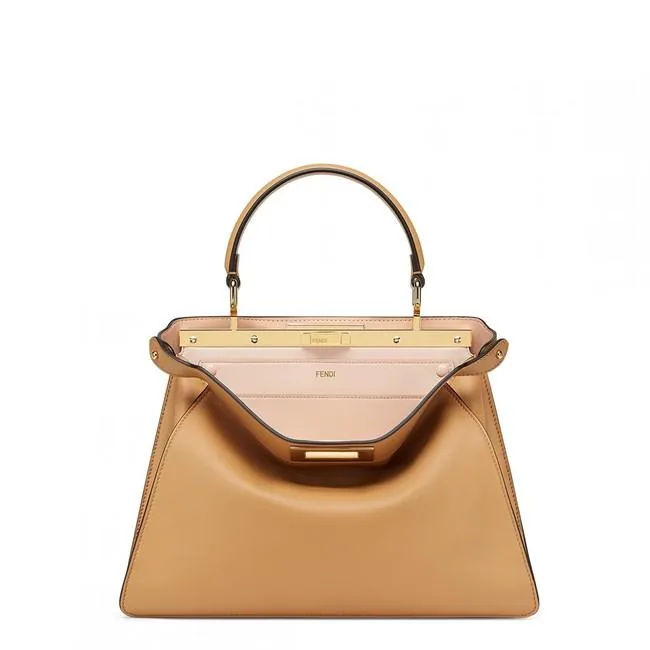
An expression completed by opening
Fendi Peekaboo ISeeU history can be approached through a movement: the front lowers and reveals the interior. A composed closed outline acquires another expression when opened. In a direct interview, Silvia Venturini Fendi described a balance between softness and the ability to retain volume. Character comes from what the material does, rather than from an additional decorative emblem placed on an otherwise finished surface.
The 2008 presentation and 2009 release
The original Peekaboo was presented in late 2008 and reached the market in spring 2009. Silvia Venturini Fendi gave that sequence in her retrospective interview. The Spring Summer 2009 season and the earlier presentation date describe different stages of the same introduction. ISeeU belongs to a later chapter within the family, so its name should not simply be projected backwards onto the first model.
The front acts both as a wall concealing the contents and as a surface through which the interior becomes visible. Opening changes the amount of colour and material information available to the eye. The user’s gesture consequently participates in the design. Rather than possessing one definitive face, the bag moves between states, with different curves and relationships becoming apparent in the open and closed positions.
ISeeU in 2020: a deeper opening
Fendi Japan’s 2020 release documents the new version shown that February for Fall Winter. Its accordion frame supported a deeper opening, with an exchangeable interior pocket. The accordion frame makes the expanding side structure part of the design’s explanation. Against that supporting framework, the descending leather front becomes more legible. ISeeU develops the earlier reveal through a particular structural revision rather than merely renaming the original bag.
A campaign of gesture and music
An August 2020 campaign featured actor Zoey Deutch, accompanied by The Horrors’ song I See You. The film connected the revelation of the interior with the performer’s gestures. Name, music and movement returned to the same idea of seeing and being seen. The object was staged as something activated by a body, extending the formal reveal into a short piece of visual storytelling.
The documented black Selleria medium provides a different, material perspective. Fendi specifies 1,414 hand-sewn topstitches for that reference. Selleria stitching makes boundaries visible across the leather, directing attention to edges and assembled surfaces. The number belongs to this example rather than to every Peekaboo. It gives a precise point of contact between the shape seen in campaigns and the manual work described in the product record.
From bag to an archival book
The 2024 presentation of Peekaboo-k brought eighty archival bags into a photographic volume. The family’s conversation and different photographers added further perspectives to a product already developed through successive versions. Within that larger record, Fendi Peekaboo ISeeU history occupies a distinct position: an inherited idea of revelation, revised structure and specific material examples meet. The opening remains the action connecting those layers, even as their forms and images change.
Timeline
- 2008–2009
- The Peekaboo was shown in late 2008 and released in spring 2009.
- 2020
- ISeeU appeared in the Fall Winter collection.
- 2024
- A family interview revisited the design alongside Peekaboo-k.