Fendi Baguette history: form and reinvention
Fendi Baguette history connects its 1997 debut with textile craft, screen culture and anniversary reissues, following a small bag through changing surfaces.
A small bag beneath the arm in 1997
Fendi Baguette history begins in 1997 with a small shoulder bag designed by Silvia Venturini Fendi. Its name evokes a French loaf tucked beneath the arm. The horizontal body and short strap keep the object close to clothing rather than suspending it far below. That relationship helps explain the importance of its surface: textile, embroidery or leather can read almost as another area of the outfit.
Lisio, the collaborator behind the surface
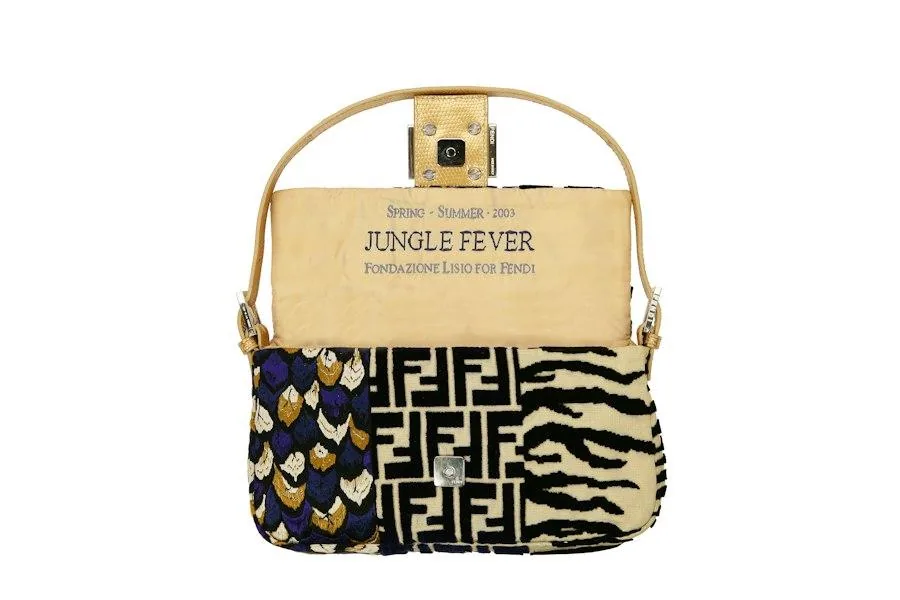
Fendi began working with Florence’s Fondazione Lisio in the same year. The foundation records fabrics for eleven collections between 1997 and 2005. Handwoven silk brought textile craft into the body of the bag itself. This was more than a decorative afterthought: the fabric required collaboration between the house’s design decisions and the foundation’s preparation and weaving, giving the small object a substantial manufacturing history.
An early FF velvet arranged the double-F motif across the surface. Cut and uncut pile handle light differently, giving the emblem depth rather than leaving it as a flat printed sign. Here textile craft becomes a way of changing how the bag is seen. The compact outline provides a consistent frame against which differences in reflection, density and texture become particularly apparent to the viewer.
Successive surfaces within one outline
Lisio’s archive preserves named seasonal examples, including Heavenly Spring from 1999 and Haute Summer from 2000, followed by The Wall for the 2007 Great Wall show. Those names and dates turn an abstract claim about craftsmanship into identifiable work. The recurring outline serves as a frame in which different surfaces can accumulate, allowing a product family to function as a record of successive material experiments.
After the bag entered the screen
Silvia Venturini Fendi’s shoulder bag also became associated with Carrie Bradshaw, played by Sarah Jessica Parker in Sex and the City. Screen appearances placed it inside a character’s wardrobe and an urban narrative. Viewers encountered not merely a container but an object connected with scenes and gestures. That cultural circulation is a separate chapter from the 1997 design, adding remembered images to the bag’s material development.
For the twenty-fifth anniversary in 2022, twenty-five archive designs returned in reinterpretations. Bringing back several surfaces rather than just one representative colour made the breadth of the archive visible. An anniversary edition is a later object, but comparison with its source reveals what the house chose to preserve. Such a collection is also an editorial act: it selects which earlier designs will stand for the larger story.
A compact object with a layered record
The Baguette’s continuity rests on several interacting elements: close-to-body proportions, a recognizable outline, a surface open to transformation and remembered screen images. Fendi Baguette history becomes richer when these are considered together. Textile archives and cultural appearances are not competing explanations. They are different traces left on the same product family, making a small bag a useful point of entry into a much larger fashion history.
Timeline
- 1997
- Silvia Venturini Fendi introduced the Baguette.
- 2007
- Fondazione Lisio made a textile for the Great Wall show.
- 2022
- Archive designs returned for the twenty-fifth anniversary.