Models · 009
Peggy Moffitt
Life & Career
- Born
- 1937-10-02
- Died
- 2024-08-10
- Nationality
- American
Origins
Born in Los Angeles in 1937, Moffitt studied performance and took small film roles before becoming a leading model. Theatrical training informed her expressive physical style.[1][2]
Entry into fashion
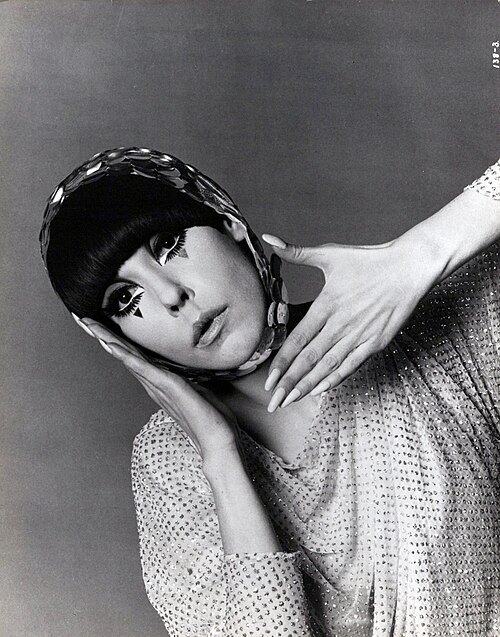
Her collaboration with Rudi Gernreich and photographer William Claxton integrated garment, gesture and image. Later museum exhibitions accordingly treated the three as creative partners.[1][3]
Creative partnership
Graphic makeup, geometric hair and mime-like gestures created a coordinated total look. Her deliberately constructed appearance offered an alternative to a single supposedly natural beauty ideal. Angular movement emphasized the lines of the clothing and brought a theatrical quality even to a flat printed image. Hair and makeup were elements of the design rather than unrelated decoration.[1][2][3]
Defining work
The 1964 monokini photograph prompted international debate about dress and the body. It belonged to a wider design practice and should not eclipse the rest of her work.[1][2]
Changing direction
She appeared in Blow-Up (1966), while Claxton’s fashion films preserved her clothes in motion. Moving images help explain gestures that can seem merely exaggerated in isolated stills. Seeing still photographs, films and surviving clothes together clarifies the total look. A garment changes shape on a moving body, making the model’s interpretation part of how the design is understood.[1][3]
Later career
After Gernreich’s death she preserved garments and helped publish The Rudi Gernreich Book in 1991. Her collection enabled later exhibitions to reconnect photographs with surviving clothes.[1][2][3]
Legacy
MOCA revisited the collaboration in 2012. She died on August 10, 2024. Her broader legacy is the model as a co-creator across clothing, makeup, photography and performance.[1][3][4] Displaying films alongside garments makes the model’s contribution to a design visible. Compare the garment on its own with its appearance on a moving body. Pose, expression and hair participate in the impression it creates. This makes the roles of collaborators worth examining rather than assigning the finished image to one contributor. Film and still photography offer complementary views: speed and direction can reveal aspects of presentation that a single frozen frame does not show.