Models · 001
Lisa Fonssagrives
Life & Career
- Born
- 1911-05-17
- Died
- 1992-02-04
- Nationality
- Swedish
Origins
Born in Sweden in 1911, Fonssagrives trained in art and dance, including at Mary Wigman’s school in Berlin, and taught dance. Her bodily discipline helps explain the balance and extended lines of her later poses.[1][2] Dance training is more than a brief preliminary entry in the chronology. Observe the direction of the torso and the lines made by the arms, while keeping those observations separate from claims about a particular lesson. Early experience provides a perspective on later work, rather than a complete explanation of every pose.
Entry into fashion
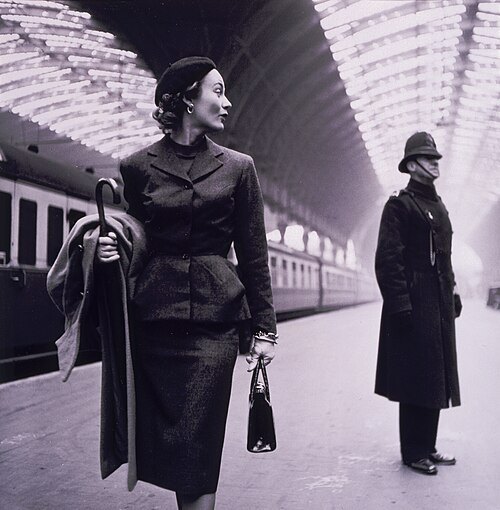
Work with Willy Maywald and Horst P. Horst in Paris in 1936 led her into modeling. Arriving from another art, she treated posing as an extension of movement and studied portrait painting for ways of arranging the body.[1][3] The transition also involved different working conditions: movement on a stage and a selected moment before a camera. Hand and foot placement participate in that still composition. Following the assignments behind the transition reveals more than a single debut date.
Creative partnership
Her collaborators included Fernand Fonssagrives, Hoyningen-Huene, Blumenfeld, Dahl-Wolfe and Man Ray. The range of settings and photographic approaches demonstrates a contribution extending beyond a single photographer’s muse.[2][3] Compare working conditions rather than memorizing every collaborator. A wide setting and a close view give the body different roles; an image may emphasize the full outline or one detail. The same subject offers a point of comparison across different photographic approaches.
Defining work
After moving to America in 1939, she became a major presence in postwar magazines. Her 1949 Time cover exemplified the emergence of the model herself as a recognizable public personality.[2][3] Distinguish the change of location from changes in public visibility. Interior magazine pages and covers introduce a subject differently. A celebrated cover is a milestone, while the work before and after it establishes continuity. Read preparation and repeated assignments together.
Changing direction
She married Irving Penn in 1950 and became an important collaborator in his fashion work. Their partnership should be understood alongside, rather than as a substitute for, her established independent expertise.[1][2] Observe which parts of the garment a pose reveals and which it conceals. A hand near the waist or away from the body changes the space in the image. Keep the biographical event of marriage distinct from professional collaboration so neither replaces the other in the account.
Later career
She continued making art, including sculpture and design, after reducing her modeling work. This was a return to interests predating fashion and gives her career a wider artistic continuity.[1][2] Different media need not serve an identical purpose. Presenting clothing in a photograph and making a three-dimensional object involve different processes. Preserving that distinction makes the change in her work meaningful and prevents the biography from ending at a single professional peak.
Legacy
She died in 1992. A 2024 Maison Européenne de la Photographie exhibition revisited her archive. “First supermodel” is a historical assessment; her documented importance lies in her agency as an image maker.[2][3] The exhibition connects dance, modeling and art making; image dates should be distinguished from later prints and exhibitions. One way to read this career is to look for the experience of movement within a still pose. The direction of a hand or the angle of the body helps present the garment. Different photographers and clothes produce different expressions, so a single celebrated image cannot stand for every assignment. Reading early performance alongside later art offers a way to compare approaches to form. A posthumous exhibition also selects and arranges surviving material. Record original production and later display separately. Present-day interpretation may differ from an image’s original purpose. Move between chronology and work descriptions when following the references.