Ottavio Missoni: Color Built into Knitwear
Color Built into Knitwear.
ÉPOPLI ·
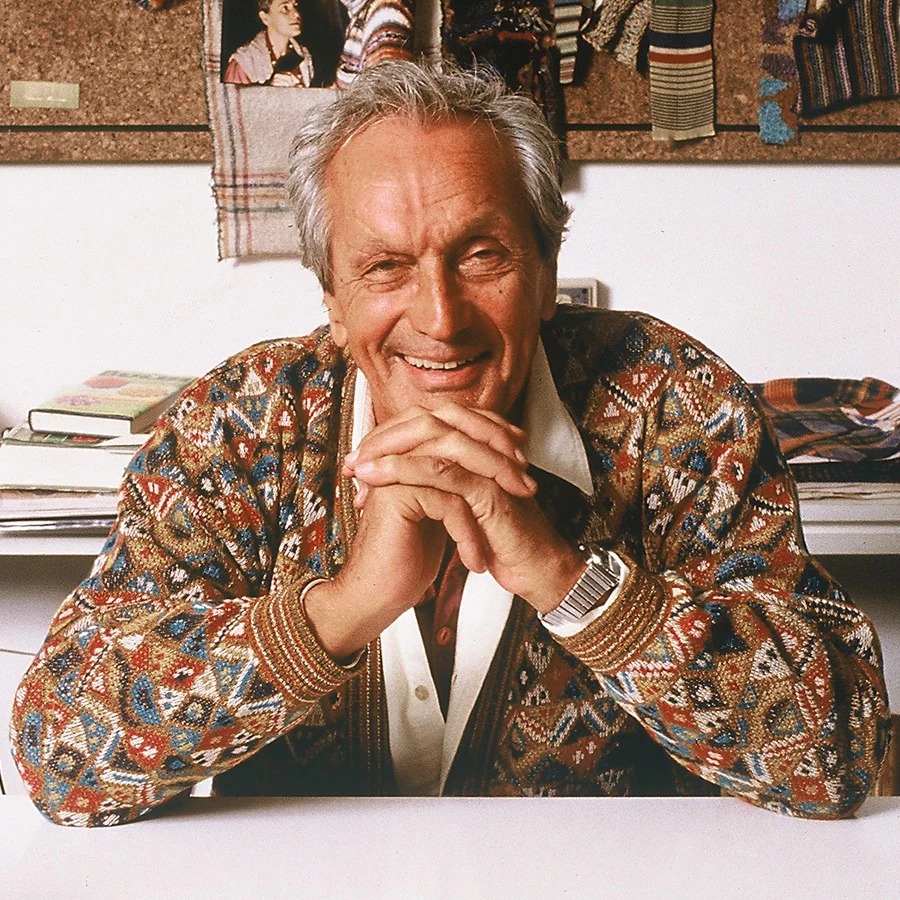
A pattern begins before a dress is cut
A Missoni fabric invites the eye to travel before it settles on the shape of the garment. Bands, broken lines and changes of color appear to move across its surface. Ottavio Missoni brand history starts with this relationship between the making of a textile and the making of an outfit. The pattern is often built into the fabric rather than printed as a finished image on top of it.
This changes the designer’s task. Yarn, stitch and the sequence of colors must be considered together. A sleeve cut from a patterned length may interrupt one rhythm and begin another at the shoulder. The finished look therefore depends both on the material’s internal organization and on Rosita Missoni’s work developing it into clothing. Treating the label as the achievement of one founder would conceal that partnership from the outset.
A passage that looks like a single field of colour from a distance can resolve into repeating structures of different yarns at close range. Comparing an overall view with a textile detail helps distinguish colour applied to a surface from colour built into its making.
Athletics before the fashion house
Born in Ragusa in Dalmatia in 1921, Ottavio grew up amid changing borders and later lived in several Italian cities. Athletics was an important part of his early professional life. He competed in the 1948 London Olympics, where he met Rosita Jelmini. Ottavio Missoni brand history also reaches back to the knitwear business he established with Giorgio Oberweger in Trieste, producing wool training suits under the Venjulia name.
A training suit has a clear relationship to the moving body. It needs to accommodate limbs, provide warmth and work as a repeatable product for a team. This practical beginning helps situate his later use of knitted material without pretending that every decorative choice came directly from sport. His wartime captivity and interrupted education belong to the biography, but they do not justify speculation about the psychological meaning of every subsequent color or motif.
A shared workshop in Gallarate
Ottavio and Rosita married in 1953 and established a small workshop in Gallarate. She brought experience from a family business producing shawls and embroidered fabrics. Ottavio Missoni brand history follows the growth of this partnership through the 1958 Milano-Simpathy collection for La Rinascente. Its striped shirt-dresses joined a simple, legible outline to a material with a strong visual identity.
The shift from a small workshop to department-store distribution required more than an attractive sample. Colors had to be reproduced, garments delivered and a collection understood by buyers. The label sewn into the clothes gave that work a recognizable name. Their collaboration with Louis Hidalgo and the attention of editors later helped the business develop. The early shirt-dress is consequently useful as both a design example and evidence of a production system finding its audience.
An old machine yields a different fabric
In 1962 the founders adapted machines previously used for shawls to make light, colorful clothing fabrics. Experiments with rayon-viscose followed. Ottavio Missoni brand history locates innovation in the adjustment of available tools and fibers, rather than in the claim that the house invented knitting. The knitting machines provided a framework of possibilities; design emerged from choosing and combining those possibilities.
A narrow repeat produces a different optical effect from a broad band. A dark interval may separate two bright colors, while a softer intermediate tone lets them merge. These observations explain why color composition is more specific than simply using many colors. The fabric can look dense in a small photograph yet become airy when held against light. Texture, transparency and the stretch of the loops all contribute to the experience of the garment.
From coordinated outfits to textile mosaics
The 1970 collection helped establish the approach described in the American press as put-together dressing. Different pieces could be combined within a related textile vocabulary. Ottavio Missoni brand history examines that idea alongside the patchwork made for a 1971 magazine cover at Anna Piaggi’s request, photographed by Oliviero Toscani. A garment assembled from distinct areas of pattern makes the joining itself part of the design.
The resulting surface can be compared to a mosaic, but it remains flexible clothing. Its fragments bend around a torso and move at the knees or elbows. A jacket and trousers need not repeat precisely the same pattern to appear connected; shared tones or a related scale can create continuity. This gives the wearer a role in arranging the final outfit, while the designer supplies a vocabulary within which those choices remain coherent.
Textile, exhibition and the work of looking
The exhibition of his fabrics at the Galleria del Naviglio in Venice in 1975 moved the work into a different setting. Later displays placed drawings, tapestries and garments in conversation with art. Ottavio Missoni brand history distinguishes this curatorial comparison from a claim that each fabric directly copied a particular painting. The surviving studies on squared paper show color composition being worked out through sequences and intervals.
In a patchwork tapestry, separate knitted fragments retain their textures while forming a larger field. The wall removes some of the movement supplied by a wearer and lets the viewer concentrate on relationships across the surface. Returning from the wall to a garment changes the question again: how does that field wrap, fold or break at a seam? The knitting machines, drawings and finished clothes belong together in the archive because each reveals a different stage of the process.
A family name with several authors
Ottavio died in 2013. Ottavio Missoni brand history keeps his lifetime experiments distinct from later collections by other members of the family and subsequent designers. Rosita’s contribution, Angela’s direction of fashion and Luca’s work with the archive form separate strands, even when they share a surname. The family archive makes it possible to trace those strands rather than attributing every Missoni product to the same pair of hands.
The most useful way to read his influence is to begin close to the material. Follow one line of yarn, notice where its color changes, and then observe what happens when the textile becomes a sleeve or a skirt. The recognizable zigzag is only one result of a broader investigation into rhythm and surface. That investigation gave industrially produced knitwear a visual complexity that could survive repeated use, reinterpretation and display beyond the runway.
Timeline
- 1921 — Born in Ragusa, Dalmatia
- 1948 — Competed at the London Olympics; met Rosita Jelmini
- 1953 — Married Rosita and established the Gallarate workshop
- 1958 — Milano-Simpathy collection at La Rinascente
- 1962 — Experiments with shawl-making machines
- 1975 — Textiles exhibited at Galleria del Naviglio, Venice
- 2013 — Died
Sources
- Archivio Missoni — Biography and company chronology
- Archivio Missoni — Marc Chagall, Ottavio Missoni: Sogno e Colore