Rosita Missoni: From a Collection to a Living Space
From a Collection to a Living Space.
ÉPOPLI ·
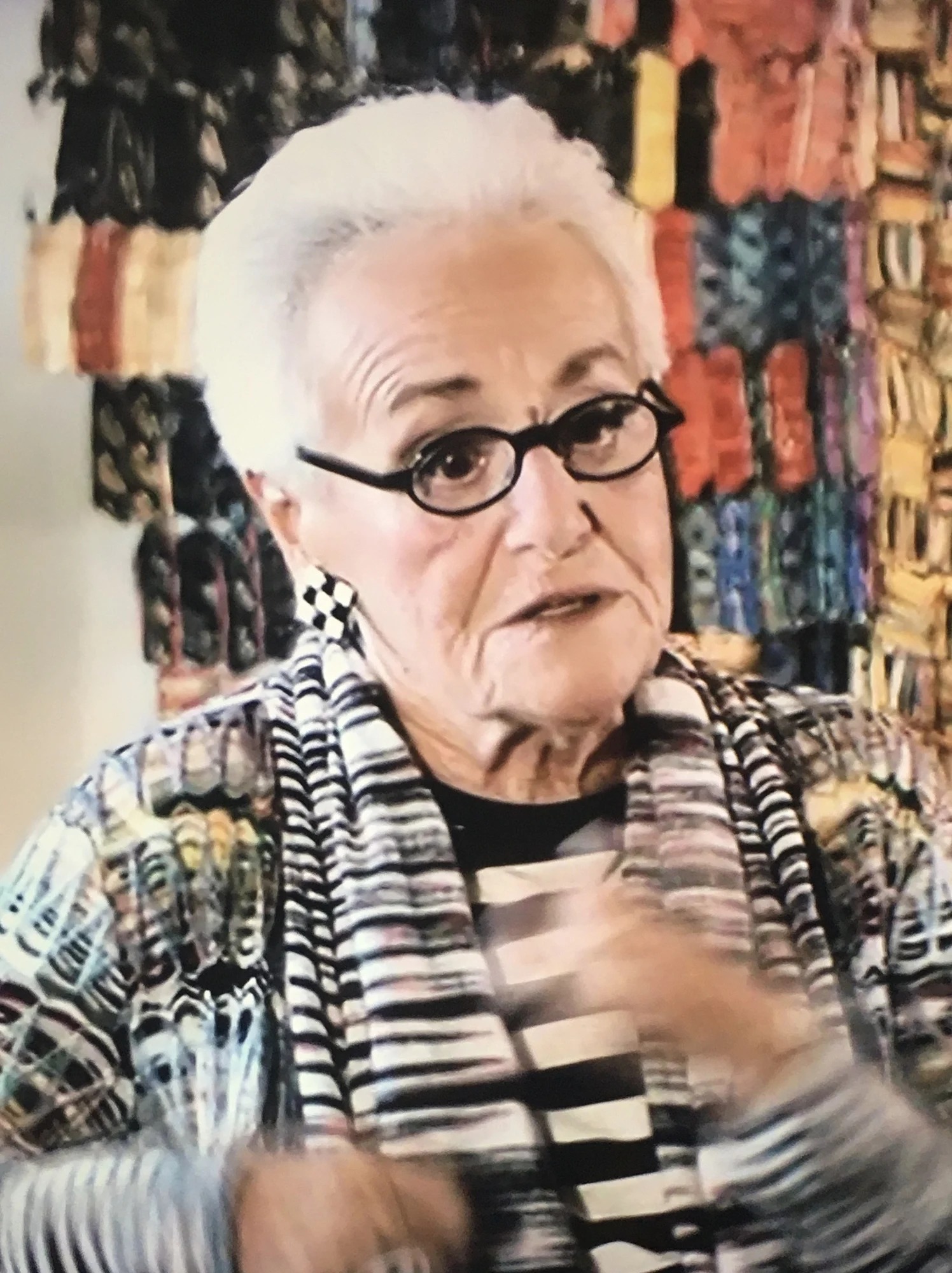
Making different patterns live together
A room filled with Missoni textiles offers a different view of the fashion house. Cushions, a rug and upholstery can carry unlike patterns without appearing unrelated. Rosita Missoni brand history begins with this ability to organize difference. Rosita worked with colors and surfaces as components of a larger setting, first around a body and later throughout a living space.
The same principle can be observed in an outfit. A jacket and skirt do not have to match exactly; their relationship may depend on scale, a repeated color or the balance of dense and open areas. The designer’s contribution lies in choosing how those elements coexist. It is not enough to describe the result as colorful. Looking at the intervals between patterns, and at the relatively quiet areas that allow them to be seen, reveals a more deliberate process.
A textile business before a fashion label
Rosita Jelmini was born in Golasecca in 1931, near the family’s shawl and embroidered-fabric factory. She studied languages and spent time in London in 1948, meeting the Olympic athlete Ottavio Missoni during that visit. Rosita Missoni brand history connects her later work to this documented experience of textiles and travel, without assuming that family background predetermined every design decision.
She began working on the creative side of the family business before marrying in 1953. The couple established their own workshop in Gallarate. Ottavio brought experience making knitted training suits, while Rosita’s familiarity with fabrics and clothing helped turn a production activity into a fashion proposition. Their roles overlapped and developed over time. Describing her only as a wife or muse would omit her work as a co-founder and designer, just as assigning every shared textile to her alone would distort the partnership.
A striped dress in a department-store window
The 1958 Milano-Simpathy collection at La Rinascente is an early landmark in Rosita Missoni brand history. A striped shirt-dress presented a clear outline and a repeatable product, supported by the store’s display and advertising. The clothes brought the workshop’s name to customers who had never encountered the founders in person.
This example shows how a collection becomes public. A textile can be compelling on a sample card yet still need a suitable shape, a price and a place of sale. The dress provided those relationships in a recognizable everyday format. Its stripes directed attention along the garment while the loose outline allowed the pattern to remain legible. The illustration by Brunetta used in advertising added another interpretation, translating the material object into a printed image. Retailers and image-makers were active participants in that transition.
Transparency becomes a public incident
At the 1967 Pitti presentation, light garments proved more transparent under the runway lighting than expected. Rosita’s decision about the models’ undergarments became a controversy, and the house was not invited back for the following edition. Rosita Missoni brand history treats the episode as a collision between fabric, lighting and the rules of a particular presentation, rather than reducing it to a story of deliberate provocation.
The subsequent presentation at Milan’s Piscina Solari used a different setting, including floating furniture. Moving the collection away from the established platform created room for another kind of display. These events also remind us that knitwear is not necessarily thick or opaque. Yarn, stitch and illumination change what can be seen through a garment. A museum photograph taken against a neutral background may therefore communicate something quite different from the same piece worn beneath intense show lights.
A collection as a set of choices
The put-together approach associated with the 1970 collection offered customers coordinated possibilities rather than a single rigid uniform. Rosita Missoni brand history looks at pattern combinations as a form of editing. One piece could repeat a color found in another without repeating its exact motif. A stripe, a zigzag and a more irregular surface could coexist when their visual weights were balanced.
Anna Piaggi and photographer Alfa Castaldi helped communicate the clothes through fashion images, while Diana Vreeland and American retailers supported their international visibility. Those relationships did not create the garments, but they shaped how a new audience understood them. The growing factory in Sumirago also mattered: recurring experiments needed a place where material knowledge could be retained. The public image of effortless dressing rested on choices made throughout design, manufacturing, styling and distribution.
From the wardrobe to the home
The house’s furnishing activities developed through several collaborations, including textiles for Saporiti furniture in the 1970s and the later MissoniHome business. After the children took greater responsibility for fashion and management in 1997, Rosita concentrated on interiors. Rosita Missoni brand history follows the home collection as a substantial phase of design work, not a retirement hobby.
A cushion places color close to the eye and hand; a curtain filters light; upholstery wraps a volume that stays in one place. These are different technical situations from a knitted dress. The scale of a motif may need to change, and repeated use raises questions of durability. These pattern combinations also extend across objects separated by space. The room becomes an arrangement that a person inhabits rather than an outfit that moves with the person. The shared visual language survives because it is adapted to those differences.
Recognizing a co-founder’s full career
Rosita died in 2025, after a career spanning clothing, textiles and interiors. Rosita Missoni brand history distinguishes her own work from the continuing activities of a company with subsequent creative and business leadership. Angela’s fashion collections, Luca’s archive work and later house products need their own dates and credits. A family name is not a substitute for identifying the author of a particular object.
Her influence can be read through the practical act of bringing things together. The early department-store dress, the light Pitti garments, coordinated separates and the home collection each organize material for a different use. In all of them, knitwear and other textiles become part of a life rather than isolated decorative samples. Close attention to the relationships between pieces makes her contribution visible and gives a more accurate account of the partnership that built the house.
Timeline
- 1931 — Born in Golasecca
- 1948 — Met Ottavio Missoni in London
- 1953 — Co-founded the Gallarate workshop
- 1958 — Milano-Simpathy presented at La Rinascente
- 1967 — Pitti presentation and subsequent move to another format
- 1997 — Children assumed leadership; focus shifted toward interiors
- 2025 — Died