Ossie Clark: Pattern Made to Move
Celia Birtwell’s flat designs meet a cutter’s three-dimensional forms.
ÉPOPLI ·
Cut on the diagonal
A halterneck dress at London Museum opens Ossie Clark history through movement. Three bias-cut skirt panels, a deeply open back and unequal arrangements of pleated flounces organize the body asymmetrically. Bias cutting places cloth diagonally to its woven grain, allowing a more fluid fall. Decoration on one side of the skirt answers detail at the opposite shoulder. The record gives conflicting dates, so this is treated as an early-1970s work. Its construction remains clear: different parts respond at different moments as a wearer turns.
Student experiments
Ossie Clark history begins with a designer born in 1942, raised in north-west England and educated in Manchester before attending the Royal College of Art from 1962 to 1965. Raymond, known as Ossie, made student work with Op Art patterns and a battery-lit coat. Op Art uses repeated lines and forms to create optical vibration. This differs from his later romantic image, yet both consider what movement does to appearance. Historical clothing also provided working material: earlier silhouettes could be reconsidered for contemporary bodies rather than discarded as obsolete.
Two kinds of expertise
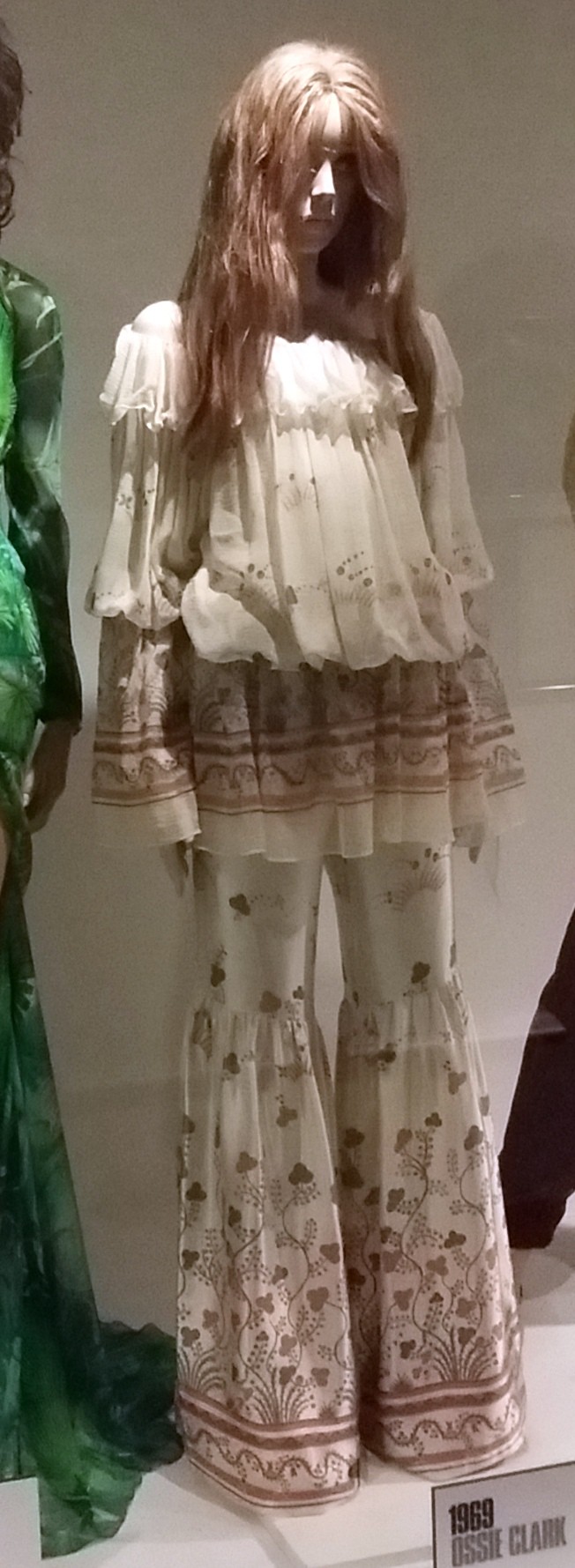
Alice Pollock’s Quorum boutique became central to Ossie Clark history. Celia Birtwell began textile collaboration in 1965, initially with few prints because funds were limited. Their marriage in 1969 should not obscure distinct professional skills: she developed flat pattern while he shaped volume. A 1969 NGV dress retains separate labels for Clark’s garment and Birtwell’s print. This small material record makes shared authorship concrete. One pattern could also behave differently as it crossed seams, folds and different garment shapes.
Paper as another proposition
A 1966 paper dress manufactured by Ascher places another experiment in Ossie Clark history. The V&A credits both designers. Paper fashion joined bold graphic surfaces to short-lived novelty, but tearing and creasing challenged ordinary expectations of durability. It should not be recast as sustainable clothing. Its relevance is the testing of material and consumption, beyond his familiar flowing cuts. Print dominates a flat paper surface; flexible cloth lets a moving body transform it. Different materials changed the way their collaboration could be seen.
Painting and performance
The red-and-black dress in David Hockney’s 1970–1971 portrait gives Ossie Clark history another medium. On Birtwell’s body it moved; in a painting its colour and silhouette become fixed relationships. Shows worked in the opposite direction. Birtwell recalled models from varied backgrounds moving to music, making drape visible through performance. No claim to the first musical fashion show is needed. Stage, photograph and painting let viewers read related garments at different speeds, exposing qualities unavailable on a hanger.
Recognition and financial reality
Ossie Clark history also includes financial difficulty and bankruptcy in the early 1980s. His marriage ended in 1974, but that event alone cannot explain a business trajectory. Making desired images and sustaining orders, payment and production are different demands. Later recognition of surviving clothes does not erase those difficulties. He died in 1996. Reading achievement alongside the organizational conditions required to continue working gives a fuller account than either nostalgic celebration or sensational private anecdotes.
Pattern placed on a body
The 2022–2023 Clark and Birtwell exhibition continued Ossie Clark history through approximately thirty garments with drawings, photographs and family material. It made the relationship between textile and garment authors visible again. As boutique clothing enters collections, its original setting recedes, but close comparison becomes possible. Grain, flounces and the point where print meets a seam show distinctions hidden by a general label such as retro. His influence includes translating flat imagery onto moving bodies and adapting inherited techniques for contemporary life.
Timeline
- 1942 — Born
- 1962 — Entered the Royal College of Art
- 1965 — Graduated; collaboration with Birtwell
- 1966 — Paper dress for Ascher
- 1969 — Married Birtwell
- 1980s — Bankruptcy early in the decade
- 1996 — Died
Sources
- RCA — Swinging London student work
- The Independent — Celia Birtwell interview
- V&A — Paper dresses
- London Museum — Dress, object 2003.75
- NGV — Dress, 1969
- European Fashion Heritage Association — Clark and Birtwell exhibition
- Fondazione Sozzani — Exhibition press release (PDF)
- National Portrait Gallery — Ossie Clark
- Encyclopedia of Clothing and Fashion — Ossie Clark